



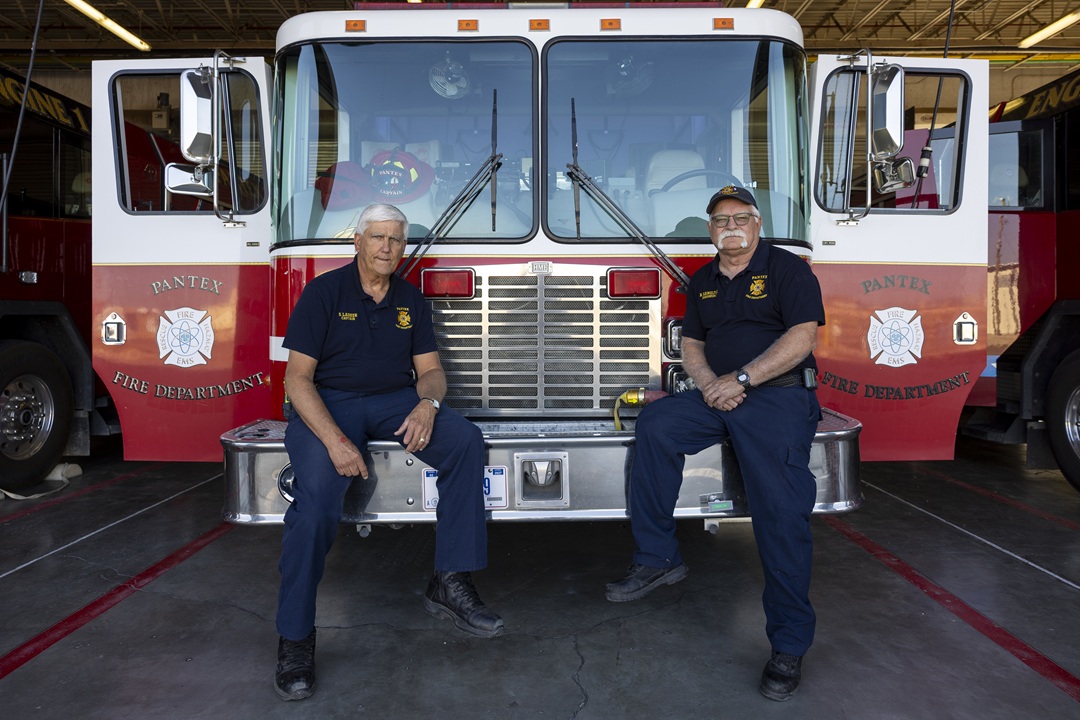
As the two longest-tenured firefighters on staff, Steve Lasher and Ricky Hamilton have lived through many significant historical moments. Photo by Adam Baker.
More than 100 people currently working at Pantex weren’t born by September 11, 2001. Several hundred more were likely too young to remember when terrorists crashed two passenger jets into the Twin Towers of the World Trade Center in New York City. While the next generation learns about the devastating attacks in school, Firefighters Steve Lasher and Ricky Hamilton will never forget living through it while working at Pantex.
Lasher had just finished a 72-hour shift at the Pantex Fire Department (PXFD) and was walking through the front door of his house when his wife called him and told him to turn on the TV.
“When the second plane came in, I told her this wasn’t an accident, something is going on. I think the United States is under attack,” Lasher said. “I was called back to the site and spent the next several days there waiting to respond in case we were needed. We felt like we had to defend this place; that was our feelings.”
Hamilton was at medical getting his yearly physical when he received an ominous call on his radio.
“All they said was to get back to the station,” Hamilton began. “They said, ‘you don’t understand — come back to the station.’ They didn’t know what was going on so they didn’t want anything on the radio.”
Hamilton immediately rushed back and learned what had happened. Firefighters were then proactively staged at different parts of the plant. Hamilton was sent to the south side of Pantex where he resourcefully rigged a wire clothes hanger to a TV on a cart allowing him to tune into a local news station out of Amarillo to see what was happening.
“There was no one fighting over the TV channels that day,” Hamilton said. “Everyone was glued to the news.”
Lasher was sent to the radio shop where he spent the night in the breakroom — his crew sleeping sitting up in a chair at the table or on the floor with makeshift blankets. In the following days, all shifts were brought back to the station but not released from duty. Firefighters slept where they could, taking turns in bunks or rotating floor space to lay down when not working.
“We felt like we had to be here to protect Pantex no matter what,” Lasher said. “That’s in our DNA. We want to help. Every single firefighter came back in unless they were out of town.”
Lasher stayed at Pantex for four days straight – Hamilton seven. The two men had families of their own and an unrelenting desire to serve others. But not all memories from that time were of the uncertainty of what was to come or urgency in response preparations. Some memories were deeply rooted in camaraderie, preservation, and bonding.
“At first no one was allowed to enter the plant, but we still had to eat,” Hamilton said. “At that time, the plant ran the cafeteria. The higher-ups had keys, and they went to the cafeteria and got supplies. Our guys are such good cooks; they made meals for everyone, including the plant manager — until the fourth day —then they ordered pizza.”
Hamilton and Lasher can recall that day 25 years ago as if it happened yesterday and reminisce about memorials thoughtfully placed for remembrance tomorrow.
“If you visit the Pantex Fire Department you’ll see a monument displaying steel from the World Trade Center sitting on a stand built and maintained by craft workers at Pantex,” Lasher said. “When you go inside Building 12-130, you’ll walk under a dual trunk oak tree planted in the front, specially selected by former battalion chief Don Morgan on the one-year anniversary in remembrance of the two towers that fell 25 years ago.”
And once inside the fire station, you’ll see the brave men and women of the Pantex Fire Department who have sworn an oath pledging to uphold their duty of service to Pantex and in turn our nation during normal times and times of crisis.
“Just talking about it then, it was emotional,” Hamilton said. “Everything we did was.”
After more than 40 years of service each, both Hamilton and Lasher will be retiring in the coming years, but not before passing their knowledge, memories, and obligation to the next generation of first responders.
“You’re going to do what you need to do,” Lasher said. “You know what you signed up for as a firefighter. Among the lives lost that day in 2001, 343 firefighters died trying to save others. It’s what we do, and it’s what we’ll continue to do.”