



News
NNSA Release: NNSA awards Pantex Management and Operating contract
WASHINGTON, D.C. – The Department of Energy’s National Nuclear Security Administration (DOE/NNSA) announced today it has selected PanTeXas Deterrence, LLC for the Management and Operating (M&O) contract for the Pantex Plant located in Amarillo, Texas.
PanTeXas Deterrence is a limited liability company, which consists of BWXT Technical Services Group, Inc. (BWXT TSG); Fluor Federal Services, Inc. (Fluor); SOC LLC (SOC); and the Texas A&M University System (TAMUS).
All media inquires should be directed to Mig Owens, Pantex Field Office.
Read the full release on the NNSA website.
Consolidated Nuclear Security, LLC operates the Pantex Plant, located in Amarillo, Texas, and the Y-12 National Security Complex, located in Oak Ridge, Tennessee, for the U.S. National Nuclear Security Administration. Bechtel National, Inc. is the lead member of CNS; minority members include Leidos, Inc.; ATK Launch Systems, LLC; and SOC LLC. Pantex and Y-12 are key facilities in the U.S. Nuclear Security Enterprise, and CNS performs its work with a focus on performance excellence and the imperatives of safety, security, zero defects, and delivery as promised.
For more information on each site, visit www.pantex.energy.gov or www.y12.doe.gov. Follow Pantex on Facebook, X or LinkedIn. Follow Y-12 on Facebook, X, and LinkedIn.
Working with dad

Pantexan father and daughter, David and Madison, share that the best part of working together is getting to see each other throughout the day.
June is the month to celebrate the fathers in our lives. Some lucky employees have the privilege of working with their fathers on‑site.
Meet Pantexans David and Madison L., father and daughter.
As a technical specialist in Process Engineering, Madison has the opportunity to see and work with her dad on a frequent basis.
“We see each other a lot since we work in the same wing of the JCDC, and we carpool to work,” said David, who is a senior specialist in Nuclear Explosive Safety. “Our roles also intersect. Being a technical specialist, she sends us [Nuclear Explosive Safety] procedures to review.”
Madison, who started at Pantex in December 2022, says her dad has always been the best role model, and she hopes to live up to the reputation that he has made for himself over the course of his 30-year career at Pantex.
“He has taught me to never give up whether in school or just in general,” Madison said. “That has helped me persevere to get to where I am today. He has shown me how to treat others no matter what environment I’m in, and that I should always be respectful and kind.”
For David, his proudest moments as a father are representative of the example he’s set for his daughter.
“Madison is a very kind and generous person with a big heart. My first proudest moment was watching her being baptized and second when she graduated from Texas Tech University in 3 years,” David said. “It showed her determination and desire to reach her goals.”
Protecting personnel and property for the mission

Carlos G., fire protection engineer, conducts a monthly prevention check on equipment.
With approximately 500 facilities at Pantex and more than 400 at Y-12, protecting the lives and property inside each building is an essential job. Fire protection engineers work daily to ensure the safety of personnel and property.
“With Pantex being the primary nuclear weapons plant, a fire in a nuclear or explosive facility would cause a huge impact to the nuclear deterrent for the United States and our allies,” said Justin H., Pantex Fire Protection Engineering manager. “A fire could cause an explosion, contamination, or worse, the loss of life.”
Justin’s Y-12 counterpart, Jake G., echoed the importance of mitigating fire dangers.
“In addition to the off-site release concerns associated with a fire, any major fire at the site could cause an extended shutdown,” said Jake, Y-12 Fire Protection Engineering manager. “Understanding the potential consequences of a major fire and the associated impact to not only the site but the employees is how I feel I contribute to the overall mission of Y-12.”
Fire protection engineers serve as the technical authority on fire protection–related items. They also review combustibles that are present in nuclear facilities, perform fire modeling, and review procedures to verify that all operations are implementing fire safety controls.
“Knowing that my job directly protects my Pantex coworkers by ensuring their safety as well as the safety of the surrounding community is very rewarding,” said Fire Protection Engineer, Carlos G.
Only a handful of universities offer fire protection engineering degrees. Justin, Jake, and Carlos all earned their degrees at Oklahoma State University where, in addition to the regular curriculum of math and science courses, they worked hands-on in fire labs.
“I interviewed with Pantex at the OSU career fair and accepted an offer a couple of months before graduating. I knew it would be a one-of-a-kind experience and opportunity,” Carlos said. “I had also heard great things from friends and previous classmates who had been hired on before me. I have been a proud Pantexan for 4 1/2 years.”
It is easy for anyone to get bogged down in the daily grind, but at the end of the day, remembering how the work impacts the overall mission is rewarding.
“My favorite part of the job is being able to assist in solving issues associated with the unique and one-of-a-kind processes, equipment, and hazards that we have at Y-12,” Jake said.
Justin shares similar sentiments with Jake and other Fire Protection Engineering colleagues. Each voiced a selfless dedication to the wellbeing of their sites and the people who work there.
“It is gratifying when you take a step back and think about how Pantex is a place in the Nuclear Security Enterprise that deters other countries from using nuclear weapons,” Justin said. “Knowing you have played a role in that mission is rewarding.”
The Burlington-Pantex Transfer
The early 1970s was a tumultuous time, with the Vietnam War raging and major political upheaval. Americans were struggling with the rising cost of living and a looming gas crisis. The Cold War was still in full swing, and the facilities that actively participated in ensuring the United States’ nuclear security were numerous.
At the time, there were about 30 places that had a role in the work; today less than 10 facilities make up the Nuclear Security Enterprise, including Pantex and Y-12.
At the time, a factory at Burlington, Iowa, was doing assembly and disassembly work, and that site was chosen to be closed and consolidated.
Fifty years ago this year, the mission performed at Burlington was in the process of being moved to Pantex. At the time, both facilities were managed by Mason & Hanger.
“The government did a study to look at cutting costs and consolidate the work into a couple of plants, instead of having it spread around,” said employee Katie P. “One of the reasons Pantex was chosen is it would have cost $30 million in 1974 money to move the work Pantex did up to Burlington, but only $10 million to move the work done at Burlington down here.”
Some of the other advantages that Pantex had were adequate space, updated facilities, better weather, and a larger nearby city—as well as a major advocate in the form of John C. Drummond, for whom the flagship office building at the facility is now named.
Employees made the move in 1974, and among them was Harvey B., who continues to work at Pantex.
Harvey began working at Burlington shortly after graduating college, and met his wife there. Once they made the move to Pantex, a local employee tried to help them get settled in to their new home.
“He gave us a local tour, took us to Lake Meredith. He was proud of this area,” Harvey remembered. “It was different. My wife grew up with trees. Down here, if you want one, you have to plant it. We got home, and [my wife] said, ‘It looked to me like the moon.’”
Today, Pantex is preparing for more change as its management and operating contractor is set to be changed this year. One of the enduring truths at Pantex is the need to adapt to change while continuing to perform the mission without missing a beat.
“Fifty years ago, our mission we still carry out today really got consolidated,” Katie said. “It was a time of change, not only for the U.S., but also for people locally.
“Now, instead of consolidating, we’re growing, getting more duties and getting new people who are becoming part of our family and our culture,” she continued. “We have endured change before, but now we’re in a new era. There is a lot of stuff going on. It’s a different time, but a similar story of change happening then and now.”
Plants may be rich in wildlife, but employees should enjoy with caution
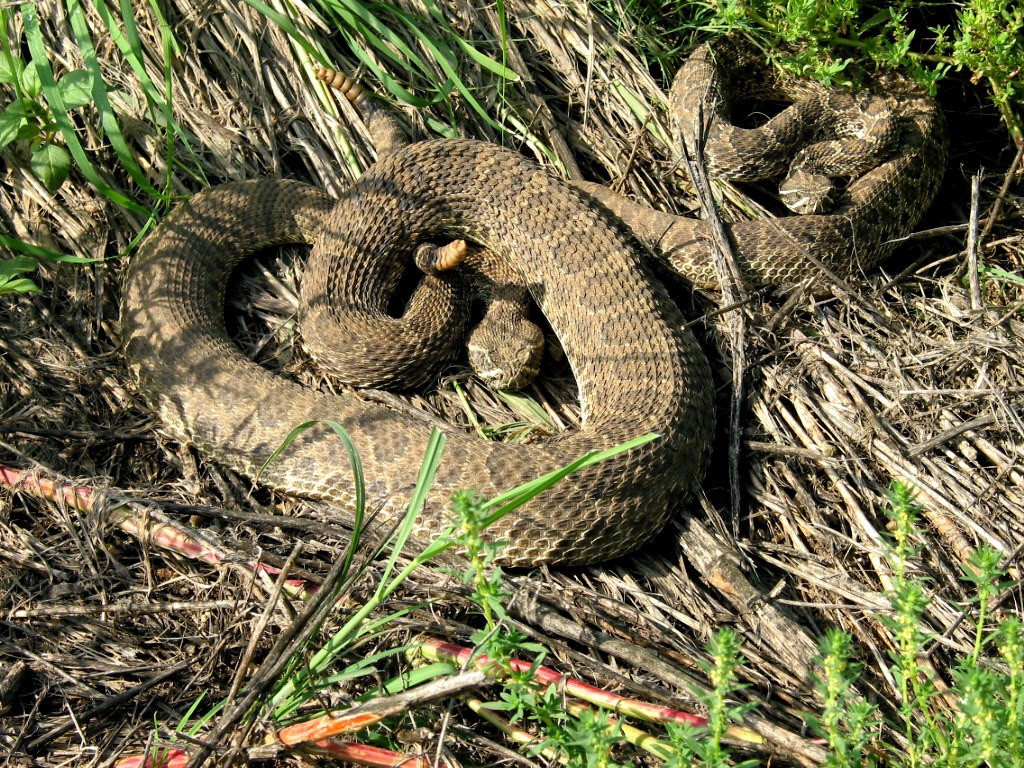
A pair of rattlesnakes warn off what they perceive as predators. Snakes like these are a common sight at Pantex, where the availability of prey and warm facilities prove inviting.
An employee replacing a Pantex air-handling unit in the ceiling felt something fall out of the ductwork onto his shoulder. Focused on his work, he brushed off the offending object…only to glance down and realize he’d just swiped away a garter snake.
Thankfully, the creature was nonvenomous, and no employees were harmed. However, that doesn’t change the fact that at Pantex, the potential to encounter wildlife—including some creatures that are potentially hazardous to humans—is an everyday reality.
At Pantex, rattlesnakes are the proverbial king of wildlife encounters, with 22 calls in 2023. Along with many other reports, an additional 38 calls reported various other species of snakes, and another 19 calls reported skunks.
“Sometimes, we’ll catch other things when trying to catch a skunk,” explained Environmental Safety & Health Generalist Katie P. “We have gotten some feral cats before. When we get cats in, we take them to the City of Amarillo, and they put them in their barn cat program, where they can be adopted by a farmer and live out a happy life chasing mice and such as that.”
The site is also seeing a boom in other wildlife populations.
“We are starting to see more deer, more pronghorn, more coyotes,” explained Pantex Wildlife Biologist Kevin B.
He cautioned employees against feeding or creating any condition that might invite a wild animal to enter an area where they should not be. The outcome, he warned, could not only create a hazard for employees but also prove tragic for the animal itself.
“They are not your pet dog,” Kevin said. “You are not helping the animal; in fact, you are hurting the animal because they are more likely to come in … and we have to deal with that.”
Pantex employees who see dangerous wildlife or wildlife acting strangely should call the site’s Operations Center. Their first duty, though, is to ensure their own safety and the safety of those around them.
“If you run across a predator-type animal and it’s acting aggressively,” Kevin said, “don’t try to approach it, but still keep an eye on it until one of our team gets there.”

A pair of mule deer cross a Pantex road that divides grazing areas.
Armed Forces Day – Families serve too
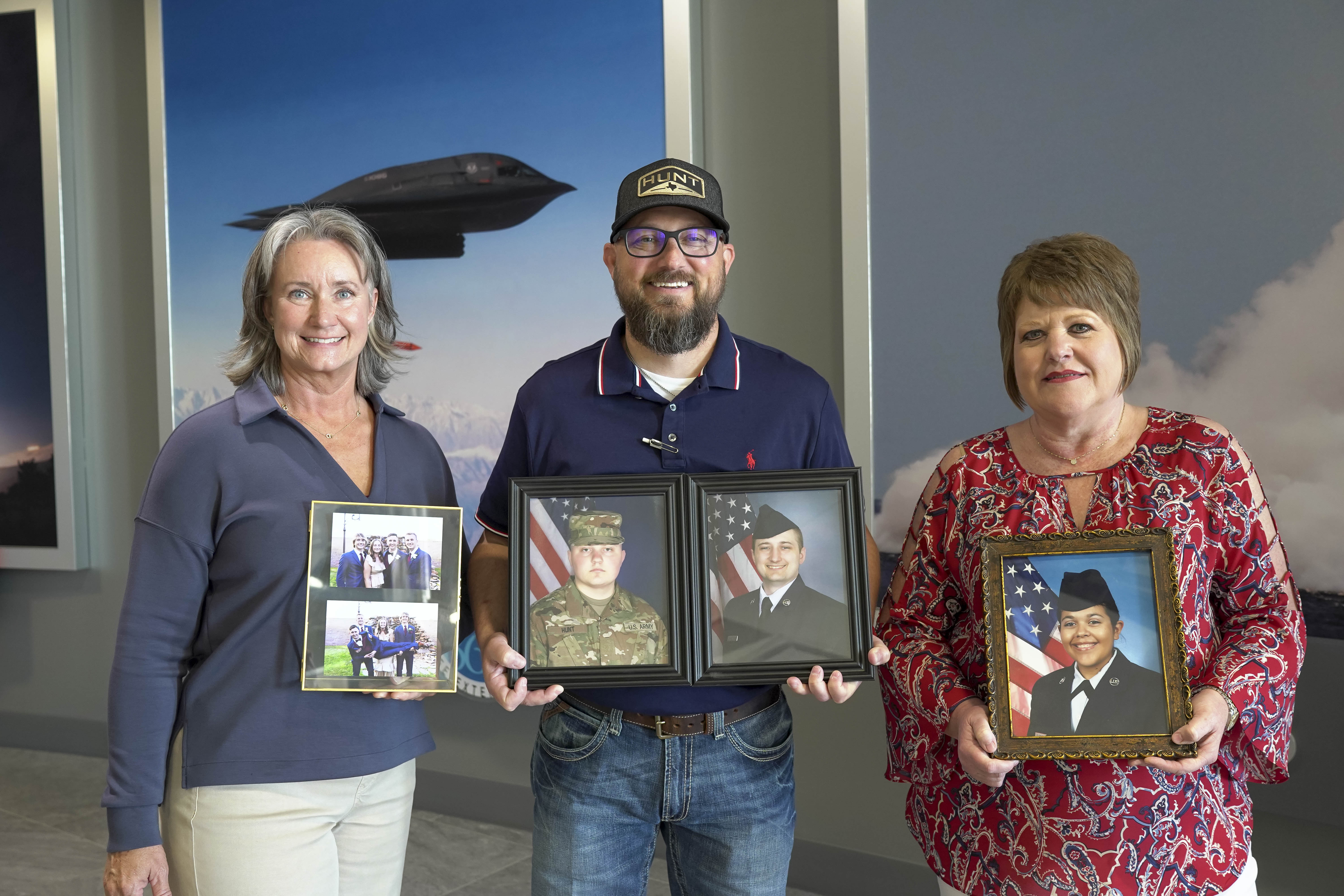
Michele M., Thomas H., and Felecia B. share photos of their family members currently serving in the Armed Forces.
Pantex Emergency Preparedness Specialist Felecia B. has always known that Pantex played a vital role in the nation’s safety and security, but it wasn’t until her daughter joined the U.S. Air Force that the site’s mission truly resonated with her.
“I have always believed in our mission, but now, after my daughter has been to 5 duty locations, 2 deployments to the Middle East, and over 20 countries, I know that what we do here directly impacts the protection of our nation, our allies, and our military members stationed around the world,” Felecia said.
Felecia’s daughter, Sergeant Katelyn V., is now stationed in Fayetteville, North Carolina. She is one of the many family members of Pantex and Y-12 employees serving in the nation’s military. As Armed Forces Day is celebrated, the military families of Pantex and Y-12 provide a clear and tangible link to the important missions of the sites but also a unique set of challenges…and worries.
Being part of a military family has challenges and benefits unique to military service. As a U.S. Army veteran myself, I know well that servicemembers give up a lot of freedoms to protect our nation, but so do the families supporting them. These families are often unrecognized for their role in service to the nation. They often don’t have a choice regarding where they will live and work.
The servicemember is deployed for months at a time, leaving the family behind to deal with the home front.
“We never realized how much those in the military sacrifice, along with their families, until now,” Felecia said. “We had taken for granted all of the family gatherings or special occasions that our daughter would now be unable to attend.”
Pantex Procurement Engineer Thomas H. has two sons and a daughter-in-law serving in three different locations, and, while he’s proud they are serving their country, he misses the time he gets to spend with them.
“Life from the aspect of military commitment means that the relationships are carried through phone and online communication,” Thomas said. “We sacrifice a lot of free-range visits for the schedule that is set by the military. If we’re lucky, the Air Force and Army block-leave assignments allow us to have everybody together at once, but most of the time, we only get a week with each of them –– once in the summer and once in the winter/holiday season.”
That longing for togetherness as well as concerns for safety are heightened when the servicemember is deployed to a combat environment. The uneasiness of whether or not you’ll see a loved one again never really leaves the mind.
“The most challenging part of being a military family is when the servicemember gets deployed to a remote location and communicating is very limited,” said Lisa H., information specialist in CNS Communications at Y-12. “This is especially challenging when the remote location is in a war zone. When your family member is away, you try to keep busy with day-to-day challenges of life, but your mind is always on the one deployed.”
Those extended deployments can stress the family environment, but they also create opportunities.
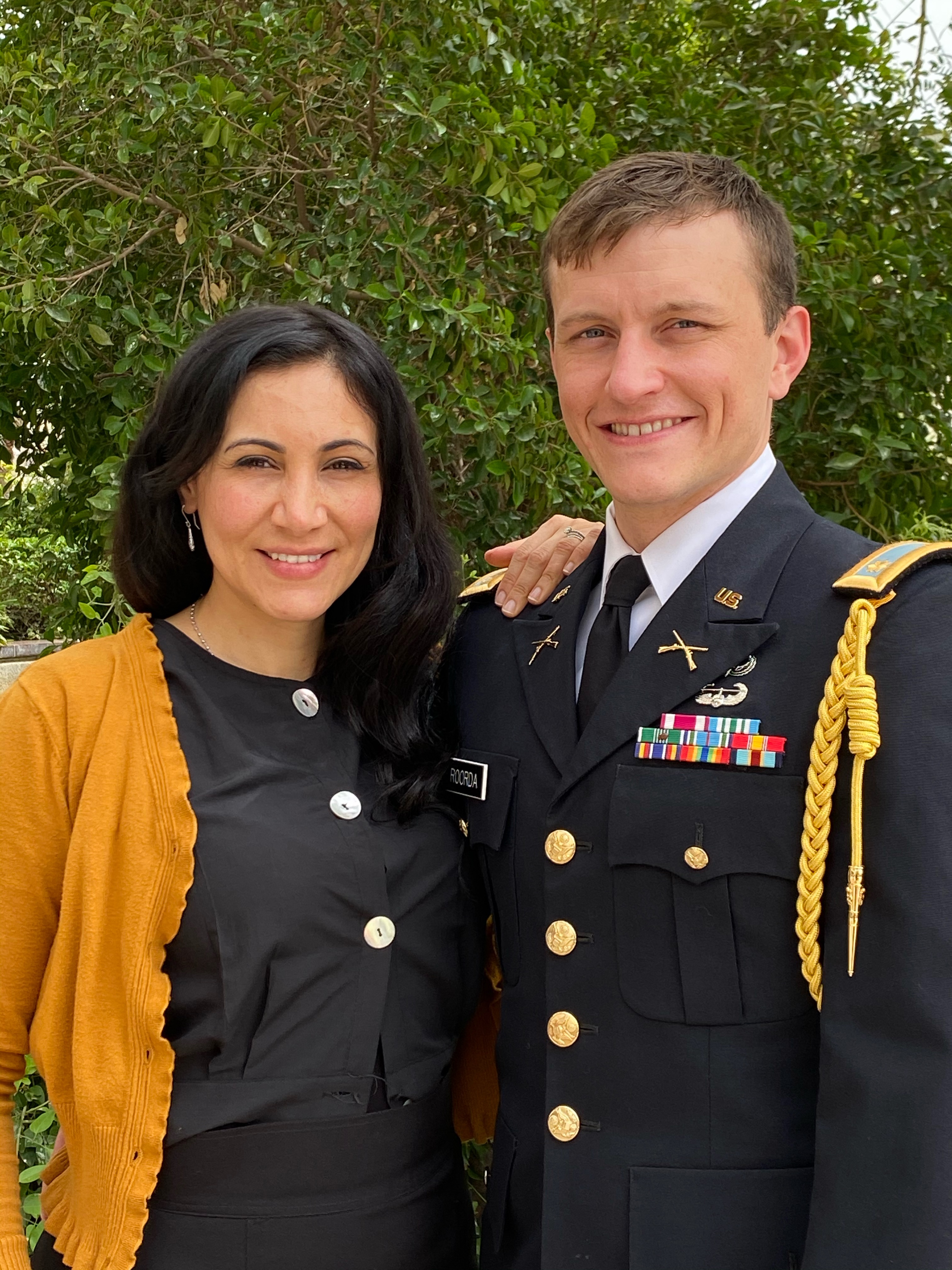
Rose R. stands with her husband, Major Brennan R., at his promotion ceremony.
“Deployments will change your spouse, cause your kids to grow up too fast, stress your marriage, and provide an amazing opportunity for growth,” said Michele M., Pantex Performance Excellence Disciplined Operations lead. “Through my husband's military obligations of weekend drills, schools, and deployments, I have grown into a stronger person. I learned to balance keeping a household going, working a full-time job, meeting the varied demands of four kids, continuing my education, and taking care of myself.”
Rose R., Y-12 administrative assistant for Nuclear Safety, describes her life as an adventure.
“Being a military family is different to lives as nonmilitary families, as expectations for your level of flexibility and resiliency are much higher than in regular civilian life” Rose said. “We have moved 7 times in the past 14 years to places like Vicenza, Italy; Tunis, Tunisia; and my husband is currently stationed in Bamako, Mali. It can be difficult to plant deep roots anywhere, but you have roots far and wide, across the U.S. or the world, wherever your posts may be.”
Like their active-duty counterparts, many military families develop deep bonds with other families they’ve been stationed with.
“Your military friends and associates become your family members, especially when serving overseas,” Lisa said. “You are in a small, remote group with the same purpose. They are family you will always maintain contact with, just as you would your immediate family. If you need help, your ‘family’ will be the ones there to assist.”
The bond that military family members who work at Pantex and Y-12 share with the armed forces also strengthens their sense of pride to be a part of the sites’ missions, knowing the work they do directly affects their servicemembers’ lives.
Thomas stated, “My job at Pantex ties me to a deeper sense of patriotism than I had before because I did not serve in the military, nor did my father. I have a deeper understanding knowing that what we do ends up in the hands of the generation I took part in raising to go forward and protect the world. That connection, and the opportunity that Pantex provides for them as a career option once their enlistment completes, gives me great pride in what I do.”
As both seen and unseen sacrifices continue to be made daily for the protection of our nation, Pantex and Y-12 would like to say “thank you” to all active servicemembers, veterans, and military families for all they have given in service to this country.
Newest Panhandle weather tracking system - StrikeNet
Pantex develops weather app

AMARILLO, Texas– When it comes to weather in the Texas Panhandle, what’s happening at one location may be completely different than conditions only a few miles away. For the more than 4,500+ Pantex employees, weather onsite can be vastly different than what is occurring at their homes.
As the nation’s primary assembly, disassembly, and life-extension center for nuclear weapons, weather events at Pantex can impact both workers and production, so having access to real-time meteorological data across the entire region is paramount to everyone’s safety.
To address regional weather events, Pantex Meteorologist Steve Kersh is working with school districts and private landowners to refurbish and upgrade area-wide weather stations formerly maintained by a local TV station. These sites include new weather and lightning-detection software providing real-time data on wind speed, temperature, rainfall, and lightning from each location, which is now available to the public on the StrikeNet© website.
Pantex also initiated development of the StrikeNet© weather app, which is free and available to the public on Google Play and the App Store.
On both the StrikeNet© website and app, all available weather data are listed in its drop-down menu. For example, when lightning maps are enabled, the strikes are represented by the lightning symbol, with the most current strikes in the red circle and the estimated distance from Pantex indicated on the symbol itself.
“Severe weather can have a direct impact on Pantex operations, both from a safety standpoint for our employees and for our mission. Enhancing capabilities that track weather events to specific locations using our newly developed sensors is a huge step forward for the site and our surrounding area,” said Pantex Site Manager Colby Yeary.
Initially,10 sites signed up to the StrikeNet© network including schools, homes, ranches, and businesses, with an additional 11 sites quickly added. School officials indicate that the lightning detection data would be used to help with determining whether to seek shelter if and when thunderstorms approach during regular school hours and extracurricular events, while ranchers and farmers can access real-time weather conditions aiding in crop and livestock production.
Pantex views StrikeNet© as an opportunity to offer accurate and localized weather information to Texas Panhandle residents, internet users, and weather station owners at no cost.
Consolidated Nuclear Security, LLC operates the Pantex Plant, located in Amarillo, Texas, and the Y-12 National Security Complex, located in Oak Ridge, Tennessee, for the U.S. National Nuclear Security Administration. Bechtel National, Inc. is the lead member of CNS; minority members include Leidos, Inc.; ATK Launch Systems, LLC; and SOC LLC. Pantex and Y-12 are key facilities in the U.S. Nuclear Security Enterprise, and CNS performs its work with a focus on performance excellence and the imperatives of safety, security, zero defects, and delivery as promised.
For more information on each site, visit www.pantex.energy.gov or www.y12.doe.gov. Follow Pantex on Facebook, X or LinkedIn. Follow Y-12 on Facebook, X, and LinkedIn.
CONTACT
Steve Myers
Communications
Office (806) 573.0490
Cell (806) 236.2826
Stephen.Myers@pantex.doe.gov
I am mission success: Kimberly H.
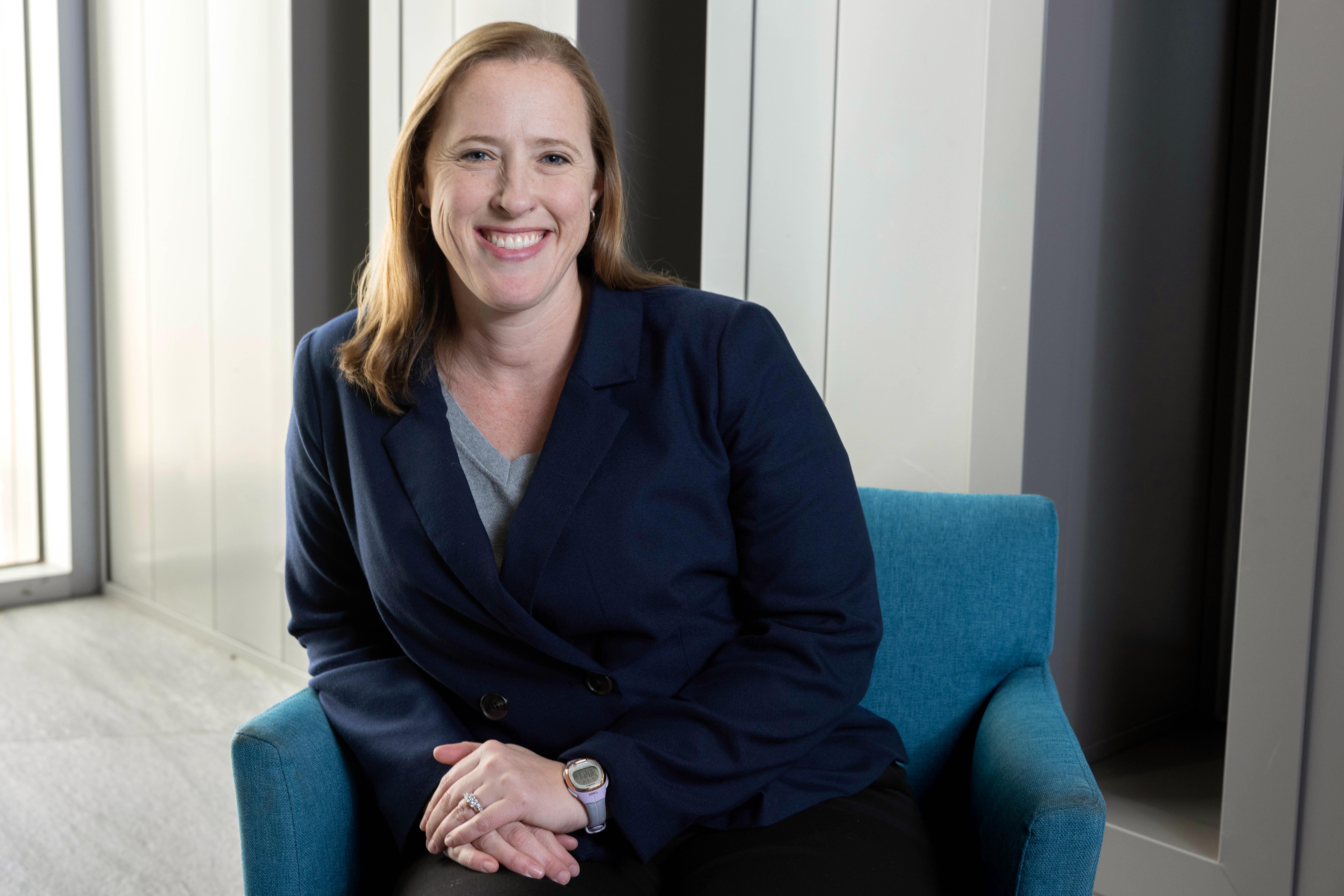
Take 5 minutes to learn about Kimberly H. This article details Kimberly’s role at Pantex and reinforces the diverse workplace culture CNS offers. All views and opinions are the employee’s own and do not necessarily reflect those of CNS.
When Kimberly H. started thinking about what she wanted to do with her life, she knew she wanted to be a part of something bigger. For her, this would be the American military, where she could keep growing as a person, as well as providing a way to travel the world. Kimberly, who now works in project management, originally joined the U.S. Navy to become a pilot, but things quickly changed when she started flight school.
“When I got to flight school, I realized I was much better when my feet were on the ground and not in the air,” Kimberly said. “Through that I found a better direction for myself working with the Seabees doing construction management and that has translated into a new role in national defense at Pantex. It’s not exactly the career path I expected, but I am happy it led me to where I am now.”
In addition to learning valuable lessons in flight school, it is also where she met her husband, Joshua. After deciding flying was not her speed, she became a part of the U.S. Navy Civil Engineer Corps, which she has been a part of for 15 years. Kimberly, who holds the rank of lieutenant commander, joined CNS through the SkillBridge program in January 2024, and will soon join the Navy Reserve to keep serving while she also serves through her new role at Pantex.
What top strength do you bring to your organization and why?
There are “big rocks” people who focus on the big picture with creative, strategic, and visionary ideas, and there are “little rocks” people who are detail-oriented and focus on executing individual details precisely. I think of myself as a “medium rocks” person, someone who focuses on how all the pieces and resources fit together for maximum productivity—someone who can bridge the gap between the big picture thinkers and the detailed-oriented planners to help make an idea a reality.
How has working for CNS changed or reinforced your thoughts on our mission (nuclear deterrence, managing the stockpile, etc.)?
Coming from the U.S. Navy, I have spent my career providing engineering, facilities, and construction support to assist our nation’s warfighters and our country’s highest priority missions, and nuclear deterrence has long been one of the Department of Defense’s highest priority missions. But my understanding of nuclear deterrence focused on the nuclear triad, not the vast support network that exists to ensure the effectiveness of the nation’s nuclear deterrent. Coming to Pantex, it has given me greater appreciation for the huge enterprise that exists beyond the military that is essential in the success of that mission and the number of civilians in our nation, such as those at Pantex and Y-12, who play a vital role in ensuring our national and global security.
What is your favorite aspect about your work environment? How does that aspect make you know the mission is being met?
I really enjoy working with people and collaborating. There seems to be a very strong collaborative culture here. When people are willing to come together and talk through problems to get to solutions, that is when you are able to know that the mission is going to be met.
What CNS principle drives you to be successful?
I am an industrial engineer by education, so continuous improvement and figuring out how to do things better is the core of everything we do. How can we improve to be better and more efficient? How can we build a better team through the process? I am always looking for ways to improve our processes, communication, and teamwork through that lens.
What’s your top bucket list item and why?
One of the things I would love to do one day is take a vacation to Greece. I have seen so many pictures of the Greek Island and they look beautiful. My parents also met in Greece, so it would be a fun place to visit!
Working with mom
May is the month to celebrate the mothers in our lives. Some lucky employees even have the privilege of working with their mothers on-site.

Meet Pantexan mother and son, Debbie M. and Michael O.
Michael O., end user support with Pantex Information Solutions and Services, and Debbie M., tester program coordinator in Pantex Tooling and Tester Engineering, only get a chance to see each other on-site maybe once a month, but Michael always steals a hug from his mom when he can get one.
“I’ve been given an opportunity that most children will never get, to see into the lives of their parents outside of the home and the chance to see a greater picture of the woman who raised me,” Michael said.
Michael started at Pantex in 2021, and has often relied on his mom’s 30 years of experience at the plant. Her presence made the transition less intimidating as a new employee, and even now she’s always willing to help him figure things out.
“She’s not afraid to go out and find answers, and she passed along the idea of being curious and seeing what others might not,” he said. “This has encouraged me to help mentor those around me, so I can share it with the next generation of Pantexans.”
Debbie says it warms her heart to know she can occasionally pop into the John C. Drummond Center and get a hug from her son.
“The best part of working at Pantex together is knowing that he is close to me and close to family, and the longer he works out here, he will discover that Pantex is also a family,” Debbie said.
She also loves hearing from others about how well he’s doing with his work. “They tell me he can be relied on to be accountable and get the job done,” she said. “I love that he is respected and valued in his field. I am proud of him because he is a good man.”
Pantex partners with the best to prepare for the worst
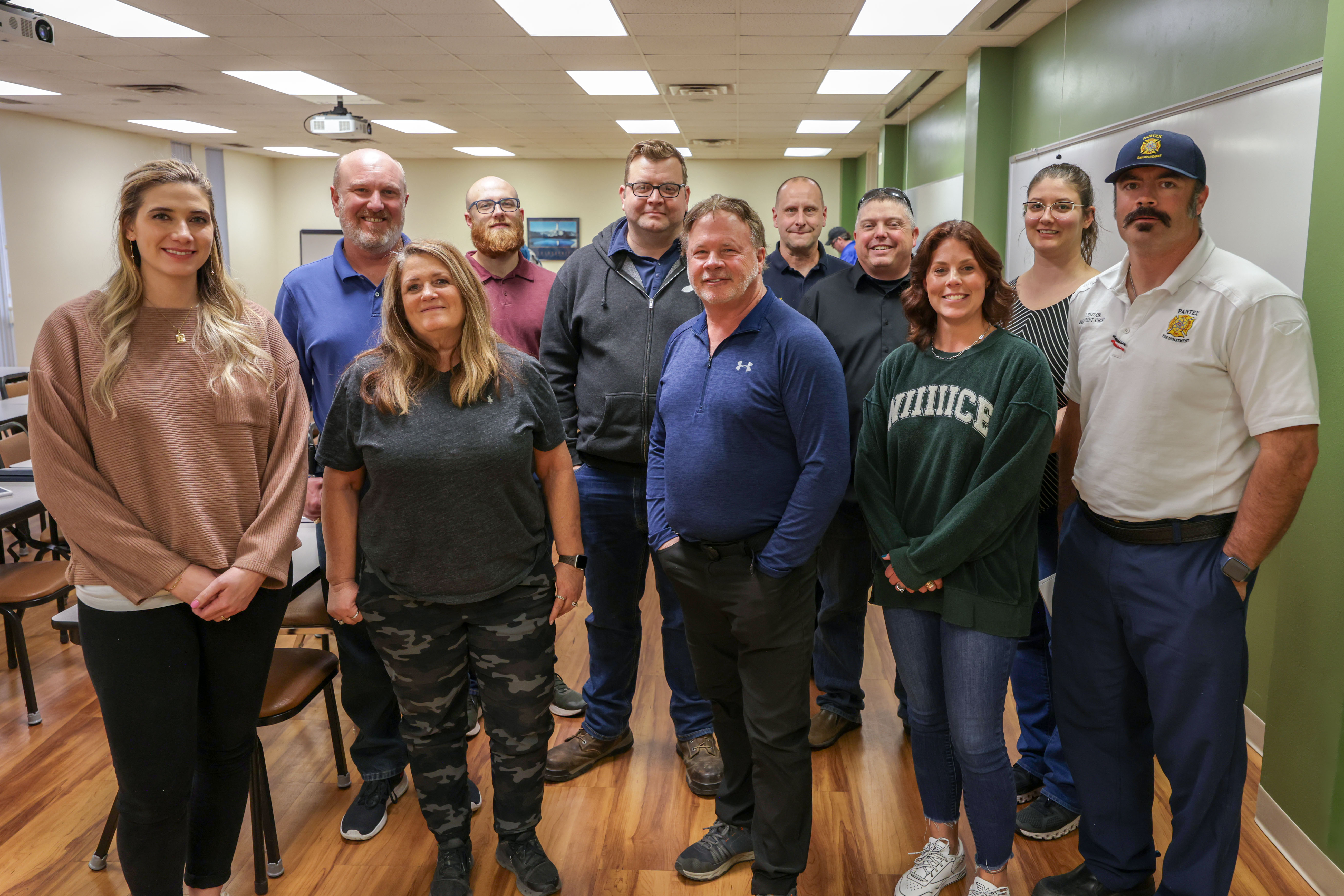
Pantexans from all over the plant joined together to train on emergency response to rural mass casualties.
Disaster can strike as quickly and unexpectedly as a rattlesnake bite while walking through weeds. Once it happens, the needs from every angle – from the initial emergency response to assisting the families of victims – are rapid-fire, and can exhaust the limited resources of small communities. The isolation in the Texas Panhandle exacerbates that problem.
“Amarillo is an island in the Texas Panhandle. If we need help, it could be 48-72 hours before we get it,” said instructor Elton B.
To help Panhandle-area organizations better prepare for what could – and does – happen, Amarillo College in February conducted a Mass Fatalities Planning and Response for Rural Communities training. This class was made possible by a grant that Pantex and Amarillo College secured through the National Institute of Environmental Health Sciences/Department of Energy Nuclear Workers Training Program. This unique learning opportunity expanded because Pantex decided to open up the training to local first responders and connected entities in the Panhandle and South Plains.
Co-trainer, Dana H., defined a mass casualty as anything “more than a rural community has the resources to handle.” This, they said, can be the result of natural disaster, inclement weather, an active shooter, large crashes, a gas leak, and more.
The course was tailored to the people in the Texas Panhandle due to its unique needs and covered a variety of topics that could be needed after a mass casualty event that could lead to fatalities in a rural area. This included how to set up a temporary morgue, human remains recovery and storage, family assistance, data collection, and how to get federal resources to your rural community.
Thanks to the wide variety of attendees, topics were discussed from many different perspectives., Firefighters, law enforcement officers, dispatchers, a meteorologist, individuals from public health and emergency management, morgue technicians, and even a Justice of the Peace all provided input based on their respective experiences. Attendees from all over the region, including Pantex, Amarillo, Brownfield, Lefors, Borger, Hereford, Lazbuddie, Panhandle, and Wheeler, participated in the event.
Though this class material was very heavy in nature, many attendees complimented the instructors for keeping the training engaging.
Elton, whose experience comes from the Army Intelligence field, Amarillo Fire Department, and his years teaching environmental health and fire protection technology at Amarillo College, and Dana, who is recently retired from Amarillo Fire Department after 32 years, focused on participants knowing their resources and pushed networking throughout the day.
Dana noted several times that “it is key to break things down into something you can manage,” and on days when the worst happens “it is incredibly important that we have that cooperation” between entities working incidents like this.
“The ability to see how the whole Panhandle can work together to help each other out and the networking that is available here is essential for such a rural area,” said Pantexan Sandra L. “This is all helpful in regards to preparing for mass casualties.”
Jeff W., the director of Safety & Environmental Technology for Amarillo College, worked with Terrel C. to secure a grant from National Partnership for Environmental Training that provided this training for Pantex employees.
“Attendees now have those tools in their toolkit so that they can reach out and effectively deal with a mass fatalities incident,” said Terrel. “This class was effective because we had so many people from different backgrounds and we had a sharing of information for a dynamic group discussion. At Pantex we are so fortunate to have our Amarillo College partners. We have received almost $3 million in grants since we started working together to get more training for Pantex employees, which also at times benefits area groups that might not have the funds for it.”