



It’s a warehouse — a place where stuff is stored. What possible research and development could be done in this area? How could asset storage be optimized?
It was exactly that last question that started the Plant Directed Research and Development (PDRD) Warehouse Optimization Project at the Pantex Plant (Pantex). Was there a way to optimize storage efficiency, improve space constraints, control inventory and placement, or track the location of assets?
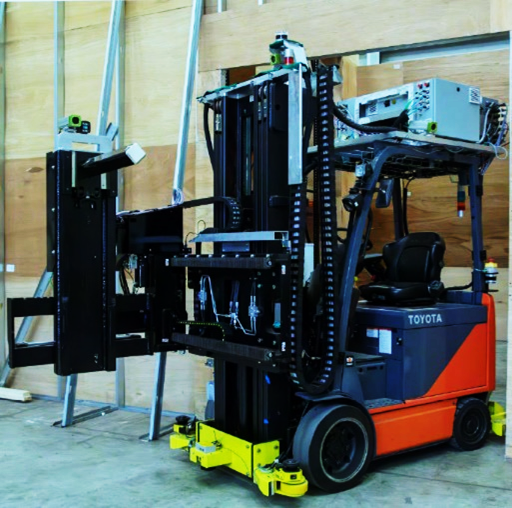
Deliver Automated Material Management System
(DAMMS): Initial ware house optimization research.
A group of Pantex principal investigators set out to research ways to optimize and modernize the plant’s storage facilities.
Initial research focused on an automated forklift system that moves stored assets within a storage facility. The research used an unmanned forklift controlled remotely by an operator and a mockup of a warehouse.
“This early research demonstrated a forklift can be guided through aisles from a remote-control station, where the operator uses camera feeds to navigate, select specific pallet locations, and transport items to designated drop-off points, all without the need for direct human presence in the storage area,” stated Caleb Heltenberg, Pantex PDRD program manager.
This research’s success spawned additional warehouse research.
Automated Storage and Retrieval System
By automating the retrieval and storage of assets, this research presents a comprehensive feasibility study and a preliminary implementation framework for integrating an automated storage and retrieval system (AS/RS) into warehouses. It addresses critical horizontal footprint constraints and delivers a tailored solution and strategic roadmap for execution. Additionally, this system has shown an advantage in vertical applications with high-ceiling clearances in warehousing facilities.
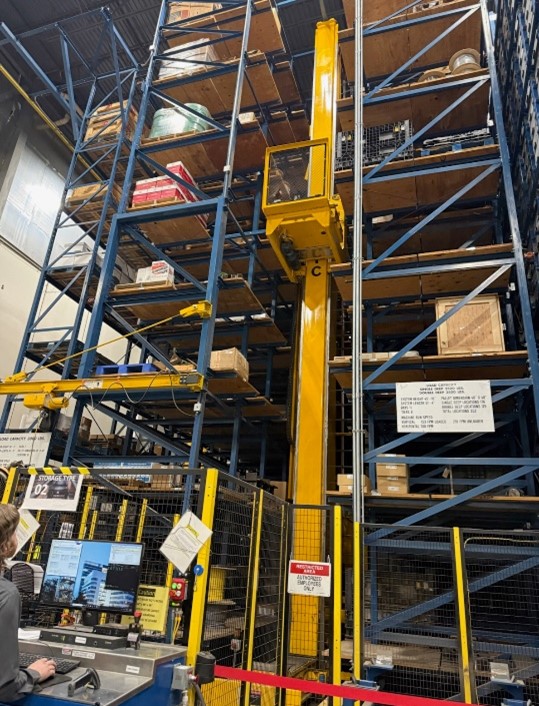
Automated Storage and Retrieval Systems (AS/RS):
An ongoing research effort into Warehouse Optimization.
“The proposed system is projected to significantly maximize volumetric storage capacity, optimize inventory organization, reduce retrieval latency, and enhance overall occupational safety,” explained Josue Perez, principal investigator for the AS/RS project.
Vertical Lift Modules
This project was initiated out of a necessity for additional space in the special tooling warehouse. Vertical lift models (VLMs) consolidate items from storage or location bins into a single location. By using a combination of storage solutions that include the VLM and AS/RS systems, the team has determined that storage capacity can double per square foot in the areas in which these systems are installed. This saves space as well as centralizes the location for assets, reducing the back and forth of asset movement and taking advantage of the high-ceilings clearances in the facility.
Conveyor Systems
Conveyor systems allow for assets to be moved throughout the facility without the need to load and offload pallets using a forklift. This reduces wait time and allows for on-demand asset handling when needed. In the tooling warehouse, the conveyor system moves assets from the storage location to maintenance, to quality control, then to another facility.
These areas of warehouse research have increased facilities’ storage capacity, with reports of up to a 100% increase. This research has also increased throughput for selecting and placing assets, as well as moving assets between required workstations (maintenance, inspection, quality, etc.), without requiring a manual. Most notably, this research has led to an increase in occupational safety. Collectively, these PDRD research projects drive Pantex’s material handling towards the factory of the future.
“This research enables Pantex to maximize current facility/warehouse space while also providing technology for future facilities,” stated Heltenberg. “Future facilities and warehouses can be designed around this technology to optimize operations.”
Additionally, the warehouse optimization research supports the supply chain in general and also supports the Smart Factory and robotics/automation initiatives of Pantex’s digital transformation. It helps to enable rapid response, ensuring equipment, tooling, and other assets are where they need to be when they need to be, improving efficiency.
“Implementing this technology is the start of advanced technology in supply chain management and asset handling at Pantex” indicated Perez. “This is very mature technology that has a significant impact, but it also enables the future implementation of newer, less mature technologies in this space.”
In fiscal year 2026, several VLMs have been and continue to be installed across facilities at Pantex. Fiscal year 2027 will focus on transitioning the AS/RS and conveyor system from a conceptual study to implementation at Pantex. Key actions will include defining the final system integration requirements and preparing facilities for preliminary integration.
“This research enables Pantex to maximize current facility/warehouse space while also proving this technology for future facilities,” stated Heltenberg. “Future facilities and warehouses can be designed around this technology for optimization.”