



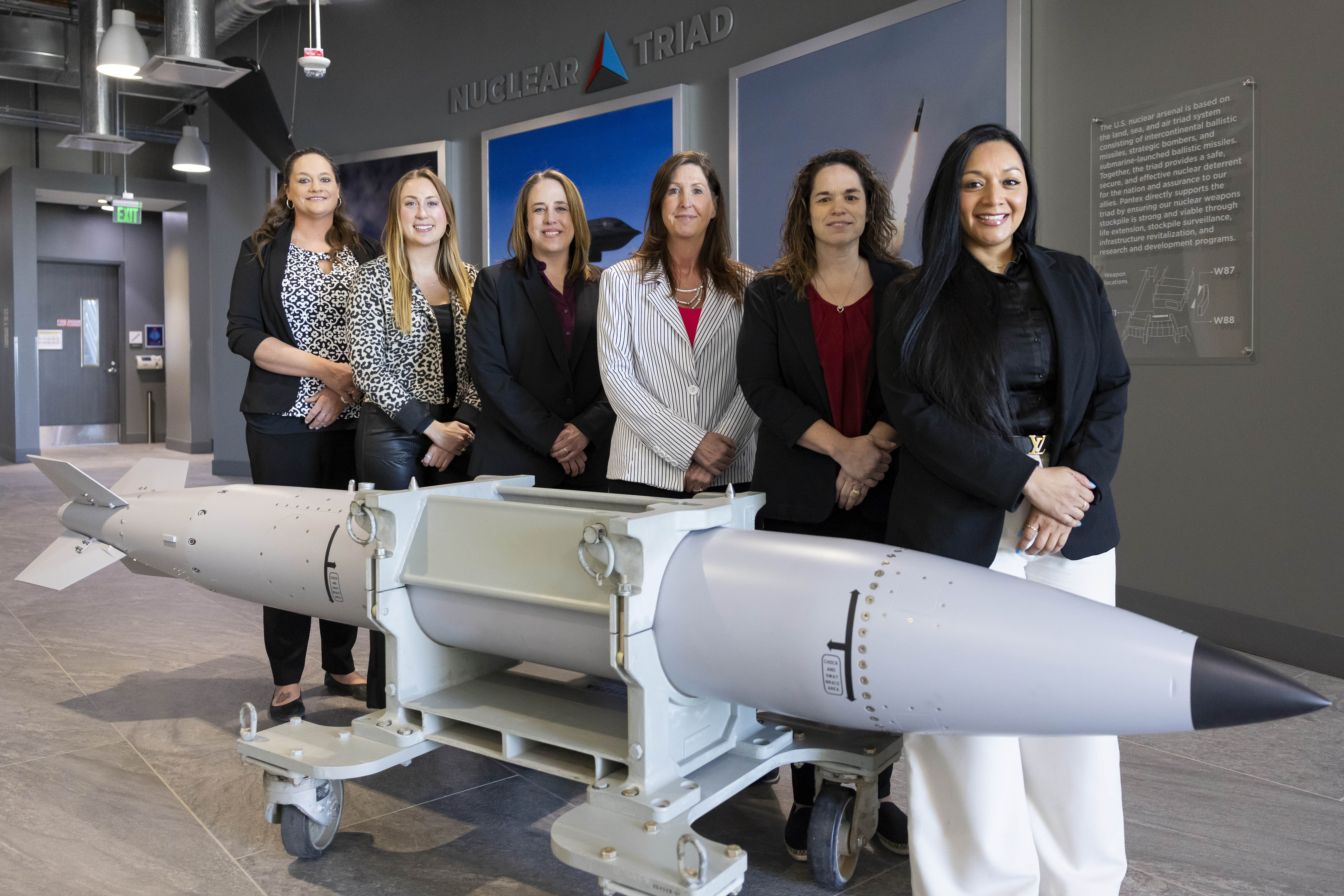
The six women of Pantex Operations. From L to R: Whitney Conner, Jordan Payton, Adriene Marcos Ott, Daphne Gann, Juanita Jones, and Crystal Ybarra
At Pantex, we build bombs.
We build them safely, we build them efficiently, we build them with quality. From the minds behind designing efforts, the analysis required for testing, and the hands that put them together, national security is our mission.
When it comes to efficiency, Pantex’s Production Section Managers (PSMs) work diligently to make sure that work remains on schedule, that their respective teams know what the plan is, and what is expected of them.
In this unique industry that has been made up mostly of men from various mechanical and technical backgrounds, Operations PSMs Whitney Conner, Daphne Gann, Juanita Jones, Adriene Marcos Ott, Jordan Payton, and Crystal Ybarra make up the growing female production leadership at the plant.
From being a former a schoolteacher, auto mechanic, x-ray technician, or body shop technician, their various career paths led them to the operations world of Pantex where their work and accomplishments presented them with an opportunity to lead.
Women in operations leadership are rare, but these six have set the example that by having the interest, obtaining the skills, and exemplifying leadership in their daily work, they don’t have to be.
So, what do these six leaders have to say about women in leadership, their work experiences, and their best advice for those who aspire to serve in leadership?
Why is it so important to have women in leadership?
Whitney Conner: It’s easy to box yourself in on what jobs you can and cannot do. Seeing women out there every day working in leadership roles is a way to show other women that these jobs are out there and available.
Daphne Gann: It provides different perspectives, viewpoints, and experiences along with more robust discussions that lead to better decision making.
Juanita Jones: I think it introduces a diverse perspective. It allows us to serve as role models for those who have the traits to lead, but may not feel that they can. It’s important for us to step into these roles.
Adriene Marcos Ott: It is critical because diverse lived experiences lead to more balanced and effective decision making. Different perspectives are especially valuable when navigating complex or sensitive situations.
Jordan Payton: I think it provides representation for other females. We can bring in more conversations from a different perspective which benefits the entire group.
Crystal Ybarra: I feel like female leaders can bring different perspectives and experiences, whether it be in life or on the job. We bring different problem-solving skills to the workplace which can introduce different approaches to any particular scenario.
What is the best advice you received as you prepared for leadership?
Crystal Ybarra: Ask the question. In a position such as a PSM, one encounters so many new situations. The courage to ask the question is imperative for growth and effective decision making.
How did the Pantex culture prepare, and motivate you to take the step into a leadership role?
Whitney Conner: It’s amazing for people who want to find new opportunities. There’s always an opportunity to move around within the Pantex workforce. I’d seen the supervisor job post and knew from speaking with other leaders throughout the south end that I was ready to take on that role.
What advice would you offer other female employees who aspire to serve in positions of leadership?
Daphne Gann: Don’t be intimidated. You can do what you put your mind to. As long as you lead by example you will succeed.
Did you ever see yourself in a leadership role? Or did it first become an opportunity while at Pantex?
Juanita Jones: I never aspired to be a PSM. It took encouragement and recognition from another female leader before I noticed the leadership qualities in myself.
How have your experiences working within your departments prepared you to lead?
Adriene Marcos Ott: Having started as a technician in the SNM (Special Nuclear Material) department, I bridge the gap between management strategy and technician execution. This allows me to spot potential operational issues before they occur because I understand the technical realities my team faces every day.
What was a challenge of moving into a leadership role?
Jordan Payton: I think for me, it’s that I wasn’t a tech before. I didn’t feel adequate not having the knowledge of day-to-day operations like others. Having trustworthy peers remind me of my potential gave me the courage to apply for it.
Whether through challenge, opportunity, or walking the border of their comfort zone, these six leaders prove that their hard work and determination are an inspiration to all and their stories a roadmap to what we are capable of.