



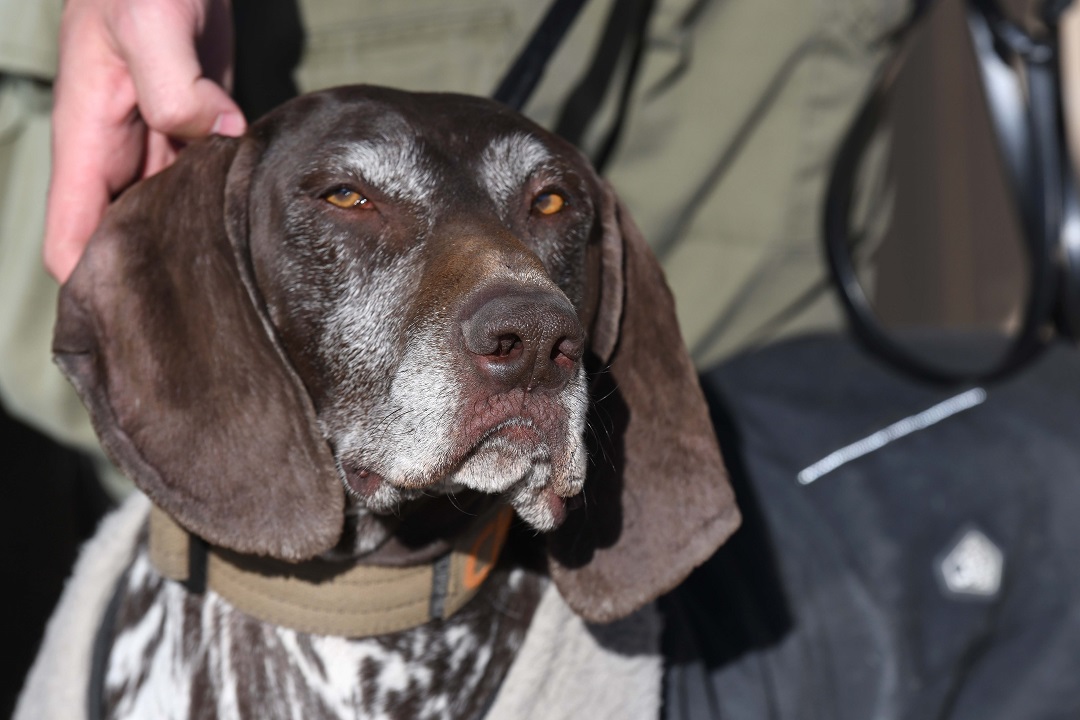
Pantex is home to a large, well-trained team of security police officers, otherwise known as the ProForce. But there are five members of this dedicated team that stick out from the rest. They don’t swipe badges or carry radios, but they do love a good treat. With noses trained sharper than any sensor and loyalty that can’t be taught, these team members are a powerful reminder that sometimes the best security comes with a fur coat and a wagging tail. Enter the good boys and girls of Pantex: Chief, Hazel, Alo, Stryker, and Hunter.
Canine units offer unique capabilities that greatly augment human efforts in various missions. Their senses are significantly more sensitive than those of people, enabling them to detect subtle scents associated with a variety of substances, even in challenging conditions or when items are concealed. Much like people, the dogs all have their strengths and bring different skills to the table.
“Some dogs might struggle with low hides, deep hides, or high hides,” K-9 Handler Wesley Wood said. “It’s very important that we spend time getting to know them so we can encourage their strengths.”
Their specialized sensory input allows for rapid and precise detection that is unattainable through human observation or technological means alone. They possess super agility, endurance, and a natural ability to navigate complex terrains, making them incredibly valuable to rescue operations, tracking, and perimeter security.
“The dogs are an incredible asset to Pantex and our protection strategy,” K-9 Operation Manager Captain Bobby Ovalle said. “They work in tandem with our current protective posture and make for excellent partners to our security police officers.”
These officers exhibit a great sense of pride in their work and every handler is quick to say how much their dogs “love their job.”
“Hunter loves to work. He loves doing a good job and you can always tell that he walks like he owns the place when he finds an odor or does a good job,” K-9 Handler Cali Bernard said.
But just like people, the dogs like to decompress. They love a variety of activities like hiking, swimming, going to Home Depot or Lowe’s, and, in Chief’s case, napping on the couch.
Canine units are a powerful reminder of the benefits of collaboration. Their presence provides a psychological deterrent and their behavioral traits allow for them to contribute to mission success in ways that complement and enhance our physical security requirements. When it comes to protecting the site, they really have a nose for it.