



News
DP Awards of Excellence focus: Pantex additive manufacturing
Pantex and Y-12 received numerous 2014 Defense Programs Awards of Excellence. The award program highlights those who have made a significant difference in improving any phase of the nuclear weapons life-cycle process. The recent awards ceremonies at each site honored programs from the 2014 fiscal year. At the ceremony the following team was recognized.
You see it on television shows, in movies, and it’s just as popular at Pantex — additive manufacturing, also known as 3D printing. For several years, Pantex has been advancing in this area and taking advantage of the endless possibilities it can bring. Recently the Pantex Additive Manufacturing Program, made up of the team Tek Ferguson, Royce McGrath and David Thomas, received recognition at the Defense Program Awards of Excellence.
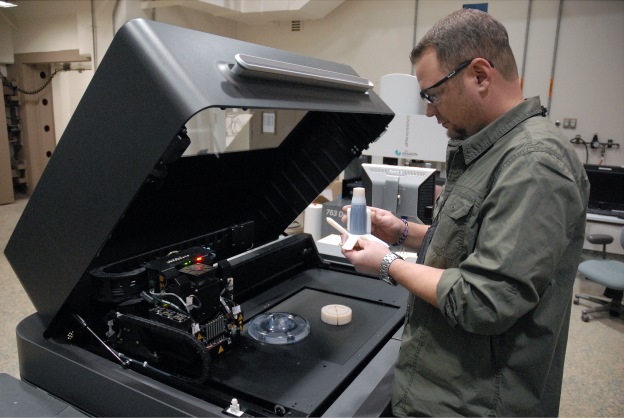
Tek Ferguson examines a part that was created for the High Explosives department on the Connex 500. The High Explosives department has benefited from the Additive Manufacturing Program.
Before getting into the various parts the program manufactures, it’s important to clarify why it’s called “additive manufacturing.” The traditional process that is used to create parts is technically called subtractive manufacturing. This is because a mass of material is whittled away, with a lathe or other tooling machine, until the desired part is created. The result is not only the part that was created, but also a pile of waste that was subtracted from the original mass in order the make the designed part. With additive manufacturing, you are adding layers of material together to create the part, leaving little to no waste with the end result.
Two experts who get to make the magic happen are Tek Ferguson, an applied technology specialist, and Royce McGrath, an engineering technician. Both gentlemen have been working with additive manufacturing for more than three years. The machine that does the most work at Pantex is the Connex 500, a printer used for the past three years. Pantex and Y-12 worked together to purchase SML 280 printers that will be located at each site. “The Connex 500 prints polymers ranging from rubberlike material to hard plastics,” McGrath said. “The SLM 280 is a metal printer that uses high power lasers to create each layer by melting the fine metal powders.”
“It’s amazing the stuff we can make now; the parts that took weeks or more, now can be finished in a few days,” McGrath said about the 3D printers.
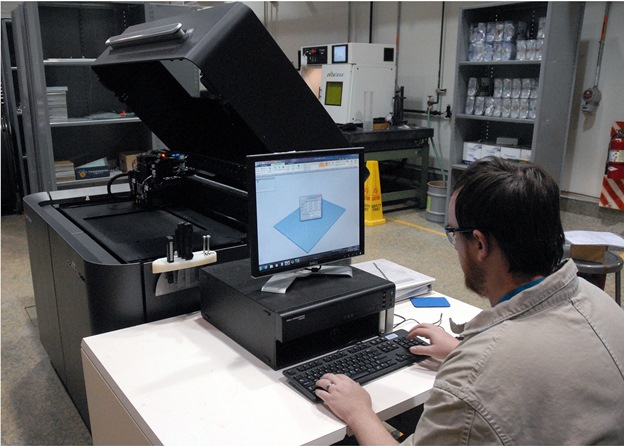
Royce McGrath prepares the Connex 500, one of the printers used in Additive Manufacturing.
With time and cost savings always a main goal, there is a reason why the additive manufacturing program is popular. It’s in such high demand that Ferguson said the printers are running every day, creating a new part for almost any of the departments at Pantex.
“We’ve made up to 600 parts in one year,” Ferguson said. “The main department that needs parts is High Explosives. They blow up a lot of our stuff.”
One of the biggest reasons the Additive Manufacturing Program has done so well is that engineers have found how much cost savings take place using the 3D printers versus traditional machining, especially when the part will end up in a million pieces at the firing sites.
Matt Reyes, a scientist in the High Explosives Performance and Surveillance Operations Department, may be their number-one customer. “I can have someone come up to me asking if I can build something for them and really all I need is the time to design it, machining time is no longer an issue for several parts,” Reyes said. “They are getting pieces printed as quickly as I can design them.”
The way 3D printing works, adding layers, means that what can be created is really only limited by the mind. With traditional manufacturing, intricate parts and hard-to-reach areas could create roadblocks in getting a product finished, but now that is not an issue. Parts have been made that help the production technicians with their training and have even revamped how some testing is done. Ferguson created a new and more efficient way to test materials with the HE holding fixture.
“In the past to test materials you would have to use glue, acrylic sheets and other materials just to hold a sample for testing,” Ferguson said. The problem with the old way of testing is that there is a tedious process that is required to remove the glue, acrylic and material before it can be disposed of properly.
“There are barrels of these that need to be disposed of, but it takes time and the special process before they can be sent to the burning grounds, with this new fixture the whole thing can be disposed of with no problem.” McGrath added.
From recreating parts that are no longer available to manufacturing parts that make a process better and more cost effective, additive manufacturing is the new and better way to create.
Becoming one team, better together
For Pantex and Y 12, delivering the mission as one team is more than the sum of its parts; it’s a shared responsibility to find smarter ways to integrate resources, eliminate redundancies, tackle shared problems and break up bottlenecks. That, in turn, helps to better meet mission requirements at both sites.
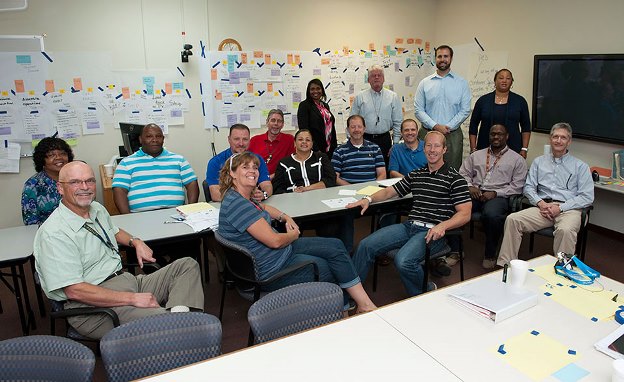
An integrated team of Pantex and Y-12 employees (some members shown here) work on the beginning stages of the container improvement initiative.
With more than a thousand miles separating the sites and decades of operating independently, becoming one team hasn’t been easy, but it makes sense. The production sites play an essential role in the nation’s defense and nonproliferation strategy. The two sites’ missions are intertwined and now so are many of their operations.
Several Consolidated Nuclear Security, LLC (CNS) organizations are playing an important role in integrating the sites’ processes and systems. “Our CNS team is accomplishing integration on a scale that has never been done before within the Nuclear Security Enterprise,” said Darrell Graddy, CNS’s vice president for Operations Support. “We’ve already made a lot of progress, but there is still more that can be done.”
Graddy said the biggest challenge is to “raise the standards in everything we do to a level reflective of our mission success.”
Following are a few examples of how CNS employees are fostering a collaborative work environment.
Mission first
CNS synchronized weapons baseline schedules for Pantex and Y 12. Both sites jointly reworked the B61 12 Life Extension Program project schedules to include bottom up resource estimates and integration of key subprojects. The team also consolidated the Earned Value Management System — the method used to plan and measure the cost and progress of large projects — on both unclassified and classified platforms.
“The result of these efforts was the successful B61 integrated baseline review at both sites,” said James Fine, senior director of Enterprise Planning and Controls.
Integrated mission planning
Another example of cross site collaboration is CNS’s work with the National Nuclear Security Administration, Sandia National Laboratories (SNL) and the National Security Campus in Kansas City on the Logistics, Accountability, Planning and Scheduling project, or LAPS. LAPS encompasses the functions that support many aspects of the Nuclear Security Enterprise weapons production business. The integrated project team is working to deliver new processes and a computer system of integrated technology and data to replace aging applications.
The new system, a first for the Nuclear Security Enterprise, will improve planning capabilities, reduce costs and provide for operational efficiencies throughout the supply chain. “CNS is responsible for leading development of planning and scheduling aspects, and SNL is responsible for accountability and logistics. Together in 2015, we completed a joint proof of concept effort in two closely coordinated project plans,” said John Hudson, senior program manager in Enterprise Planning and Controls. “This laid the groundwork for system requirements definition to proceed in 2016.”
Prioritizing infrastructure upgrades
The National Nuclear Security Administration (NNSA) recently designated Lawrence Livermore National Laboratory, Pantex and Y 12 as BUILDER Centers of Excellence.
BUILDER, a knowledge-based condition assessment software developed by the U.S. Army Corps of Engineers, is being implemented across the NNSA complex to help plan for maintenance and prioritize infrastructure upgrades. The three site team has been working to gather data on every facility in the Nuclear Security Enterprise. All the data — including building square footage; number of windows and doors; and type and condition of foundation, roofing and flooring — have been entered into BUILDER.
“BUILDER will provide an enterprise level understanding of the condition of existing facilities and will allow for a risk-based approach to future infrastructure needs,” said Jane Nations, Y 12 site master planner. “CNS was selected as a Center of Excellence because of our willingness to investigate and share methods to make the NNSA implementation process more efficient.”
Successful W87 Flight Test used CNS-made components
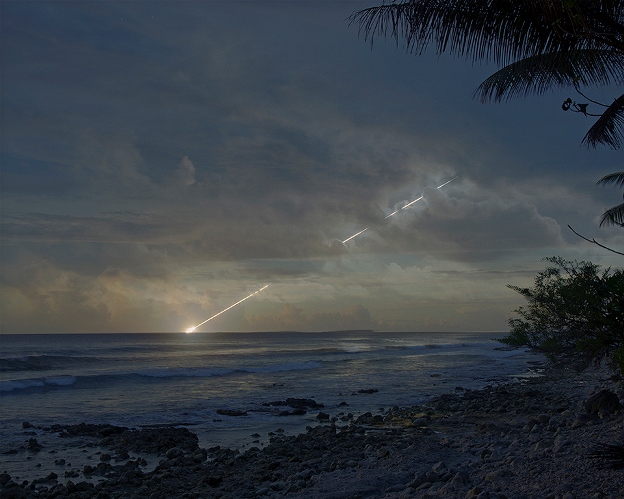
A W87/MK21 Flight Test was successfully launched from Vandenberg Air Force Base in late October. The Minuteman III missile carried a single, hi fidelity W87/MK21 Joint Test Assembly and was launched using standard ground launch procedures. The JTA re-entry vehicle was targeted and successfully detonated in the Vicinity of Illeginni at the Reagan Test Site, Kwajalein Atoll.
CNS employees at Y-12 built the canned subassembly (with surrogate material replacing special nuclear material), and Pantex produced the high explosives and assembled the final weapon for this test. In the absence of nuclear testing, JTAs are an essential component of our ability to ensure the effectiveness of stockpile nuclear weapons. They prove that all non-special nuclear material components of the weapons and their launch systems work as designed.
West Texas Building Trades and Construction Approves Contract with Pantex
Over the last few weeks, CNS has been engaged in negotiations with West Texas Building Trades and Construction Council (WTBTCC) to reach agreement on terms and conditions for a new collective bargaining contract.
CNS is pleased to announce the negotiations have successfully concluded with the WTBTCC membership ratifying its 3-year collective bargaining agreement, which became effective February 10, 2016, and will be valid until its expiration in February 10, 2019.
CNS is pleased that negotiations led to an agreement that provides stability to the workforce and recognizes the WTBTCC membership’s important contributions to Pantex and national security.
Consolidated Nuclear Security, LLC (CNS) operates the Pantex Plant, located in Amarillo, Texas, and the Y-12 National Security Complex, located in Oak Ridge, Tennessee, under a single contract for the U.S. National Nuclear Security Administration. Pantex and Y-12 are key facilities in the U.S. Nuclear Security Enterprise, and CNS performs its work with a focus on the performance excellence and the imperatives of safety, security, zero defects and delivery as promised.
For more information on each site, visit www.pantex.energy.gov or www.y12.doe.gov. Follow Pantex on Facebook, X or LinkedIn. Follow Y-12 on Facebook, X, and LinkedIn.
CONTACT
Steve Myers
Public Affairs
Office (806) 573.0490
Stephen.Myers@pantex.doe.gov
CNS represented at inaugural Energetics Consortium
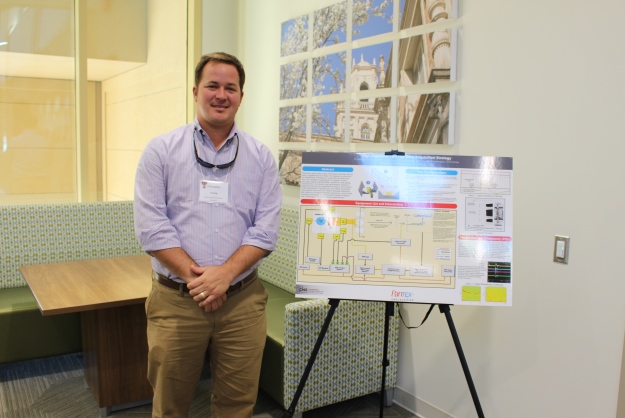
About 70 university researchers and government and industry experts from across the country, including Consolidated Nuclear Security employees, joined forces at the first ever National Energetic Materials Consortium hosted by Texas Tech University.
Pantex’s Christopher Young said, “There are a great many types of energetic materials and an array of applications. The explosives used by the Department of Energy are a specialized subset and have very stringent requirements in regards to their precision, timing, reproducibility, sensitivity and ageing characteristics.”
NEMC was formed by leading universities across the U.S. to combine technology and science within the academic community with the manufacturing resources of private industry. The aim is to bring critically needed innovations to the energetics sector of the national technological industrial base; NEMC is designed to allow for a rapid transition of new materials to a modernized industrial base.
“Acceptance and performance testing of explosives has been accomplished at Pantex for DOE since the 1960s,” Young said. “We’ve teamed up with Los Alamos National Laboratory and Lawrence Livermore National Laboratory on this work. Current data acquisition strategies are continuously balanced against new technologies and ever evolving requirements.”
There was a strong showing from Pantex and Y 12 presenters.
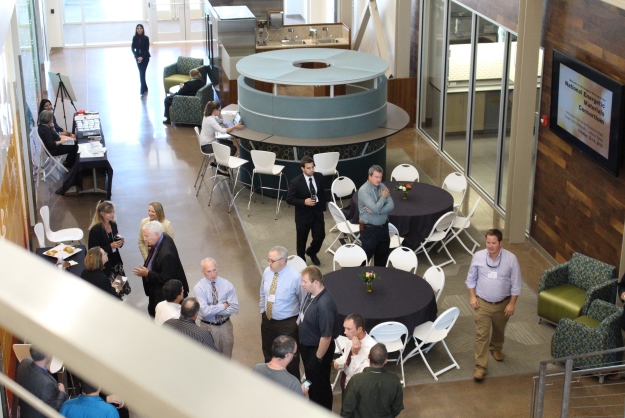
Pantexan Patrick Goguen said, “It was a great opportunity to share ideas with some of the leaders in academia, government and industry related to advancing the frontiers of energetic materials. Rarely can you get such a diverse audience together to have such a focused interchange.”
CNS was one of the sponsors of the event, held in Lubbock, Texas, and is collaborating with Texas Tech University in research and development areas.
Former Strategic Command chief emphasizes importance of Pantex, Y-12 missions
Gen. Kevin Chilton, former commander of U.S. Strategic Command, recently spoke to Pantex employees and delivered a clear message: “From the bottom of my heart, thank you for what you do every single day.” During the Jan. 26 all hands address, he encouraged employees to be proud of themselves, calling the mission “unique,” “vital” and “special.”
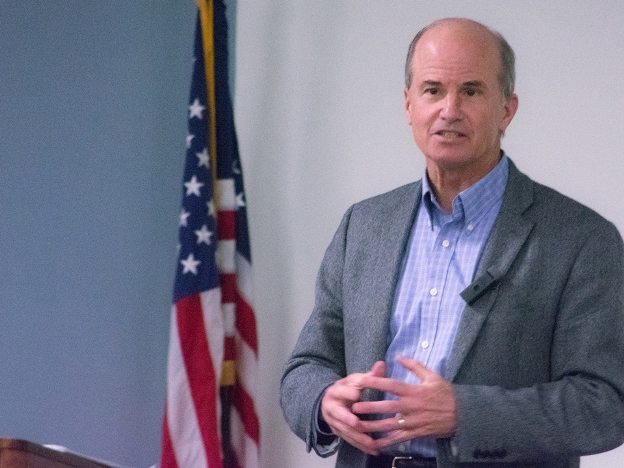
Chilton, who is now working with Consolidated Nuclear Security to support Pantex and Y 12 missions, was at Pantex as a member of a Technical Advisory Board focused on enhancing mission delivery. His talk with employees emphasized the importance of the CNS mission, linking employees’ roles to the broader nuclear deterrent.
“One thing I’m certain of, folks, is that we in this room, our children, grandchildren and great-grandchildren will absolutely need and depend on every one of you and the work you do to provide security for them and our great country,” he said. “For that and your dedicated and hard work, I thank you again.”
And he noted that more work will be coming to Pantex and Y 12 as nuclear weapons work ramps up in the coming decades.
“The cycle is picking up right now, and it’s picking up fast. There is a tremendous amount of work to be done, and there are those who doubt we can do it,” Chilton said. “And then there are those like me who are counting on folks like you to make it happen because we have to make it happen. It’s just so important to our country.”
In addition to thanking employees for their work, Chilton explained that the purpose of the United States’ nuclear stockpile is to deter and assure — deter those who think striking us wouldn’t be so bad and assure our allies that the U.S. can provide protection. Chilton said our nation has used nuclear weapons as a deterrent every day since they were first fielded. “We have been 100 percent successful,” he noted.
Aside from stressing the importance of a strong nuclear deterrent and the role CNS plays, he peppered his remarks with stories of his days as the commander of STRATCOM, his long and prestigious Air Force career and his service at NASA, where he was on three space shuttle missions: Endeavour (1992), Endeavour (1994) and Atlantis (1996), which he commanded.
Consolidated Nuclear Security announces additional leadership changes
Michelle Reichert named Deputy Enterprise Manager; Todd Ailes to manage Pantex Plant
OAK RIDGE, Tenn. – Effective Feb. 15, 2016, Michelle Reichert becomes the Deputy Enterprise Manager for Consolidated Nuclear Security, LLC (CNS), reporting directly to CNS President and CEO Morgan Smith. CNS is the managing and operating contractor for two key national security facilities: the Pantex Plant in Amarillo, Texas, and the Y-12 National Security Complex in Oak Ridge, Tenn.
Operating primarily out of CNS offices at Pantex, Reichert will share leadership responsibilities with Smith, focusing on communications with employees, customers and other key stakeholders. Reichert will also coordinate integration activities between the two sites to ensure they are aligned in the best interest of CNS and the NNSA.
“Michelle possesses a strong understanding of the operations and missions of Pantex and Y-12 after serving in senior management roles at both sites,” Smith said. “She will provide executive level leadership and integration across both sites while ensuring a greater executive presence at Pantex.”
Reichert has 28 years of experience in Department of Energy operations environments. Serving in leadership roles, her responsibilities have included manufacturing operations; environment, safety and health; safeguards and security; emergency management; waste management; and transportation.
At Pantex, in the roles of Site Manager and Deputy General Manager, Reichert oversaw daily operations to sustain a safe, secure and effective nuclear deterrent. She also provided leadership in all aspects of plant operations involving nuclear weapons, plutonium pit storage, high explosives, engineering, safety, security, emergency management, facilities management, quality, environmental protection and general administration.
Previously at Y-12, Reichert served as vice president of environment, safety and health. She was the interpretive authority for environment, safety and health; waste operations; human performance improvement; behavior based safety; and integrated safety management. Also at Y-12, she managed enriched uranium metalworking, production and manufacturing compliance, and she served as the program manager for modernization and as the operations manager of analytical chemistry.
Reichert holds a B.S. in biology/chemistry from Viterbo University in Wisconsin and an M.S. in radiological engineering/health physics from the University of Florida.
In concert, Todd Ailes will succeed Reichert as the Pantex Site Manager where his focus will be on conducting the site’s mission in a safe, secure and quality manner. Pantex is responsible for nuclear weapons surveillance and life extension programs; nuclear weapons dismantlement; the development, testing, and fabrication of high explosive components; and the interim storage and surveillance of plutonium pits.
Since July 2014, Ailes has been the site’s Deputy Manager. He previously led the Pantex Manufacturing Division and the Pantex Quality and Performance Assurance Division. Prior to joining Pantex, he was responsible for production scheduling and manufacturing operations of nuclear weapon components at the Kansas City Plant. He also has 12 years of Naval Nuclear Power operational experience.
“Todd has demonstrated his effectiveness as the Pantex Deputy Site Manager, and is well known and respected by the Pantex workforce,” Smith said. “He possesses extensive experience with Pantex operations and is fully prepared to lead Pantex in its production mission.”
Smith was named CNS CEO last month replacing former CEO Jim Haynes, who took an assignment at the headquarters of Bechtel Corporation.
Consolidated Nuclear Security, LLC (CNS) operates the Pantex Plant, located in Amarillo, Texas, and the Y-12 National Security Complex, located in Oak Ridge, Tennessee, under a single contract for the U.S. National Nuclear Security Administration. Pantex and Y-12 are key facilities in the U.S. Nuclear Security Enterprise, and CNS performs its work with a focus on the performance excellence and the imperatives of safety, security, zero defects and delivery as promised.
For more information on each site, visit www.pantex.energy.gov or www.y12.doe.gov. Follow Pantex on Facebook, X or LinkedIn. Follow Y-12 on Facebook, X, and LinkedIn.
CONTACT
Jason Bohne
(865) 241-1400
EMInS improves communications during emergencies
Pantex Emergency Management just received a giant communications boost with the installation of the Emergency Management Information System, or EMInS. Y 12, the Pantex sister site, has used EMInS for many years. The addition at Pantex brings the two sites closer in their management of emergency events.
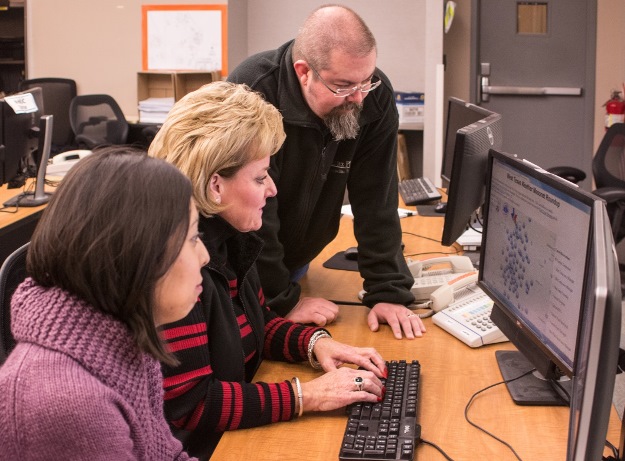
Pantex Emergency Services now uses the Emergency Management Information System, or EMInS. From left: Maribel Martinez, Brenda Graham and Greg Roddahl.
“Pantex and Y-12 are required to maintain an Emergency Management Department to oversee activities needed during an emergency that may affect employees, the public or the environment,” said Daniel Gleaves, Emergency Services senior manager at Pantex. “Y-12 has an outstanding Emergency Management Department, and EMInS is one of the primary reasons.”
EMInS is an interactive computer program used to provide real-time information, data, graphics, maps and video capabilities necessary to efficiently manage an emergency. The software provides a structured means of recording emergency information and sharing it among Emergency Response Organization cadre members.
Maribel Martinez, Emergency Management Program section manager said, “The implementation of EMInS at Pantex starts the integration of resources, datasets and information throughout Pantex and Y-12. These improvements are designed to enhance coordination efforts. It is a tool our ERO can use to ensure constant situational awareness and helps to create a common operating picture to improve our operations and information processes to ensure the safety of our employees and our neighbors.”
The Pantex EM team works closely with its National Nuclear Security Administration counterparts to continuously revitalize the ERO.
Gleaves said, “We continually review our plans to look for improvement opportunities. EMInS is one of those opportunities. Using this system will allow us to communicate all issues involved in an emergency. Team members can discuss specific issues on private team boards or submit updates, questions or suggested media facts to appropriate EMInS users.”
A phased implementation of EMInS capabilities will allow state and local agencies some access to the system. These agencies participate in Pantex drills and exercises and would respond in the event of a real emergency. EMInS will help in coordination of response efforts and information flow; this will improve communication and performance.
“We recently provided EMInS training to members of the ERO team followed by a drill.” Gleaves said. “We were very pleased with the outcome and look forward to showing how the software enhances our performance during upcoming drills and exercises,” he added.
Consolidated Nuclear Security announces leadership change
Morgan Smith named President and CEO
OAK RIDGE, Tenn. – Effective Feb. 1, 2016, Morgan Smith will become the President and CEO of Consolidated Nuclear Security, LLC. Smith succeeds Jim Haynes, who returns to an executive position at Bechtel after successfully leading CNS through its first phase as a consolidated organization. As President and CEO, Smith will be responsible for the management and operations of the Pantex Plant and the Y-12 National Security Complex, key production facilities in the U.S. Nuclear Security Enterprise.
“With the majority of key consolidation activities complete, CNS moves to its next phase focused on advancing operational performance and increasing production,” Haynes said. “Morgan Smith is uniquely positioned to lead CNS at this time based on his past experience managing Naval Nuclear Propulsion Program facilities and his time at CNS. Morgan and I have mapped out the path for a successful handoff. I could not be more confident in Morgan’s abilities.”
Smith, who has been the CNS COO since the company took over management of Pantex and Y-12 on July 1, 2014, has 38 years of technical and managerial experience. Prior to coming to CNS, he was instrumental in planning and implementing the consolidation of Bettis and Knolls Atomic Power Laboratories into a single organization run by Bechtel Marine Propulsion Corporation. As general manager of Knolls Atomic Power Laboratory from 2009 through mid-2014, Smith directly managed the lab and co-managed BMPC—scope that included 7,000 employees and nearly $2 billion worth of work across five sites.
“I have great respect for the work performed by the dedicated employees of Pantex and Y-12—work that our great nation and her allies rely upon,” Smith said. “I am committed to delivering the safety, security, quality and overall excellence that our country requires as we execute our important mission for the country. I also look forward to continuing the great relationships Jim Haynes developed with the communities of Amarillo and Oak Ridge and throughout the Texas Panhandle and East Tennessee.”
Haynes arrived at Y-12 from Bechtel in 2011, first serving as deputy general manager under the previous operating contractor. He became the first CNS President and CEO at the start of contract transition in early 2014. He is recognized as a leader in managing large organizations during times of consolidation and structural change and where safety is paramount.
“Jim Haynes led CNS through one of the most challenging transitions in NNSA history, joining two sites into one unified enterprise,” said CNS Chairman of the Board Craig Albert. “Under Jim, CNS faced the challenges of consolidation head on and met key mission deliverables and milestones, improved project performance, and helped establish a strong capital project pipeline. CNS has developed a strong foundation with common goals, values and daily absolutes. He leaves CNS well positioned to meet the growing demands for providing global security and national defense well into the future.”
Haynes will remain with CNS through the end of January to complete the transition of duties to Smith before beginning his new role with Bechtel on Feb. 1.
Consolidated Nuclear Security, LLC (CNS) operates the Pantex Plant, located in Amarillo, Texas, and the Y-12 National Security Complex, located in Oak Ridge, Tennessee, under a single contract for the U.S. National Nuclear Security Administration. Pantex and Y-12 are key facilities in the U.S. Nuclear Security Enterprise, and CNS performs its work with a focus on the performance excellence and the imperatives of safety, security, zero defects and delivery as promised.
For more information on each site, visit www.pantex.energy.gov or www.y12.doe.gov. Follow Pantex on Facebook, X or LinkedIn. Follow Y-12 on Facebook, X, and LinkedIn.
CONTACT
Jason Bohne
(865) 241-1400
CNS creates community investment fund
Funds distributed though Amarillo Area Foundation
AMARILLO, Texas - Charitable organizations from across the Texas Panhandle are invited to apply for grants from the Pantex Community Investment Fund established by Consolidated Nuclear Security (CNS).
CNS, responsible for management and operations at the Pantex Plant, has established the fund through the Amarillo Area Foundation as part of its commitment to Amarillo and surrounding communities. A Pantex Community Investment Advisory Committee was formed by selecting site employees to work with CNS and the Foundation to allocate grants where the need is greatest and company resources can be best allocated.
The Advisory Committee identified the following funding preferences and priorities for grants:
- Basic Needs (Food, Clothing, and Shelter)
- Children, Youth, and Family
- Community Development
- Education
- Financial Literacy
- Health and Wellness
Organizations who fit the eligibility requirements and whose work aligns with the funding priorities are encouraged to participate in the competitive application process. Applications are available online at aaf.spectrum.net and are due February 12, 2016, by noon.
The Advisory Committee for the CNS Pantex Community Investment Fund will entertain proposals from nonprofit and charitable institutions throughout the 26 northernmost counties in the Texas Panhandle (individuals and non-charitable organizations are not eligible). Priority will be given to proposals from organizations located and operating in twelve contiguous counties surrounding the Pantex Plant, which includes Armstrong, Carson, Deaf Smith, Donley, Gray, Hall, Hutchinson, Moore, Oldham, Potter, Randall and Swisher.
Grant amounts will range from $500 to $10,000 with grantees announced in late March. Eligible organizations must be tax-exempt 501(c)(3) organizations or other exempt entities, such as public schools and governments or municipalities. Training for the online Spectrum system will be held Wednesday, January 13 from 1:30-2:30 p.m. and again on Tuesday, February 9, from 9-10 a.m. To register for the training visit: http://bit.ly/1L00BJi.
For registration questions, please contact Roxann Ball, AAF Program Officer, at (806) 376-4521 or roxann@aaf-hf.org. Questions about eligibility or the grant process, please contact Kathie Grant, AAF Grants Administrator, at (806) 376-4521 or kathie@aaf-hf.org. For questions about grant priorities, please contact Jessica Tudyk, AAF Grants Manager, at (806) 376-4521 or jessica@aaf-hf.org.
Consolidated Nuclear Security, LLC (CNS) operates the Pantex Plant, located in Amarillo, Texas, and the Y-12 National Security Complex, located in Oak Ridge, Tennessee, under a single contract for the U.S. National Nuclear Security Administration. Pantex and Y-12 are key facilities in the U.S. Nuclear Security Enterprise, and CNS performs its work with a focus on the performance excellence and the imperatives of safety, security, zero defects and delivery as promised.
For more information on each site, visit www.pantex.energy.gov or www.y12.doe.gov. Follow Pantex on Facebook, X or LinkedIn. Follow Y-12 on Facebook, X, and LinkedIn.
About the Amarillo Area Foundation
The Amarillo Area Foundation is a community foundation that serves the northernmost 26 counties of the Texas Panhandle. The Foundation's mission is to improve the quality of life in the Texas Panhandle. Since its inception in 1957, the Foundation has provided grants and a variety of other services to strengthen nonprofit organizations and the services they deliver.