



News
Pantex and Y-12 teams receive Defense Programs awards
NNSA NEWS
U.S. Department of Energy
National Nuclear Security Administration
Production Office News Release
Oak Ridge, Tenn.--More than 230 Pantex and Y-12 employees were recognized at National Nuclear Security Administration Defense Programs Awards of Excellence ceremonies recently held at the respective sites.
Two Pantex teams and six Y-12 teams were recognized by members of site management, as well as Roger Lewis, NNSA Associate Deputy Administrator for Stockpile Management, and Mike Thompson, NNSA Assistant Deputy Administrator for Major Modernization Programs, in Washington, D.C.
“It is an honor for me to present you with these awards,” Lewis said. “The accomplishments you have achieved and the jobs you do every day contribute to our mission of maintaining a safe, secure and effective nuclear deterrent.”
Geoff Beausoleil, NNSA Production Office manager, joined Lewis and Thompson in presenting the awards at Pantex. “I enjoy these ceremonies because I get to celebrate the talent and determination of the people at these sites,” Beausoleil told the crowd.
Teams were recognized for their contributions to several Defense Programs projects, including support for the B61 program, weapon component assembly efforts and packaging of nuclear materials.
Pantex Plant Manager Todd Ailes told the recipients, “Day in and day out, you do the work that keeps this site safe and moving forward, as well as keeping our nation secure. And, you do that work with an unwavering commitment to safety, security and quality. Please accept my thanks and congratulations on a job well done.”
During a ceremony held at Y-12, Mike Thompson said, “I’m impressed by the magnitude of your achievements. I’m also impressed with how you accomplished your work — your complete dedication to problem solving through teamwork, respect, and mutual accountability.”
Established by NNSA in 1982, the Defense Programs Awards of Excellence recognize significant individual and team accomplishments across the nuclear weapons complex in support of NNSA’s nuclear weapons program. The awards are given annually to recognize significant achievements in quality, productivity, cost savings, safety or creativity in support of NNSA’s nuclear weapons program.
The mission of the NNSA Production Office is to ensure the safe, secure and cost-effective operation of the Pantex Plant, Amarillo, Texas, and the Y-12 National Security Complex, Oak Ridge, Tennessee. Y-12 and Pantex are operated by Consolidated Nuclear Security, LLC, for NNSA.
Follow NNSA News on Facebook, Twitter, YouTube, and Flickr
Established by Congress in 2000, NNSA is a semi-autonomous agency within the U.S. Department of Energy responsible for enhancing national security through the military application of nuclear science in the nation’s national security enterprise. NNSA maintains and enhances the safety, security, reliability, and performance of the U.S. nuclear weapons stockpile without nuclear testing; reduces the global danger from weapons of mass destruction; provides the U.S. Navy with safe and effective nuclear propulsion; and responds to nuclear and radiological emergencies in the U.S. and abroad. Visit http://www.nnsa.energy.gov for more information.
CONTACT
Steven Wyatt
NNSA Production Office
Public Affairs
Office (865) 576-9918
CNS honors top small businesses for excellence
Three subcontractors recognized for contributions to Pantex mission success
AMARILLO, Texas – Consolidated Nuclear Security, LLC (CNS) recently presented three Small Business Achievement Awards at the West Texas A&M Contract Procurement Center’s Focused and Fearless: Empowering Women Entrepreneurs in Texas event. CNS recognized A-1 Communications, Inc., Stanek Tool, and Tri-State General Contracting for their commitment to excellence.
“Our ability to partner and collaborate with small business plays an instrumental role in helping us achieve mission success,” said CNS Deputy Enterprise Manager Michelle Reichert during her remarks as the event’s keynote speaker. “During fiscal year 2016, Pantex spent $99.3 million on goods and services from more than 625 small businesses, which is more than 80 percent of total procurements,” added Reichert.
A-1 Communications, a local small business providing leased pagers, has a 16-year working relationship with the Pantex Plant. The woman-owned company is an integral part of the success of Pantex operations and emergency communications.
Wisconsin-based machine shop Stanek Tool has provided special tooling to the Plant since 2007. Anne Marie Wilkerson, the Pantex procurement specialist who nominated the company for the award, said “they go the extra mile to ensure what they deliver to us is high-quality and on time.”
CNS also recognized Tri-State General Contracting, which has provided minor and major construction support to Pantex for 13 years. The company was one of the first subcontractors selected for CNS’ mentor-protégé program.
Pantex Small Business Program Manager Ryan Johnston said, “Small businesses are the backbone to our local and national economy. We are proud to recognize these three businesses for their contributions and commend them for modeling the CNS values—integrity, trust, respect, teamwork and excellence.”
Overall, CNS used small businesses for 67.7 percent of subcontracts at Pantex and the Y-12 National Security Complex in Oak Ridge, Tenn., surpassing the company’s goal of 55 percent.
Consolidated Nuclear Security, LLC (CNS) operates the Pantex Plant, located in Amarillo, Texas, and the Y-12 National Security Complex, located in Oak Ridge, Tennessee, under a single contract for the U.S. National Nuclear Security Administration. Pantex and Y-12 are key facilities in the U.S. Nuclear Security Enterprise, and CNS performs its work with a focus on the performance excellence and the imperatives of safety, security, zero defects and delivery as promised.
For more information on each site, visit www.pantex.energy.gov or www.y12.doe.gov. Follow Pantex on Facebook, X or LinkedIn. Follow Y-12 on Facebook, X, and LinkedIn.
Pantex and Y-12 receive impressive environmental reviews
Recently, Pantex and Y-12 were inspected by the Environmental Protection Agency. Y-12’s inspection also included a visit from the Tennessee Department of Environment and Conservation. Both sites came away with stellar reviews after three day inspections in areas such as hazardous waste management, training and compliance documentation.
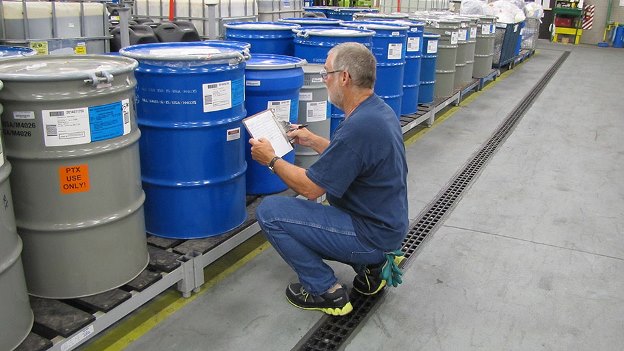
Pantex Waste Operations Engineering Technician John McMahan is one of many employees who works daily to ensure CNS meets environmental standards.
“This is a significant accomplishment that does not happen by accident, but instead through hard work, diligence, and a commitment to excellence,” said Teresa Robbins, NNSA Production Office deputy manager.
In addition to inspecting waste storage areas, the inspectors looked at numerous records. These records included hazardous waste manifests, annual hazardous waste activity reports, waste reduction reports, and hazardous waste training and lesson plan content. Despite the volume of records reviewed, inspectors noted only one minor issue.
Inspectors at each site had positive things to say about the various processes and procedures that they had observed. Inspectors noted that the Material Evaluation Process (waste characterization) employed at Pantex far exceeds what is required by regulation and is better than what he encountered at commercial waste treatment, storage, and disposal facilities. At Y-12, the inspector even asked for a photo of an exceptionally good Y 12 practice to use as a benchmark for others.
“There are hundreds of folks doing the hard work every day and likely wonder if anyone will notice. Each one needs to know that excellence is a choice. And, the string of individual decisions they have made is having a positive impact on this site’s overall reputation,” said Bill Tindal, Y-12 site manager.
“Seeing that there were no violations or concerns identified during this on site inspection only proves that we have a great group of people here that really take pride in their jobs and processes,” said Todd Ailes, Pantex site manager.
A smokin' good time
There was plenty of smoke and fire, but the Pantex firefighters weren’t responding to a four-alarm fire. They were cooking for the annual Amarillo Chamber of Commerce’s Good Times Celebration Barbeque Cook-Off. The Pantex team went up against 99 cook teams, smoking ribs, brisket and other meats, to see who had the best barbeque in town.
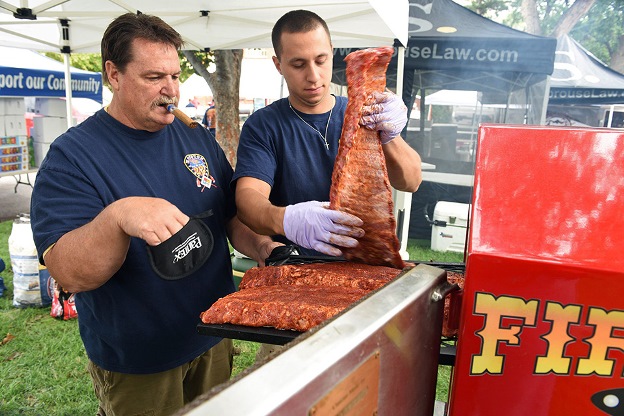
Scott Johnson, Pantex battalion fire chief (left) and Saxon Webster, firefighter/EMT, prepare ribs during the Amarillo Chamber of Commerce’s Good Times Celebration Barbeque Cook-Off. For the past 17 years, Pantex firefighters come together in September to smoke the best meats and enjoy the competition. (Photo courtesy of Michael Schumacher, Amarillo Globe-News)
The Good Times Celebration is in its 21st year, and for the past 17 years, Pantex firefighters come together for a couple of days in September to smoke the best meats and enjoy the competition. This year’s event took place Sept. 7 and 8. For some, it’s the group of co-workers that brings them to the barbeque.
“This is my first time to cook for the Chamber event, but I wanted to because of the guys out here on the cook team,” said Jeremy Baker, Pantex firefighter/paramedic. “I cook with them at the Boots vs. Badges event, and we have a great time each year.”
Not only were the Pantex firefighters serving up their best fixings to the judges, they were serving more than 6,000 people who lined the streets of downtown Amarillo for the event.
“When you watch a person bite into a rib, slice of brisket or a piece chicken and you get the eye roll along with the ‘yum’ sound effect, you feel good knowing what you worked at for hours has paid off,” said Scott Johnson, Pantex battalion fire chief.
Even though the team did not place in this year’s event, they are tweaking their recipes and will be back again next year.
“Amarillo is a unique community that’s always happy to come together for good causes and fellowship – often over great food. I love that so many Pantexans get engaged in this event each year, and a photo of our firefighters even made the front page of the newspaper. I was also happy to get to taste their amazing barbeque creations, as well as serve as a rib judge. As always, we are proud to be a member of this community, and I am very proud of all the Pantexans who took the time to volunteer,” said Michelle Reichert, CNS deputy enterprise manager.
Professional women for the WIN
For two women who represented Pantex and Y‑12 at the U.S. Women in Nuclear national conference in July, the organization lives up to its acronym — WIN — by offering win‑win benefits of professional development and networking.
Megan Houchin of Y‑12 and Evalita Perez-Bobb of Pantex participated in the national 2016 conference, “U.S. WIN: Building on the Promise of Nuclear Energy,” held in Charlotte, North Carolina. Houchin, whose job title is Lean Six Sigma Black Belt, is the president of the Oak Ridge WIN chapter. Perez‑Bobb, an electrical engineer who joined Pantex a year ago, is nearly as new as the recently formed Amarillo Pantex WIN Chapter, which is about eight months old.
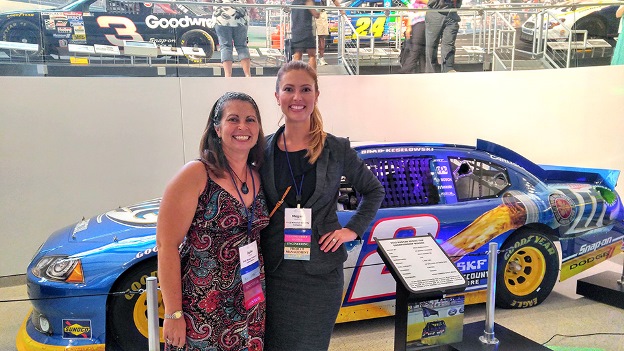
Y‑12’s Megan Houchin, right, enjoys a Women in Nuclear networking event at the NASCAR Hall of Fame in Charlotte, North Carolina. With her is Julie Ezold of the Oak Ridge National Laboratory.
U.S. WIN includes chapters from across the country, comprised of 8,000 women (and men) who work in nuclear and radiation‑related fields. The national organization is affiliated with WIN‑Global, an international organization in 100 countries.
“We do a lot of professional development. We call it womentoring,” Houchin said. “Most people think WIN is for nuclear engineers, but it’s not. It’s for anyone in the nuclear industry — which is everyone at Consolidated Nuclear Security.”
After joining Pantex about a year ago as an electrical engineer, Perez‑Bobb wondered if the organization offered peer networking like she experienced serving in the Navy. She was glad to hear that Pantex employees were establishing a WIN chapter.
Perez‑Bobb attended the conference as a last‑minute substitute and wasn’t sure what to expect. Walking into a panel discussion, she immediately recognized a familiar face and a connection to her naval service. Retired U.S. Navy Admiral Robert Willard, now president and CEO of the Institute of Nuclear Power Operations, was commanding officer of the USS Abraham Lincoln when she served on the aircraft carrier.
She said it was also amazing to see that two of the four panel speakers were women: Lynn Good, CEO of Duke Energy Corp., and Maria Korsnick, CEO of Nuclear Energy Institute.
“The women there were great, so inspirational. They were presidents, CEOs or top national experts in the nuclear energy field. I was grateful for being given the chance to socialize with so many women nuclear professionals in one place,” Perez-Bobb said.
Houchin had a similar experience as she chatted with a woman seated next to her at the lunch table, the president of one of the Savannah River Site operations.
Closer to home, the chapters meet monthly and often host guest speakers. Recent professional development topics include Facilitation 101 and networking. The chapters also take part in community outreach, such as Introduce a Girl to Engineering, and members speak at schools.
Weapon interns return as tomorrow’s leaders
Consolidated Nuclear Security (CNS) once again has two employees participating in the Sandia National Laboratories Weapon Intern Program (WIP): Tyler McClary, Mission Engineering, and Brandon Pehrson, Y‑12 Operations. This highly sought-after internship teaches the technical details of weapon systems and provides site interactions that provide a comprehensive picture of the Nuclear Security Enterprise. Following that education, the interns work on a project with enterprise and personal value.
Both are looking forward to being a member of the WIP Class of 2017. “I hope to use the knowledge I gain to better serve the needs of Pantex,” said McClary, who has been a Pantexan for almost five years and is a lead design engineer in Tooling & Tester Design.
Pehrson, a production specialist and Y‑12 employee for 11 years, said, “I want to learn more about the weapons parts and material function so I can understand impacts of changes. I also want to become an expert in the weapons field.”
Colby Yeary and Eva Irwin of Program Integration, the CNS contacts for the program, realize there are many advantages for having Pantex and Y‑12 representatives participate.
Yeary said, “Our representatives provide a perspective from two key production agencies in the Nuclear Security Enterprise. Tyler and Brandon’s perspectives, and those of past participants, offer production agency considerations that can be overlooked in important nuclear weapon product realization activities.”
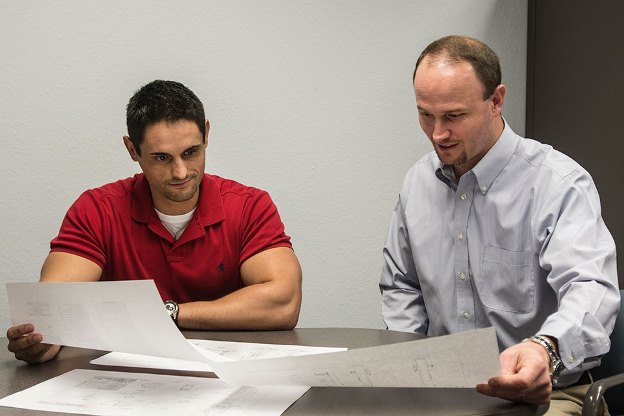
Tyler McClary (left) shares with Colby Yeary about participating in the WIP.
There are many benefits to the rigorous program. The first six months includes classroom work with site visits and research assignments. During the final five months, participants are embedded in various organizations across Sandia to work on specific projects.
“The interns are considered high potential and are able to develop and learn about the enterprise in an accelerated manner,” Yeary said. “It took me the better part of a decade to get the exposure and knowledge they will receive in less than a year.”
HaliAnne Crawford and Aaron Lee, the CNS representatives in the WIP Class of 2016B, offered advice to McClary and Pehrson. (During 2016, WIP had two classes.)
“No matter how daunting the next 11 months seem,” Lee said, “just jump in with both feet first as soon as possible. You have a limited time to learn as much as you can about a topic that is truly vast. Don’t waste a moment of the next 11 months because it will fly by.”
Crawford echoed Lee’s sentiment. “My advice is to get involved with the program, both inside and outside the classroom. Don’t be a passive participant. You will be learning from some of the greatest minds in our industry; ask questions and don’t be afraid to think outside the box.
“You will find that your classmates are some of the most brilliant individuals you will ever have the pleasure of working with,” Crawford said. “Get to know them, learn from their experiences and leverage their knowledge and abilities whenever possible. This year will be one of the best of your life. Enjoy every single second of it.”
Lee agreed: “Listen to your classmates. They will have just as much to teach you as the instructors do. Members of my class represented almost every other site within the NSE as well as NNSA and the military. They had knowledge and perspectives on certain topics that were completely different from my own due to their own different experiences. Everyone brought unique experiences to the program and had a lot of knowledge to share with the class.”
After the internship, WIP participants return to their respective sites to continue their leadership journeys. Yeary said, “The WIP prepares today’s workforce as tomorrow’s leaders by rapidly providing a holistic, yet reasonably detailed view of the nuclear weapons business. The program helps candidates connect dots to see the ‘big picture’ — an important attribute of senior leadership.”
CNS hosts summer interns
This summer, 26 college students worked at Consolidated Nuclear Security and participated in professional development, science and engineering lectures, networking events, and social activities with mentors and peers. The 2016 interns represented 16 universities from across the country and are pursuing degrees in mechanical, electrical, nuclear, and chemical engineering, as well as physics, optics, information technology, and math.
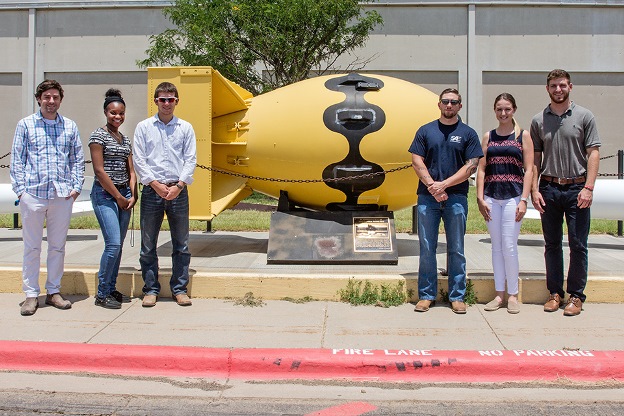
Pantex hosts summer interns (from left): Jeff Kaczmarek, Mikayla Sims, Colton Mooney, Daniel Hutton, Caitlin Bubel, and Jake Dreiling.
Ashley Stowe of Mission Engineering said the interns “are bright, hardworking and fun to interact with. They have accomplished a lot this summer. I am excited that we were able to host six interns at Pantex this summer and look forward to growing the CNS intern program further next summer.” (The six Pantex interns don’t include the two West Point cadets who also spent time at Pantex.)
CNS Student Interns Program Manager Rachel Winningham agreed. “Going forward, I would like to expand the program by providing co-op opportunities and having interns across more organizations.”
Whether they were a Pantexan or a Y-12er, one thing was certain: The interns return to college with a unique experience and the employees with whom they interacted take away something too.
Winningham said, “When you’re around the interns (even for a short timeframe), their energy rubs off on you. I want them to walk away from the internship with newly acquired skillsets, meaningful work assignments to put on their resume, and the opportunity to have networked with other interns and employees.”
Pantex, Tulane scientists test plastic polymers
Everyone loves that new car smell, as the saying goes, but do you know what causes it? The polymer materials used to build the car’s interior release volatile organic compounds, and the sun’s heat through the windshield is a stressor that increases this release.
Pantex uses polymers to render explosives stable and shapeable during the plastic bonded explosives (PBX) weapons assembly process. When weapons are returned from the stockpile, scientists evaluate the integrity of the explosives and research to determine the stressors (heat, moisture, acid, and radioactivity) that cause polymers in explosives to degrade or fail.
A two year collaboration between Pantex scientists and polymer experts from Tulane University produced a new and unique method of testing some of the polymers Pantex uses.
Pantex scientist Stephanie Steelman, the principal investigator on the project, approached researchers from the Tulane Center for Polymer Reaction Monitoring and Characterization (PolyRMC) after a course that introduced her to Simultaneous Multiple Sample Light Scattering (SMSLS) analysis.
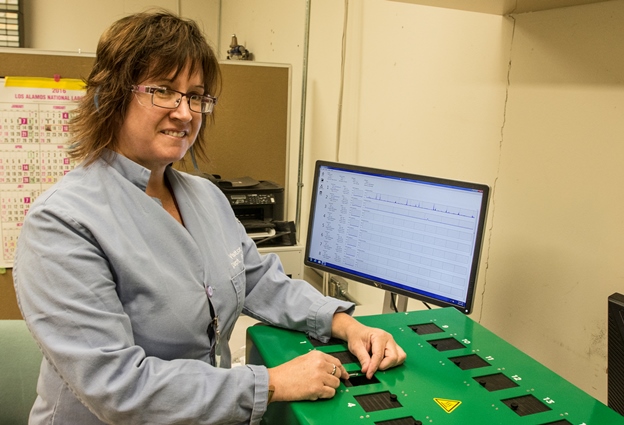
Pantex scientist Stephanie Steelman works with the SMSLS analysis instrument. Collaboration between Pantex and Tulane University developed a new method of analyzing polymers.
Steelman directs Pantex’s Gel Permeation Chromatography Lab (GPC). “GPC is used to monitor the molecular weight of the polymers in PBXs,” she said. “SMSLS allows us to determine which stressors cause polymers to degrade or fail on the molecular level when in solution, as well as determine when the polymers are in equilibrium for GPC testing.”
Steelman offered another car analogy to help explain the concept.
“The seats in a car eventually wear out. Wouldn’t it be nice to know when they’re going to wear out ahead of time? What would cause them to wear out? Then we’d know when to replace them,” she said.
When Steelman first learned about SMSLS, it was being used only in pharmaceutical and university settings. She thought it could be used at Pantex as well. The researchers at PolyRMC enthusiastically agreed and collaboration began in 2013, with funding from Plant Directed Research, Development, and Demonstration.
The SMSLS instrument takes light-scattering measurements at a rate of up to 10 data points per second to identify degradation of polymers in solution. The SMSLS data identified unique signatures for polymer degradation under temperature stressors. This information can be particularly useful in assessing performance of these polymers over time under different conditions and also build predictions about their stability over time at different temperatures.
“What I’m trying to do is build more quality into the process. SMSLS enhanced my ability to do my job, molecular weight analysis, in a much better fashion,” Steelman said. “If you don’t have the polymer in there doing its job, the explosive won’t do its job.”
After the collaboration project concluded in September 2015, the first commercial SMSLS instrument was located in the GPC Lab at Pantex. The device that scientists nicknamed “smi sls” (rhymes with missiles) bears serial no. 0001.
Alex W. Reed, associate director for Operations and Strategy at PolyRMC, said the roadmap for SMSLS initially did not include this type of polymer application.
“The collaboration with Pantex directly contributed to advancing the development and commercialization of the SMSLS technology,” Reed said. “The first SMSLS at Pantex also means that Pantex may provide some of the earliest new applications of value in the area of polymer stability and non-equilibrium processes.”
West Point cadets collaborate with Pantex
West Point. To hear or see the name, most people automatically think of honor and strength. It also makes sense that students of the U.S. Military Academy in New York would want to intern for a CNS site. This year, two West Point interns gained work experience at Pantex.
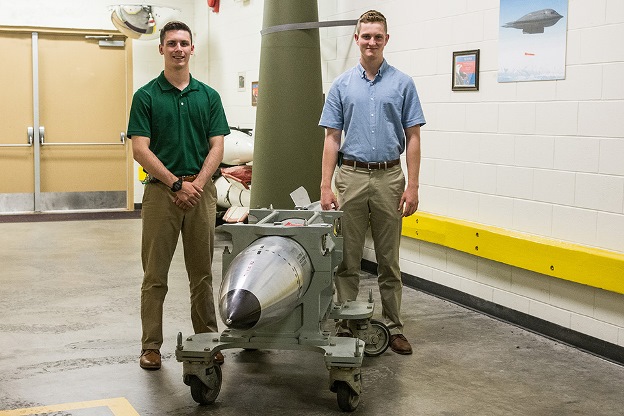
Michael Grieb (left) and Frederick Albion were Pantexans for a few months this summer as part of a Military Academy Collaboration.
“The West Point cadets we hosted, Michael Grieb and Frederick Albion, were part of a Military Academy Collaboration,” said Nate Davis of Pantex’s Engineering and Science. “Pantex typically hosts cadets as they have a nuclear engineering option in their program.”
While Davis is a first-time host to cadets, he came away with a sense of respect. “The ability of the cadets to go through military and engineering training concurrently gave me a renewed and strengthened appreciation for those who serve,” he said.
The Military Academy Collaboration’s purpose is to provide cadets “a first‑rate experience working cutting-edge research and development opportunities in disciplines and technologies of mutual interest to the Military/Service Academies, the Department of Defense, the Department of Homeland Security, the Department of Transportation, and to the NNSA [National Nuclear Security Administration].”
Ashley Stowe is Mission Engineering’s Intern Program lead. “It is always a privilege and honor to host West Point cadets. They bring a unique perspective to our work, and this internship allows cadets to see the manufacturing side of the nuclear arsenal.”
Davis said, “Having interns provides a great opportunity. It allows Pantex to show our customers how we work, and it’s also a potential recruitment tool.”
“This program gives us a great opportunity for collaborating with our customers in the DoD, and better allows them the chance to see firsthand the challenges Pantex faces in producing our product, as well as the chance to see our successes and technology advances,” Davis said.
Stowe said, “They are tomorrow’s leaders, and we provide a survey of our processes, procedures and overall role in the supply chain, so they are better equipped to make good decisions.”
The cadets were glad to be Pantexans for four weeks. Grieb said, “I think Pantex was a great experience. It certainly gave me an eye-opening to what future job opportunities could be in the nuclear enterprise.”
Albion was a fan too. “I’ve had a great time these past four weeks. It’s a great place to come to learn a whole lot.” More information about Military Academic Collaborations is available on the NNSA website.
Pantex supports emergency needs during train derailment
Brenda Vermillion, Carson County Emergency Management coordinator, said she first thought the June 28 head‑on collision between two BNSF trains was an incredibly loud test shot at the Pantex Plant, but she quickly realized the noise was located at the edge of Panhandle, Texas. “I immediately ran outside the building, and could see the cars toppling and then the explosion,” she said.
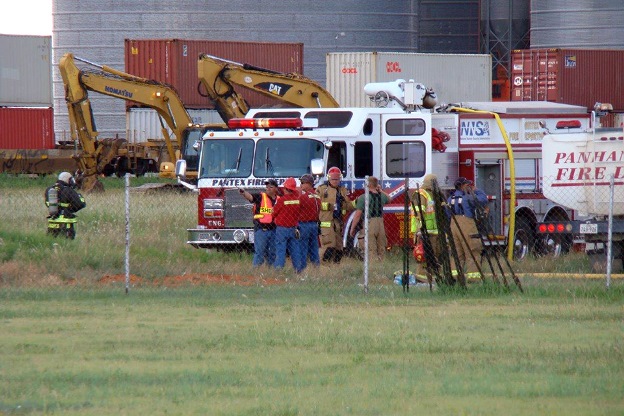
Several Pantex response vehicles that are a cross between a normal fire engine and an engine designed for a refinery fire respond to Panhandle train derailment. Photos taken by Shelly Zimmerman.
Vermillion went immediately to the dispatch office at the Carson County Law Enforcement Center. “We were already receiving 911 calls,” she said. “I told the dispatchers to call everyone and get everything you can.”
Pantex was one of the first calls. “The response from Pantex was fantastic,” Vermillion said.
Pantex dispatched one engine when the alarm sounded, said Mike Brock, Pantex fire chief. Fire department personnel then evaluated the situation and dispatched another truck as quickly as possible. The Pantex response vehicles are a cross between a normal engine found in a city like Amarillo and an engine designed for a refinery fire, Brock explained. Intended to be fed by a high‑pressure fire loop, Brock said the truck had water pumped to it so that it could blast hundreds of gallons a minute on the blaze. One truck, he said, was manned by Pantexans and ran continuously for about 48 hours.
Pantex has to maintain a level of readiness at all times. Brock said they called off‑shift personnel and set up a rotation schedule, which allowed firefighters to rest, clean up, eat and be ready to return if needed while maintaining the site’s requirements.
“Our guys operated flawlessly, and I could not be more proud of them,” said Brock.
Carson County Judge Dan Looten agreed, saying, “We stretched everyone to the limit, but Pantex ran very well while transferring people in and out.” Hundreds of first responders from across the Texas Panhandle were sent to the small town about 10 miles from Pantex.
Pantex also provided an Incident Command Vehicle that served as a command center on one side of the train. Looten explained the length of the trains made it difficult to quickly travel from one side to the other because the railroad crossings were blocked by rail cars. “We were managing two scenes — one on the north side and one on the south,” he said. Pantex’s ICV was vital to the response, he said.
Meanwhile, Vermillion, who was running the response from the county’s emergency operations center, received a call from Pantexan Chuck Rives, who was in the Pantex emergency operations center. Rives, a member of the Pantex Emergency Management Department and team lead for the Consequence Assessment Team, was able to work with Vermillion’s team to identify areas of concern in the trains’ manifests.
“Chuck was fantastic,” said Vermillion. “We couldn’t have done it without him. He stayed on the phone the entire time.” Rives quickly pointed to his co-workers — Brenda Graham, Sheryl Moran, Raj Sheth and Teri Vigil — who sorted through dozens of pages of the trains’ manifest to identify possible hazardous cargo, material properties and toxicity information. “Their work narrowed our focus to just a few dangerous cars so that I could quickly and accurately relay information to Brenda,” Rives said.
The team also provided smoke plume modeling working with the National Atmospheric Release Advisory Center. Knowing what the Panhandle winds were expected to do was vitally important, Vermillion and Looten said. Early in the day, portions of the town were evacuated because of smoke. If the winds changed, driving the fire farther down the train, other actions would be needed to keep the community safe.
Todd Ailes, Pantex site manager, praised the response efforts. He said, “This was a tragic accident that touched the lives of hundreds of our employees who live in Panhandle. Our concern was to help our neighbors in any way possible. Pantex Fire Department, Emergency Management and Communications & Public Affairs personnel worked diligently to provide any services needed by the town, and to provide accurate updates and safe route information to our employees who live in or travel through Panhandle.”
Brock conducted an after‑action review and identified some lessons, including improved interface between the agencies, different types of equipment that could be included on the trucks and the need for new communication equipment that will enable the Pantex team to hear and respond to the other teams.
“Unfortunately, when we get called to do what we are trained to do, it is someone else’s worst day,” said Brock.