News
Use Hwy 60 when traveling to or from Pantex Plant
Anyone traveling to or exiting from the plant towards Amarillo is encouraged to use Highway 60. The overpass at FM 2373 and I-40 is currently under construction.
The eastbound exit onto FM 2373 at I-40 will be closed for the duration of the project estimated to be completed by Friday, November 20. The westbound exit will remain open and the westbound entrance ramp will remain open until mid-August.
Pantex contractor CNS contributes more than $150k to local charities
Amarillo Area Foundation, United Way relief funds among recipients
AMARILLO- As the Covid-19 pandemic continues to impact the region, Consolidated Nuclear Security (CNS) and Pantex employees are reinvesting in their communities in a number of ways. CNS manages and operates the Pantex Plant for the U.S. Department of Energy’s National Nuclear Security Administration.
CNS recently donated $10,000 to the United Way of Amarillo & Canyon Emergency Relief Fund, and another $10,000 to Amarillo Area Foundation (AAF) Disaster Relief Fund. These contributions are in addition to earlier donations of $2,500 to the High Plains Food Bank and $2,500 to United Way of Amarillo & Canyon Emergency Relief Fund. Additionally, Pantex participated in the United Way of Amarillo & Canyon’s first-ever Virtual Telethon, which raised more than $80,000 for the COVID-19 Emergency Relief Fund.
“As a company, we are happy to partner with community organizations for the betterment of Amarillo and the Texas Panhandle—where our employees work, live, and give,” said Jason Bohne, CNS Senior Director of Communications. “During this stressful and difficult time, we feel it is even more important to take an active part in our communities and the welfare of residents across the area.”
CNS and Pantex employees are also continuing a five-year tradition of providing grants to nonprofit organizations in the Texas Panhandle through the CNS Pantex Community Investment Fund, in coordination with the Amarillo Area Foundation. An advisory committee of Pantex employees are determining distribution donations totaling $121,500. The committee prioritized the submissions from organizations located and operating in the 12 contiguous counties surrounding Pantex to fund basic needs, child and family development, education, community development, financial literacy, and health and wellness. To date, including the latest round of grants, CNS has donated more than $860,000 to area non-profit organizations since 2016 through the Amarillo Area Foundation. For this year’s grants, all applications have been received and funds are scheduled for distribution in June.
CNS also contributed $10,000 to the Big Brothers Big Sisters of the Texas Panhandle’s “Bowl for Kids’ Sake” fundraiser after this year’s event was cancelled.
Earlier this spring, Pantex sponsored and hosted the Department of Energy’s Regional Science Bowls for middle and high school students.
CNS also manages the Y-12 National Security Complex in Oak Ridge, Tennessee, and is supporting ongoing efforts to combat the COVID-19 outbreak in East Tennessee.
“Consolidated Nuclear Security, LLC operates the Pantex Plant and Y-12 National Security Complex in support of the National Nuclear Security Administration. CNS member companies include Bechtel National, Inc.; Leidos; ATK Launch Systems; and SOC LLC, with Booz Allen Hamilton, Inc. as a teaming subcontractor.”
Consolidated Nuclear Security, LLC (CNS) operates the Pantex Plant, located in Amarillo, Texas, and the Y-12 National Security Complex, located in Oak Ridge, Tennessee, under a single contract for the U.S. National Nuclear Security Administration. Pantex and Y-12 are key facilities in the U.S. Nuclear Security Enterprise, and CNS performs its work with a focus on the absolute priorities of safety, security, quality, mission delivery and cost efficiency.
For more information on each site, visit www.pantex.energy.gov or www.y12.doe.gov. Follow Pantex on Facebook, X or LinkedIn. Follow Y-12 on Facebook, X, and LinkedIn.
CONTACT
Steve Myers
Communications
Office (806) 573.0490
Stephen.Myers@pantex.doe.gov
The Mask Makers of CNS
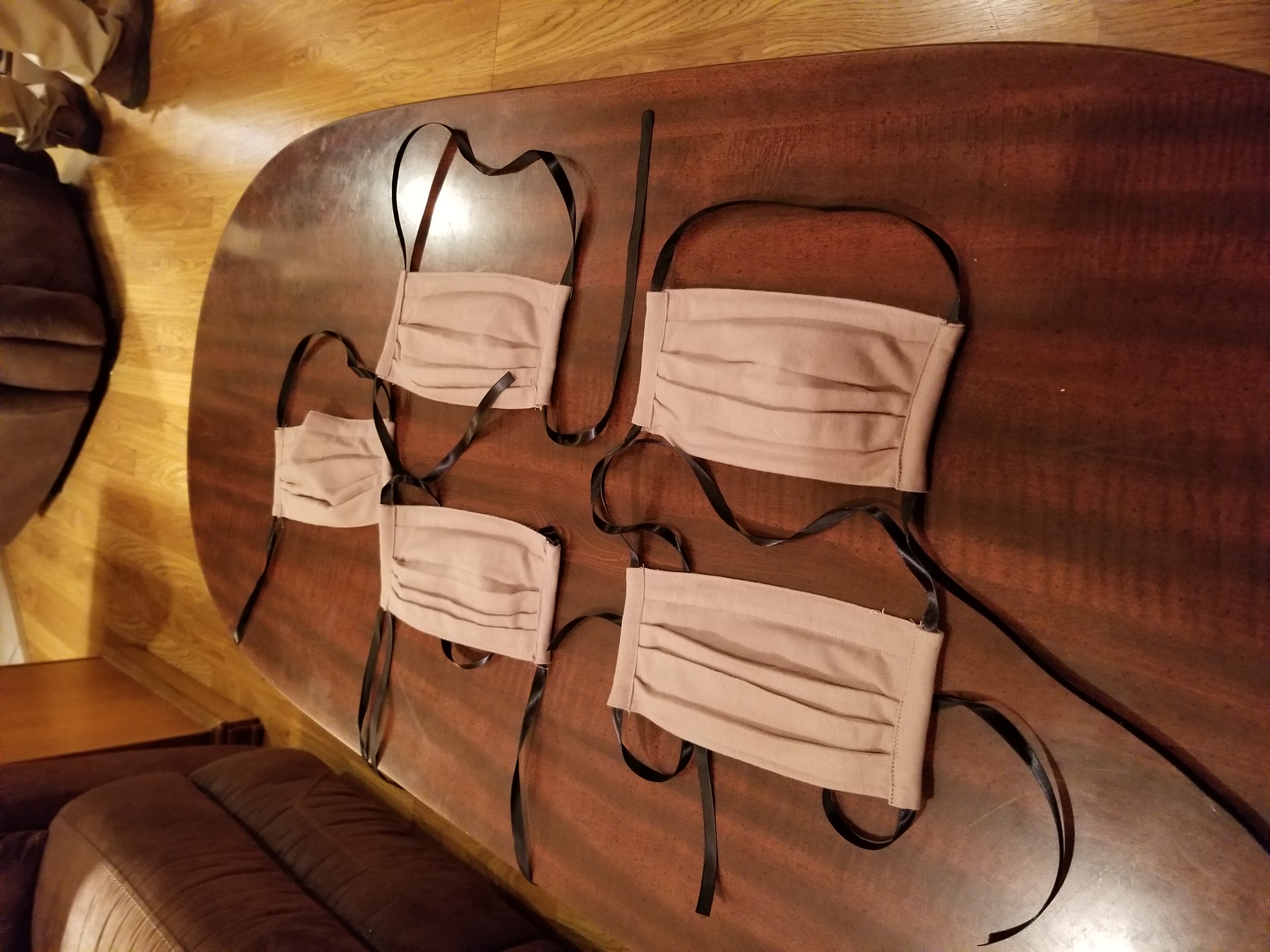
In response to the COVID-19 pandemic, many employees from both Y-12 and Pantex have become “mask makers” using their skills and talents behind a sewing machine to make masks for their friends,
neighbors and coworkers.

Pantexan Charlotte Thomas and her husband Brian Thomas |
Pantexan Charlotte Thomas has made more than 250 masks, along with the help of her husband Brian Thomas, Potter County Sheriff. He wanted to make sure his people working in the fields and those working in the jail had masks, but like everyone else they couldn’t order any. So Charlotte reached out to a friend from Sunday school who sews and asked for help. The friend directed Charlotte to a YouTube site with a 15-minute mask. On that first day they didn’t even complete one mask, but before the weekend was over they had finished 5 and by the next weekend they’d completed 25. Masks were distributed to their daughter who is an RN working in home health, River Road ISD, and others along with the Potter County Sheriff’s Office.
Charlotte said “Once the picture got out of Brian learning to sew – he had several people call and offer to make masks for him so he very graciously said thank you. And now it is not such a frantic chore to hurry up and finish them. But when you have a family that is comprised of a first responder, a nurse, and a teacher – you learn from the start to give back to the community – they work in those professions because they love serving and that is why we love them. So you help them in any way you can.”
Fellow Pantexan Lauri Minton has also been busy making masks for friends, family, and people in the medical field to wear over their N-95 masks. After her teleworking day ends and on weekends she has made more than 115 masks and a few surgical style hats for a neighbor who is a nurse practitioner in a local pediatric clinic.
Lauri said “I made some for the IS&S folks at Pantex who were issuing laptops and tokens so that many of us could telework; I think having the masks available helped ease their anxieties about exposure risks.”
Y-12er Jennifer Lawson has lost count of how many masks she and her sister have made, but estimate they’re up to around 100.
Jennifer said making masks is a way she can feel like she’s helping people during this scary time. “They at least have the protection of a mask, and in a fabric they chose,” she said. “I view it as a service
project and a way to pay forward all the blessings I have. I still have my job, and am able to work from the safety of my home. Also, lots of people don’t know how to sew, and sewing machines are scarce, along with elastic, fabric, and thread.”
Jennifer and her sister don’t accept payment for the masks they make, because she says the joy come from the giving.
“If people insisted, we asked them to find some way to help someone else or make a donation,” she said. “That way, we keep it going. Plus, people have been sending photos wearing the masks they picked out and seeing those just makes my week.”
Another Pantexan Terri Woodruff has also made masks for friends and coworkers. To date she has made between 150-175 masks and continues to make more as people request them.
Lauri also said “most of us are not doing this for the attention or for recognition – I am personally doing it because I feel called to do it (as a Christian). I have been blessed with MUCH, and ‘to whom much is given, much is expected.’”
We salute these and ALL of the “mask makers” of CNS for their contributions to their family, friends, coworkers, and our communities at large.

Check it out: Sheltering at home brings new hobbies
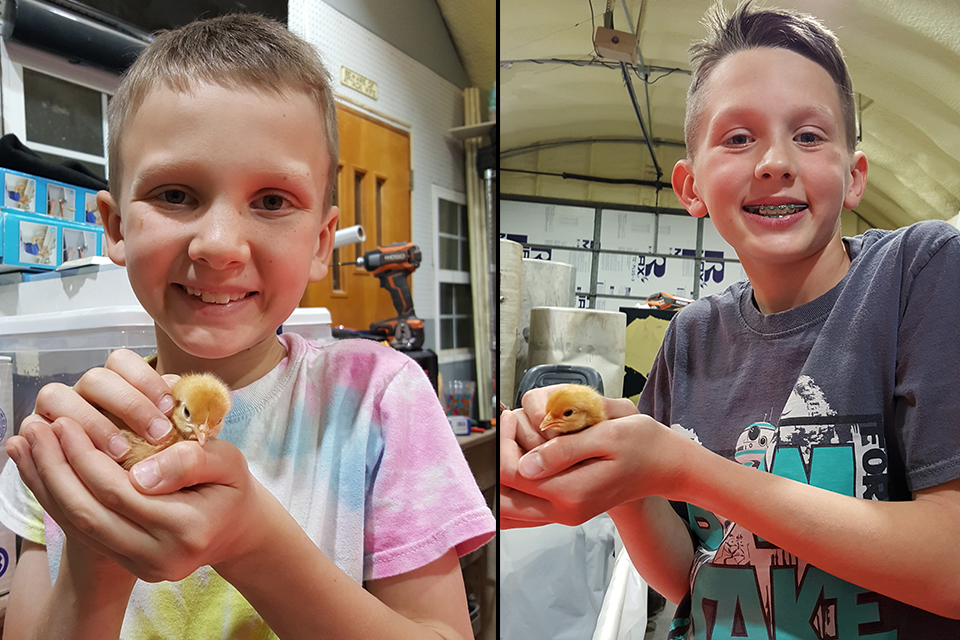
During their time sheltering at home, Pantexans Mandi and Jeremy Neusch, both of Mission Engineering, along with their elementary age sons have taken on home‑schooling in a super practical
way — they’re raising 38 chickens, started a garden, and their cat had kittens! They also planted 107 trees as a future wind break around their farm, and they’re doing all of this on top of teleworking each
day and the boys completing school work through distance learning. Mandi said, “Who says sheltering means you have to sit on the couch?"
Armed Forces Day
"As you go about your day, thank your colleagues, friends, and family who have taken an oath for America and you."
When President Harry Truman announced the creation of Armed Forces Day in 1949, he praised the work of the military services at home and across the seas. He said, "It is vital to the security of the nation and to the establishment of a desirable peace."
The world has changed dramatically since then, and so have our threats and adversaries. As we all navigate the current, unprecedented time of COVID-19, the impact it's had on our daily lives and the uncertainty it brings, I have found it easy to become sidetracked. It's easy to be so focused on what's changing that we forget some things have remained constant. Our armed forces are still working each day to secure our great nation and to establish a desirable peace. As we approach this third Saturday in May, Armed Forces Day, I want to be sure we remember and recognize those who have served and are currently serving.
I am honored to be a part of this group as a former U.S. Navy submarine officer. My time in the U.S. Navy was a rich and rewarding experience, educating me on nuclear technology, providing me rigorous training of shipboard operations, and developing me as a professional and a leader. My experience instilled in me a strong sense of mission that was supported by a value-based culture.
Integrity, trust, teamwork, respect, and excellence were constantly reinforced and grounded in my actions, behaviors, and decisions.
With these same values providing the foundation for our work at Pantex and Y-12, and with the nuclear deterrent as the core of U.S. national security posture, it's not surprising that so many of our colleagues are former or current members of the armed forces. Our values are strong, our purpose is clear, and our mission is significant!
As you go about your day, thank your colleagues, friends, and family who have taken an oath for America and you. Let them know you appreciate the sacrifices they or their children have made or continue to make every day. For without them, America would not, could not, be the symbol of freedom and liberty around the world that it is today.
Elmer Davis, news broadcaster and director of the U.S. Office of War Information during World War II, said, "This nation will remain the land of the free only so long as it is the home of the brave." May we all remember his sentiment and appreciate those brave men and women who join our armed forces.
Ted Sherry
Vice President, Performance Excellence
Pantex Reaches Milestone with W88 Alt 370
AMARILLO, Texas-- Pantex, operated by Consolidated Nuclear Security, has announced the successful assembly of the W88 Alt 370 First Production Capability Unit (FPCU).
W88 nuclear warhead, designed by the Los Alamos and Sandia National Laboratories, entered the stockpile in late 1988 and is deployed on the Navy’s Trident II D5 Submarine-Launched Ballistic Missile (SLBM) system on Ohio-class ballistic missile submarines. The W88 Alteration (Alt) 370 program includes numerous updates to address aging, enhance nuclear safety, and support future life extension program options.
The FPCU, an important milestone, allows Pantex staff to exercise processes to ensure readiness for rate production. This achievement was accomplished ahead of schedule through outstanding teamwork from Los Alamos National Laboratory, Sandia National Laboratory, Kansas City Nuclear Security Campus, and Consolidated Nuclear Security.
“Reaching this milestone required tremendous effort from Pantex employees at all levels, collaboration from thousands of workers at NSE sites across the country, and a close working relationship with the National Nuclear Security Administration (NNSA),” Pantex site manager Todd Ailes remarked. “The success of this program has required high standards of safety, security, and quality from all involved. I commend everyone involved for their contributions.”
The W88 Alt 370 team will incorporate these results and will exercise this process again prior to the start of the First Production Unit. NNSA is prepared to ramp up productions operations in support of the warhead program.
Consolidated Nuclear Security, LLC (CNS) operates the Pantex Plant, located in Amarillo, Texas, and the Y-12 National Security Complex, located in Oak Ridge, Tennessee, under a single contract for the U.S. National Nuclear Security Administration. Pantex and Y-12 are key facilities in the U.S. Nuclear Security Enterprise, and CNS performs its work with a focus on the absolute priorities of safety, security, quality, mission delivery and cost efficiency.
For more information on each site, visit www.pantex.energy.gov or www.y12.doe.gov. Follow Pantex on Facebook, X or LinkedIn. Follow Y-12 on Facebook, X, and LinkedIn.
CONTACT
Steve Myers
Communications
Office (806) 573.0490
Stephen.Myers@pantex.doe.gov
Pantex 10-mile Emergency Planning Zones updated
AMARILLO, Texas – Pantex works closely with area partners to prepare the public for the unlikely incident of an emergency at Pantex. Part of that preparation involves educating and communicating with residents living within 10 miles of Pantex – in what are called the Pantex 10-mile Emergency Planning Zones (EPZ).
A newly designed Pantex 10-mile EPZ went into effect January 1. The EPZ has changed from a pie grid shaped map to a zone system that is aligned with county roads and county borders.
“We have revised our emergency planning zone map to make it easier for people who might need to use it and take protective actions, or people who might need to make protective action decisions to identify where that needs to happen,” Chuck Rives, Pantex Emergency Management Senior Specialist said.
The earlier EPZ map was designed in pie-shaped wedges that didn’t align to anything that could be seen on the ground.
“While the old map was functional in a lot of ways, it made it really difficult in emergency management to do road closures, to have first responders know exactly where to go, and also for the residents to know what part of the pie they were in,” Carson County Judge Dan Looten said.
The updated EPZ is broken down into sectors – C, P and A sectors – which stand for Carson County, Potter County, or Armstrong County.
“If you're in C5 you'll know exactly you're in Carson County Zone 5, where beforehand you didn't know exactly the way the pies spread out in a pie shape - it would cross quite a few county lines and cross quite a few county roads,” Judge Looten said.
This updated map is easier for those living within the zones to understand which zone they reside in, and the new EPZ is more concrete by using existing roadways and county lines to separate the zones.
“The biggest benefit of this change is the understandability of the map. Someone can look at where they are on the ground compared to the map and say ‘I'm north or south of this road or east or west of that road’ and that corresponds to one of the sectors of the map,” Rives said. “If we tell Carson 3 to take a protective action, you can look at the map and see it's bounded by these roads and you know you're in or out of there.”
Residents living within the 10-mile EPZ will be receiving a new calendar from the Texas Division of Emergency Management with the new EPZ map included along with other information for residents to
use in case of an emergency at Pantex. The calendars include contact information for all of the Agreement In Principal (AIP) Emergency Management offices, what Shelter in Place means, how to pack a go bag, emergency classification levels, and more.
“I hope the public, especially those in this area, will really educate themselves, will try to use this new calendar and use this new map to educate themselves where they're at and things to look for in case there is any kind of emergency in the area,” Looten said.
A group of stakeholders called the (AIP) with representatives from state agencies, regional partners, bordering counties and Pantex have worked over the last several months to design the EPZ.
“This map came about not because we think there was a problem – we’re just improving what we already have. I think, especially from county judges’ point of view and from emergency responders, this gets us all on the same page,” Looten said. “We all know exactly how the new map reads. We'll all be able to know exactly what road closures we’re going to set up. Because, in the first few minutes to a first few hours of an emergency, that's a very critical time. We don't need to be second-guessing so we want to be for sure everybody's on the same page.”
Members of this group will be working to update the public on the new zone through town hall meetings and other initiatives in the coming weeks.
Consolidated Nuclear Security, LLC (CNS) operates the Pantex Plant, located in Amarillo, Texas, and the Y-12 National Security Complex, located in Oak Ridge, Tennessee, under a single contract for the U.S. National Nuclear Security Administration. Pantex and Y-12 are key facilities in the U.S. Nuclear Security Enterprise, and CNS performs its work with a focus on the absolute priorities of safety, security, quality, mission delivery and cost efficiency.
For more information on each site, visit www.pantex.energy.gov or www.y12.doe.gov. Follow Pantex on Facebook, X or LinkedIn. Follow Y-12 on Facebook, X, and LinkedIn.
CONTACT
Ashlee Estlack
Communications
Office (806) 573.0503
Ashlee.Estlack@pantex.doe.gov
Pantex, Y-12 Teams Recognized by NNSA Defense Programs
AMARILLO, Texas – Thirteen Consolidated Nuclear Security project teams representing more than 570 employees were recognized recently by the National Nuclear Security Administration for their work supporting the national security missions of the Pantex Plant and Y-12 National Security Complex.
In presentations at Pantex and Y-12, the teams were each recognized with a 2018 NNSA Defense Programs Award of Excellence. The awards were established in 1982 to recognize individual and team accomplishments from across the nuclear weapons complex in support of NNSA’s nuclear weapons program.
Four of the teams were based at Pantex, and nine were based at Y-12.
“It’s really important that we get out, and we see the work this complex can do. Here at Pantex, it’s nothing short of amazing,” NNSA Acting Assistant Deputy Administrator for Stockpile Management John Evans told employees at Pantex. “That plaque on the wall that all roads come to Pantex, that’s true. The important thing though is the capabilities that are embodied in you all allow for the weapons to go out of Pantex. Without your expertise and dedication and devotion to your jobs, those weapons don’t go out of Pantex. They don’t come back for repairs, and they don’t leave in a way that they can be part of the deterrent.”
NNSA Assistant Deputy Administrator for Stockpile Management Dr. Mark Suriano congratulated Y-12 employees in a similar ceremony at Y-12.
“Dr. [Charles] Verdon and the Defense Programs leadership understand the value and impact from all of the personnel at Y-12 as you execute our national security mission. We know the teams we recognize today are representative of the quality, productivity, innovation, and commitment to excellence. Going through the accomplishments of your award winners is awe inspiring. The innovation and forward thinking has helped the Nuclear Security Enterprise to be better postured for the current modernization of our entire stockpile.”
The projects recognized are listed below:
Pantex
- B61-12 Pit Requalification First Production Unit
- CoLOSSIS II Startup
- Joint NA-10/NA-22 Warhead Measurement Campaign: B61, B83, W76 Measurements
- Quality Evaluation Requirements Tracking System Record of Assembly Verification
Y-12
- Enriched Uranium Strategic Material Model Deployment
- Environmental Room Control Upgrades
- Modulated Tool Path Development & Integration
- Down-Blend Offering for Tritium Program Development
- B61-12 CSA FPU Early Delivery
- 50 + 10 Study
- B83 Dismantlement Equipment Maintenance and Schedule Recovery
- Deployment of Production Capabilities
- Lithium Chemical Specification Change
Consolidated Nuclear Security, LLC (CNS) operates the Pantex Plant, located in Amarillo, Texas, and the Y-12 National Security Complex, located in Oak Ridge, Tennessee, under a single contract for the U.S. National Nuclear Security Administration. Pantex and Y-12 are key facilities in the U.S. Nuclear Security Enterprise, and CNS performs its work with a focus on the absolute priorities of safety, security, quality, mission delivery and cost efficiency.
For more information on each site, visit www.pantex.energy.gov or www.y12.doe.gov. Follow Pantex on Facebook, X or LinkedIn. Follow Y-12 on Facebook, X, and LinkedIn.
CONTACT
Ashlee Estlack
Communications
Office (806) 573.0503
Ashlee.Estlack@pantex.doe.gov
Pantex presents check to Step Up to Success
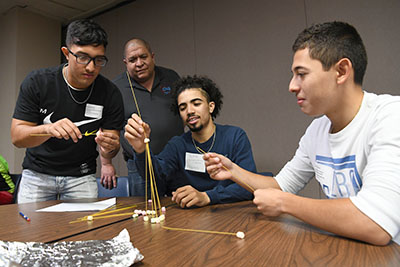
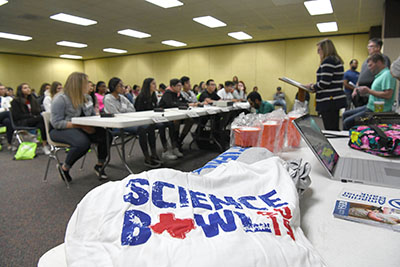
On November 6, nearly 600 middle and high school students from schools around Region 16 Education Service Center came to the bi-annual Step Up to Success conference, hosted by Los Barrios de Amarillo, to learn about various occupations within different career fields. The Pantex booth had representatives from various occupations including protective force, engineering, and project management. Dominic Cortez ran a hands-on engineering workshop where the students had to build structures with marshmallows and pasta materials. Pantex also put on a mock Science Bowl competition for the students to test their knowledge.
Los Barrios de Amarillo focuses on the importance of higher education and ties a mentorship program to its scholarships, giving the chance for the students to continue learning from adults even as they pursue higher education.
At the event, Pantex presented $1,000 to the organization to put toward its scholarship fund.


Pantex donates to WOWW Science Collaborative
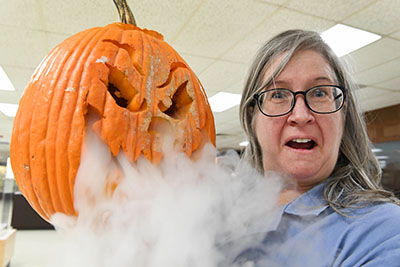
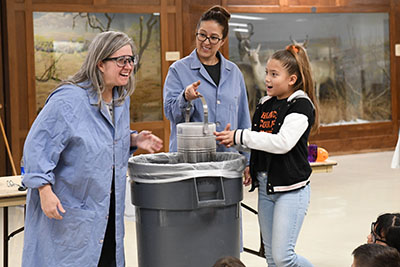
Pantexans Stephanie Steelman, Bruce Phebus, and Berenice Pitre presented science excitement and education during the Window on a Wider World (WOWW) science collaborative this month.
This event is being held throughout the month of November at the Panhandle Plains Historical Museum in Canyon. The collaborative is an opportunity for fifth graders from the area to learn more about science and STEM (science, technology, engineering, and mathematics) careers in a hands-on way from scientists working at Pantex, Bell Helicopter and other companies.
Pantex presented $5,000 to Window On a Wider World on November 11 to support the ongoing WOWW Science Collaborative efforts.