



News
A STEM tradition continues
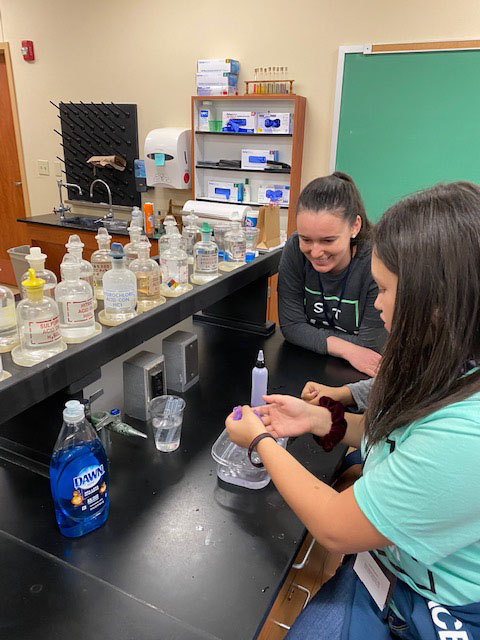
A more than 30-year tradition continued recently as Amarillo Women in Science Endeavors (WISE) offered sixth-, seventh-, and eighth- grade girls a chance to experience science, technology, engineering, and math (STEM) at a fun, hands-on conference. WISE hosted approximately 300 middle school girls from around the Texas Panhandle for workshops led by women in STEM fields.
Thanks to sponsorships from companies like CNS, attendees received breakfast, lunch, a goodie bag, and participated in three sessions with titles like Surgical Hospital, Bugs are for Girls, Rubber Band Helicopters, and We Be-Lung Together.
Stephanie Steelman, Pantex polymer chemist, led a session called Polymers All Around You to show the girls everyday uses of polymers.
“WISE helps the girls see that science is not hard, and it can be fun in a lot of situations,” said Steelman. “Opening that mental block that they’re not going to be good enough is what we have to overcome. We want to be here to tell all of them that they are good enough to do anything that they put their mind to.”
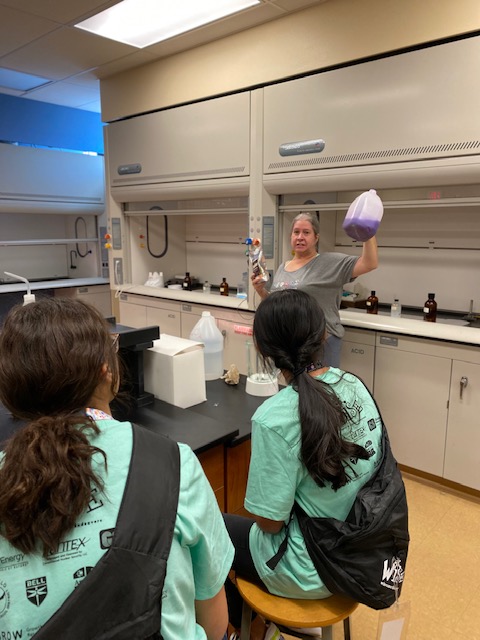
Nicole Kaufman, Pantex analytical chemistry specialist, agreed that girls having exposure to STEM at a young age shows them that they have the ability to be successful in the fields.
“I see myself in these girls,” said Kaufman. “Sometimes you get that imposter syndrome, so to have someone tell you at a young age that you can do something is really important.”
After taking a year off due to COVID-19 restrictions, the WISE committee was excited to be back with a record number of registrations.
“We had an overwhelmingly positive response to the event this year,” said Allison Roberts, WISE committee member and Pantex Communications specialist. “Our goal is to encourage as many future scientists, engineers, mathematicians, and technology professionals as possible through this annual conference and our scholarship program.”
According to the U.S. Census Bureau, women make up nearly half of the workforce, but only about 27% of STEM workers.
“We are still lacking women in those fields, and women have the capability of thinking in a different way than men,” said Steelman. “We need that diversity in our workforce.”
Skills training keeps PXFD on track
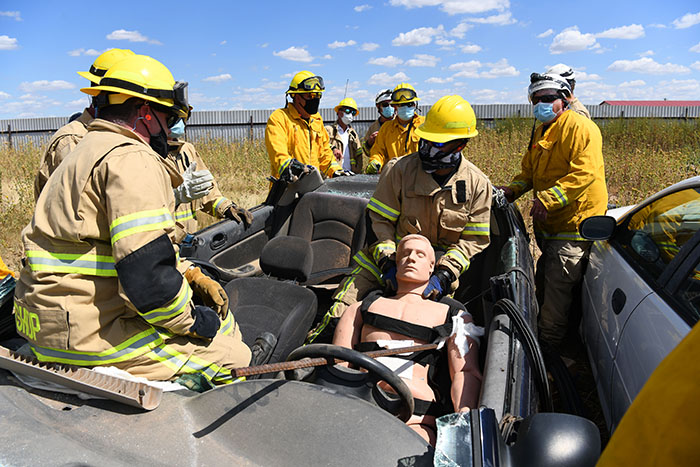
Every second counts when someone is trapped in a vehicle, and the Pantex Fire Department trains to be prepared to respond to accidents at a moment’s notice.
Pantex Fire Department participates in extrication training annually to give firefighters an opportunity to learn new techniques they will use in real life situations and train with equipment. While extrication equipment is used several times a year by the Pantex Fire Department on the highways and roads that surround the plant, these trainings allow them to get experience with equipment not used every day.
“The new techniques are necessary because of the constant improvements in vehicle construction and engineering,” Jeremy Baker, Pantex Fire Department captain, said. “These changes improve the safety of occupants, but make extrication more challenging for firefighters. We design our scenarios to challenge firefighters, providing them with opportunities to utilize critical decision-making strategies that are required in real life situations.”
From time to time, Pantex also partners with neighboring fire departments for trainings.
“We’ve trained with Claude and Washburn fire departments, which are mutual aid partners,” Baker said. “By working with these departments, it allows us to work together as one cohesive group on actual emergency scenes.”
During their most recent training, firefighters were instructed on numerous scenarios that allowed them to use their critical thinking, knowledge, and expertise to remove victims involved in difficult extractions that would challenge even the most experienced firefighters. The scenarios covered the use of new stabilization equipment, medical knowledge, lifting vehicles, and extrication techniques.
NNSA Release: Pantex Deploys System to Counter Unauthorized Unmanned Aircraft Systems
Pantex is an FAA designated "No Drone Zone"
AMARILLO, Texas -- The Pantex Plant has deployed a system to counter all unauthorized unmanned aircraft systems (UAS), or drones, over Pantex airspace, which is a Federal Aviation Administration (FAA) designated “No Drone Zone.” FAA regulations on UAS and counter UAS measures can be found by click here.
“The National Nuclear Security Administration Production Office (NPO) is announcing this deployment and the airspace restriction to the public to minimize the threat of unauthorized UAS flights over Pantex,” said Teresa Robbins, NPO Manager. “This will enhance our ability to effectively protect this vital national security facility.”
The Pantex system is intended to detect, identify, and track potentially malicious UAS threats. The 2017 National Defense Authorization Act provides the legal authority from Congress for the National Nuclear Security Administration (NNSA) to protect its facilities for its counter UAS program.
UAS operators who violate the airspace restrictions at Pantex may also be subject to enforcement action, including potential civil penalties and criminal charges. NNSA and contractor officials are working closely with federal, state, and local law enforcement to coordinate necessary enforcement actions. Advertisements and social media messages will also be issued to remind the public of these restrictions.
NNSA welcomes assistance from the local community and UAS operators to help ensure the safety and protection of the Pantex Plant and its personnel from unauthorized UAS activities. NNSA will educate the public about the “No Drone Zone.” Education efforts will include installing signage around the Pantex site perimeter advising the public of the site boundary where drones are not allowed, as well as outreach to local officials and community groups, the media and UAS hobbyists.
NPO is responsible for ensuring the safe, secure, and effective operation of Pantex Plant and the Y-12 National Security Complex, Oak Ridge, Tennessee.
Established by Congress in 2000, NNSA is a semi-autonomous agency within the U.S. Department of Energy responsible for enhancing national security through the military application of nuclear science. NNSA maintains and enhances the safety, security, and effectiveness of the U.S. nuclear weapons stockpile; works to reduce the global danger from weapons of mass destruction; provides the U.S. Navy with safe and militarily effective nuclear propulsion; and responds to nuclear and radiological emergencies in the U.S. and abroad.
Pantex, Y-12 celebrate innovative tech accomplishments

Inventions and patents recognized
Amarillo, Texas— Consolidated Nuclear Security recently celebrated innovations at Pantex and Y-12 during fiscal year 2021. Personnel behind nine inventions and five patents were recognized in a combined virtual ceremony.
Speaking to the attendees, Chief Operating Officer Bill Tindal challenged the inventors to develop a vision for leveraging transformative technology solutions to advance the National Security Enterprise. He noted, “Modeling of production processes helps us make decisions and determine how technologies can be applied by enabling understanding of the inherent complexity.”
Pantex Site Manager Jeff Yarbrough remarked on the necessity of innovation to support the increasing workload. He said, “We’re trying to replace a lot of sunsetting technology at Pantex, and we need to do that faster with innovators’ help.”
Nine inventions disclosed
Y-12 employees filed eight invention disclosures during FY 2021, ranging from environmental and electrical load controllers, to diagnostic tools, sensors and unique material processes. Among those recognized were Eric Spurgeon, Justin Holland, Rachel Bachorek, Robert Cole, Ed Ripley and Jacob Miller. At Pantex, Stephen Jones and Brian Harlow filed an invention disclosure for laser pulse shaping for a laser-powered bed fusion printer.
Five patents awarded
Y-12 employees were also awarded five patents in FY 2021:
- Toughened, Corrosion- and Wear-Resistant Composite Structures and Fabrication Methods Thereof by inventors Roland Seals (retired), Ed Ripley, and Rusty Hallman;
- Titanium-Group Nano-Whiskers and Method of Production by inventors Roland Seals of Y-12 and Paul Menchhofer and James Kiggans, Jr, of Oak Ridge National Laboratory;
- Ceramic Radiation Detector Device and Method, by inventors Jeff Preston and Ashley Stowe;
- Additive Manufacturing of Mixed-Metal Parts Using Sol-Gel Feed Materials by inventors Vincent Lamberti, Roland Seals, and Patrick Moehlen; and
- Fail-Safe Reactivity Compensation for a Nuclear Reactor by inventors Peter Angelo of Y-12 and Erik Nygaard and Scott Aase of BWXT.
A new addition to the event this year was a leadership roundtable, which engaged members of the executive leadership team in an open discussion to share their vision for innovation and inspire creative thinking for some of the most pressing and challenging problems facing national security.
Support enables success
None of these achievements would be possible without substantial support. In that vein, Ed Ripley of Y-12 and Jeff Yokum of Pantex were honored with Technology Transfer Support Awards for their significant support of the tech transfer program at their respective sites. The award recognizes employees whose efforts go above and beyond the call of duty in contributing to technology promotion and licensing.
Ripley has a long history with tech transfer, including more than 30 patents. “Ed is a thought leader, innovator, and champion for the CNS Technology Transfer Program,” said Jennifer Palmer, CNS Technology Transfer Program manager. “He’s also fostered key technology partnerships and enabled exploration of new opportunities in critical areas.”
Yokum also encourages new innovations for technology development and advancement. “Jeff is an advocate for technology innovation in high explosives manufacturing, and he worked with a machine tool company to custom design a computer numerically controlled five-axis mill-lathe machining center,” said Palmer.
Technology innovation benefits taxpayers, workforce
Y-12 Site Manager Gene Sievers closed the ceremony by thanking the group for their commitment to innovation. “Technology provides better products, better processes, and a safer work environment,” he said. “Your efforts benefit taxpayers, the workforce of today, and the workforce of tomorrow by making our work better, easier, and safer.”
Consolidated Nuclear Security manages and operates the Pantex Plant in Amarillo, Texas, and the Y-12 National Security Complex in Oak Ridge, Tennessee. A central Technology Transfer Office manages the commercialization and partnership efforts for both sites.
Consolidated Nuclear Security, LLC operates the Pantex Plant, located in Amarillo, Texas, and the Y-12 National Security Complex, located in Oak Ridge, Tennessee, under a single contract for the U.S. National Nuclear Security Administration. CNS member companies include Bechtel National, Inc.; Leidos, Inc.; ATK Launch Systems, Inc.; and SOC LLC. Pantex and Y-12 are key facilities in the U.S. Nuclear Security Enterprise, and CNS performs its work with a focus on performance excellence and the imperatives of safety, security, zero defects and delivery as promised.
For more information on each site, visit www.pantex.energy.gov or www.y12.doe.gov. Follow Pantex on Facebook, X or LinkedIn. Follow Y-12 on Facebook, X, and LinkedIn.
CONTACT
Steve Myers
Communications
Office (806) 573.0490
Cell (806) 236.2826
Stephen.Myers@pantex.doe.gov
Meet our physical therapists
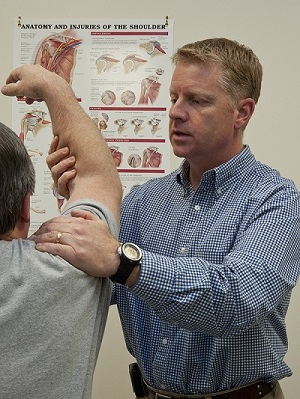
Shoulders are common problem spots for physical therapy patients. Y-12 physical therapist Gary Hall examines the arm of a client.
Not many employers offer on-site physical therapy, so let’s meet the LiveWise physical therapists and physical therapist assistants who help improve the health of Pantexans and Y-12ers.
For Y-12 physical therapist Gary Hall, sitting for long periods should come with a Surgeon General’s warning.
“Sitting is the new smoking,” he said.
The American Physical Therapy Association acknowledges people’s sedentary tendencies. The organization focuses on the importance of physical activity and how physical therapy helps people to move.
According to the organization, inadequate physical activity adds $117 billion annually in health care costs in the United States and results in reduced quality of life for millions of Americans.
“We are more sedentary than we have been,” said Pantex physical therapist Cody McClary. “We’re not getting out as much. We’re not walking with the dog or the family. We’re not exercising the ways we should. Exercise helps our muscles stay strong and loose.”
One reason for the reduced activity is the COVID-19 pandemic. It has changed how people live, which includes how they work. Like many companies across the country, teleworking from home has become the norm at Pantex and Y-12. This means many hours sitting at a desk, kitchen counter, or dining room table, staring at a computer screen. Or in Hall’s case, on the couch.
“One day I was at home teleworking,” he recalled. “I’ve got my laptop, knees hunched up. My wife walked in and said, ‘It’s a good thing no one can see you right now.’ To say the least, I was not at optimal positioning.”
Slumped shoulders while seated for work is an example of improper positioning.
“When you sit at the computer, the head naturally migrates towards the monitor,” Hall explained, “which causes the shoulders to round over. You have to pull your shoulders back. This will help strengthen the muscles between the shoulder blades.”
Rounded shoulders can cause back issues, neck pain, and rotator cuff problems.
“More Pantexans ask about their wrists and hands,” McClary said. “They are feeling numbness and tingling, pain in the wrist. It’s because of bad ergonomics.”
To help alleviate discomfort from extended sitting, the prescription is to simply move.
“Take as many breaks as you can,” McClary suggested, “This will help get the blood flowing.”
He also recommended stretching to help relieve the body. For the hands, McClary likes to use stress putty, while making a fist, then extending the fingers. Also rubber bands can be placed around fingers to create resistance, strengthening them.
For the shoulders and back, McClary advocates the “field goal” stretch, where the hands are placed on each side of a doorway, while slightly shifting the weight forward. Also helpful are big and small shoulder circles, forward and back.
In addition to helping people deal with teleworking aches and pains, the physical therapists are helping with those recovering from COVID-19.
“Many are COVID long haulers,” Hall said. “The main problem is deconditioning. They find out they are unable to do certain activities when they try to go back to their normal work routines. Everything doesn’t return at the same rate. There’s weakness in the trunk and spine. They’ve lost strength in the peripheral muscles in the arms and legs. Some have lost the ability to maintain a posture to even type.”
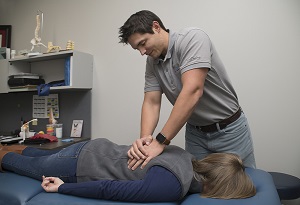
Pantex physical therapist Cody McClary applies pressure to a patient’s back to help alleviate discomfort.
McClary added, “The heart and lungs were so stressed [during the bout with the virus], walking from the parking lot is extremely difficult. I’m sure we’re going to see more and more patients with these issues.”
Also, the therapists may experience a surge in seasonal patients.
“Fall is big for physical therapy clinics,” Hall said. “People are very task focused doing yardwork, like raking and bagging leaves, and they think ‘I have this entire yard of leaves; I need to take care of it today.’ A lot of times they don’t use the proper mechanics and may not have the proper core strength, which causes them to strain something and overuse muscles.”
McClary added, “Core strength is the most important aspect of your body. The core is the first group of muscles activated when you do anything. It really needs to be the strongest muscle group. A strong core protects the discs and the nerve structures around those discs in the back and can prevent injuries.”
In addition to tackling ailments due to teleworking, COVID-19, and weekend activities, the physical therapists treat post surgical patients who have undergone such procedures as knee and hip replacements, carpal tunnel surgery, heart surgery, and more.
“It can take six months to a year to recover from a surgery,” McClary said. “That could include three or four months of therapy, maybe even six months.”
Physical therapy is a free service for employees at both sites. However, a medical referral is required to receive treatment. All physical therapy evaluations and appointments must be on the employee’s own time.
“Working with people is very cool,” Hall said. “It’s really gratifying when you can help patients achieve their best.”
NNSA Release: Pantexans support Egg Drop competition
Fifteen Pantexans volunteered as judges at the Texas Alliance for Minorities in Engineering’s 6th Annual Egg Drop Competition this past November. Held at Amarillo’s Don Harrington Discovery Center, the competition required students in grades 5–12 to design and construct an Egg Drop Mechanism to release from a height of 20 feet, testing their engineering, math, and physics skills with a fun, real-world application.
Consolidated Nuclear Security is committed to STEM education and the Egg Drop Competition is a fun and engaging way to reach students around the area.
Read the full press release on the NNSA website.
Meet our Sandia Weapon Intern Program Class of 2022 selections

Pantexan Edward Graef and Y-12 Matthew Willard (not pictured) are part of the Sandia Weapon Intern Program, Class of 2022.
Two CNS employees are joining the ranks of the prestigious Sandia Weapon Intern Program (WIP) for the class of 2022. Edward Graef, Pantex physics senior specialist, and Matthew Willard, Y-12 process engineer, began the program in August 2021.
Both Graef and Willard are looking forward to the program, saying it is considered by many within the Nuclear Security Enterprise (NSE) to be a “once in a career” opportunity.
“I have had the opportunity to meet and work with so many other capable people at Pantex that it was humbling to know I was selected from among them for this opportunity,” said Graef.
“I was both humbled and excited about the opportunity,” said Willard. “It also comes with the realization that I am a representative of all of us here at Y-12.”
WIP was created by Sandia National Laboratories as a formal mechanism to pass decades of tribal knowledge down to the next generation of scientists, engineers, and leaders. The year-long program begins with classroom work and learning in the first six months, along with site visits, and research assignments. During the final months, participants are embedded in various organizations across Sandia to work on specific projects.
Both CNS participants are looking forward to learning from and working with other WIP interns and mentors from across the abbr title="Nuclear Security Enterprise">NSE.
“The collaborations will further expand my technical and leadership capabilities to better address our stewardship missions,” said Graef.
“One topic that I look forward to learning the most is about the lifecycle of the weapon systems,” said Willard. “Specifically, how DoD requirements turn into designs, those designs eventually become physical systems, and how those physical systems are assessed and certified throughout their lifetime so that they will function as intended if ever needed to.”
Over the course of the program, the interns will learn skills and knowledge that they’ll be able to bring back to their teams at Pantex and Y-12.
“I want to bring back a more refined set of communication skills and a better understanding of the abbr title="Nuclear Security Enterprise">NSE's needs for our evolving role in stockpile stewardship and safety,” said Graef. “For Pantex as a whole, I want to bring back clearer goals to advance our modeling and simulation based engineering approaches to help address plant needs while also improving the safety and security of our workforce and the stockpile.”
Willard looks forward to the benefits of knowledge and professional relationships he will build. “Increased knowledge helps in understanding the ’why‘ when we may be asked to do things a certain way, that may be different from what we are used being asked to by our customers, and those relationships provide lines of communication throughout the NSE as we all continue our careers.”
Congratulations to Graef and Willard on their internships.
Pantex Team Nails Down NNSA Award

The Pantex Roof Asset Management Program team showcases their 2021 award. Pictured, L to R: RAMP Program Manager Denise King, Project Manager Janet Dockery, Project Engineer Kerry Bender, and Subcontractor Technical Representative Linda Bernal.
Everyone working on a national security site wants to prevent leaks. Texas weather makes that harder for the Pantex Roof Asset Management Program (RAMP) team responsible for managing 2.9 million square feet of roofing across the plant. Aging infrastructure adds to the team’s challenge.
“Every time we get a good snow or rain,” said Pantex RAMP Project Engineer Kerry Bender, “I end up with about 30 emails in my inbox saying, ‘Hey, my roof is leaking.’”
Coordinating access, materials, subcontractors, and security personnel to address thousands of square miles of roofing across a secure site requires precise coordination. Any miscommunication, no matter how minor, can delay a project for weeks. Pantex RAMP Program Manager Denise King said regular delays were a troubling occurrence in the past.
“Four years ago we couldn’t get any roof work done out here,” she said. “We wouldn’t have security police officer coverage; we wouldn’t have access—we couldn’t get contractors on the roofs.”
The team set out to change their outcomes, and in October 2021, Pantex became an award-winning site when the NNSA’s Office of Safety, Infrastructure, and Operations recognized the team’s performance with the annual RAMP award for excellence. Nine national security sites and laboratories in the RAMP Federal Program portfolio, including Pantex and Y-12, are eligible for the award.
“The annual RAMP award was started as a way to recognize the site the program felt had the best year in execution of work,” said John Dembski, materials and operations lead program manager for the NNSA’s Honeywell-managed RAMP initiative. “The criteria are based on engagement of site personnel, safety, security, planning, getting all of the right players involved early, communication with stakeholders, and overall performance improvement.”
“We reroofed 117,000 square feet in FY21,” said King. “What makes that significant is our scope – there were 30 different buildings, and we were replacing multiple roof areas on these buildings. One was over a ramp, which might not seem important, but when snow’s blowing down a ramp and you can’t get product out, it’s a problem.”
“The work we performed in FY21 took a lot of coordination,” added Pantex RAMP Project Manager Janet Dockery, who joined the team in 2020. “We would have roofing projects starting even as other roofing projects were finishing, and instead of doing this for a single project, it was for multiple roofs across multiple projects.”
The project continued on track, on time, and on budget — despite weather and COVID-19-related challenges — thanks to continuous improvement processes the team put in place and practiced during the past four years. An internal tracking system eliminated scheduling and access delays; quarterly management briefings cover improvements and lessons learned; and weekly tracking meetings allow the internal team to quickly identify and mitigate risks and obstacles.
“If we hadn’t made those improvements, we wouldn’t have this success,” said King. “We really came together as a team to work on this project and started communicating more.”
Bender said communication helped improve and build stronger relationships beyond the Pantex program that have been essential to mission success. The Pantex RAMP team works with subcontractors from Indiana and Illinois; a design team and architectural engineer with the program prime contractor in Ohio; and RAMP managers based at the Kansas City National Security Campus.
“The bottom line here is the practices we have and the relationships we’ve built with our design team, architectural engineer, and contractors— that’s why you’re seeing this award,” he said. “Over these last four years we have faced some very challenging circumstances in this roofing program, but at the same time, it’s the unique relationships we’ve created that allow those challenges to be handled and resolved so easily.”
Bender paused, then added, “Now all this work has made it into the limelight— but we didn’t change this program for recognition,” he said. “We each set out to do a job to the very best of our ability every day.”
The Pantex RAMP team includes Project Engineers Kerry Bender and Denise Moore, Project Manager Janet Dockery, Subcontractor Technical Representative Linda Bernal, and Program Manager Denise King.
Pantex sponsors Together We Can Food Drive


For the 18th year, Pantex is sponsoring the Together We Can Food Drive held by the High Plains Food Bank with a $5,000 donation this year.
COVID-19 and its impacts have affected so many in our community, and many of neighbors here in the Texas Panhandle who were already struggling are now in crisis. The High Plains Food Bank is there to help and Pantex wanted to show its commitment to our community through this annual event.
“Pantex has been a longtime supporter of High Plains Food Bank, and we are proud to support them in the fight against hunger,” Acting Pantex Site Manager Jeff Yarbrough said. “My fellow Pantexans and I are passionate about making a difference in this community.”
The Together We Can drive runs December 6-10 at Market Street United in Amarillo, Texas. Pantex was the sponsor for Wednesday’s food drive and has employees on site volunteering with the event.
“We know that this $5,000 will help alleviate hunger in the Texas Panhandle, and we are proud to be a Together We Can Ambassador Sponsor,” Yarbrough said.

Data centers launch a new generation of power
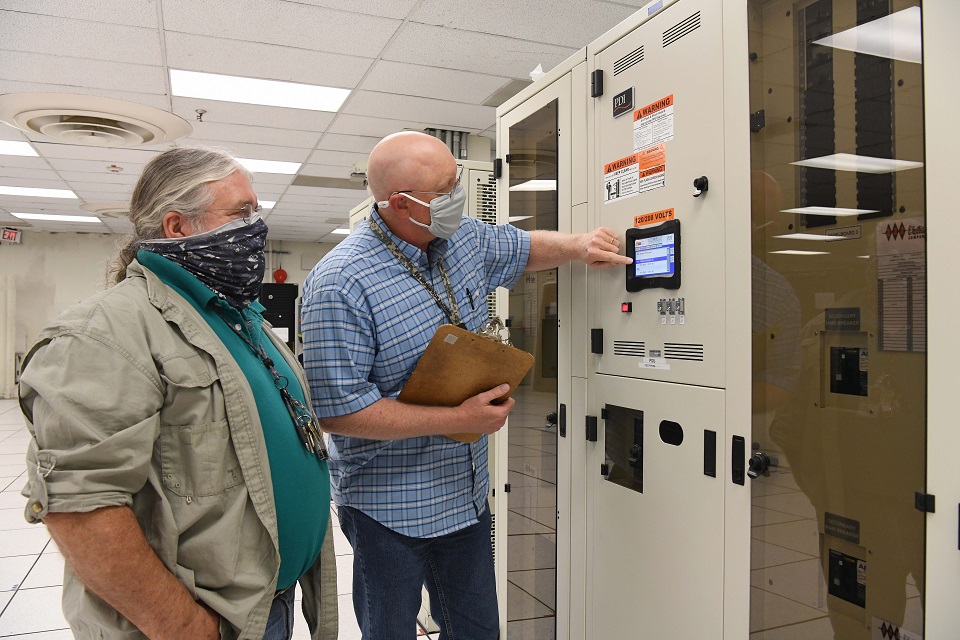
IT Systems administrators John Neusch (right) and Les Spaulding troubleshoot a new power distribution system in Pantex’s current data center.
If you think of our systems, applications, or network as living and breathing beings, the data center is the brain that essentially regulates every function. As a centralized facility tasked with housing and maintaining multiple server racks that store, process, and backup our electronic information, our data centers are vital to daily operations at Pantex and Y-12.
The Pantex and Y-12 Data Center Consolidation and Modernization projects are progressively coming to fruition, enhancing the monitoring, power reliability, and cooling infrastructure of our IT systems at both sites. At Y-12, Information Solutions and Services continues to decommission legacy hardware and move it into its new home. Meanwhile, the Power Upgrade Project at the Pantex data center continues to implement additional levels of redundancy and alternate power sources.
“Our teams support more than 650 network devices and 4,000 servers at Pantex and Y-12; thus, having a solid infrastructure at each site that hosts and backs up these systems brings us a step closer to meeting a modern industry standard. This is a major accomplishment,” said Joe Harris, Consolidated Nuclear Security’s chief information officer.
With modernization as a primary focus, once complete, both sites will have fully upgraded to 10 gigabytes worth of internet capacity due to the centers’ bandwidth. As a significant boost to our sites’ internet capacity, this will improve our virtual video and audio quality, while decreasing the time to connect to the internet or perform enterprise backups between the sites.
“Teams from across IS&S, Cybersecurity, Construction, and Power Operations have all contributed to the centers’ current and future success for our mission,” said Harris. “This is a triple play with power enhancements, modernization of our cooling of equipment, and increased capacity and resilience in our network connections. We look forward to how this advancement in our infrastructure will continue to grow to serve our people and technology.”
Inside of each data center are multiple racks of servers that store information. As you can imagine, stacks of electrical equipment can overheat if not managed carefully; therefore, in preventing any deficiencies, both centers will have a cool air containment design from the floor of each server room. Currently installed at Y-12, the design separates the cold airflow from the exhaust of the hot and active electrical equipment and ultimately creates a consistent stream of cold airflow throughout the centers that prevents equipment from overheating and shutting down.
“IT equipment creates a lot of heat, which has to be cooled to maintain the equipment’s required temperatures,” said Matt Beattie, who manages both Pantex’s and Y-12’s data centers. “By using an air containment design, we’re able to evenly manage the centers’ temperatures, protect our equipment from overheating, and install more IT equipment in each server rack to make efficient use of our space.”
Adding to the efficiency of the project, the data centers will also be accompanied by a Data Center Infrastructure Management tool, or DCIM. The tool will provide IS&S with a 3-D view of each data center and enable operators to monitor and manage the centers’ equipment, systems, space, power, cooling, and even alert systems administrators of any operational problems after hours.
“From breaking ground to now, both data centers have been nothing short of a collective effort, but we’re not finished yet,” Harris said. “We still have more to do as we continue to move capabilities while maintaining services so as not to impact the site mission and site deliverables.”