



News
Pantex honored by Amarillo College for engagement with business and leadership councils
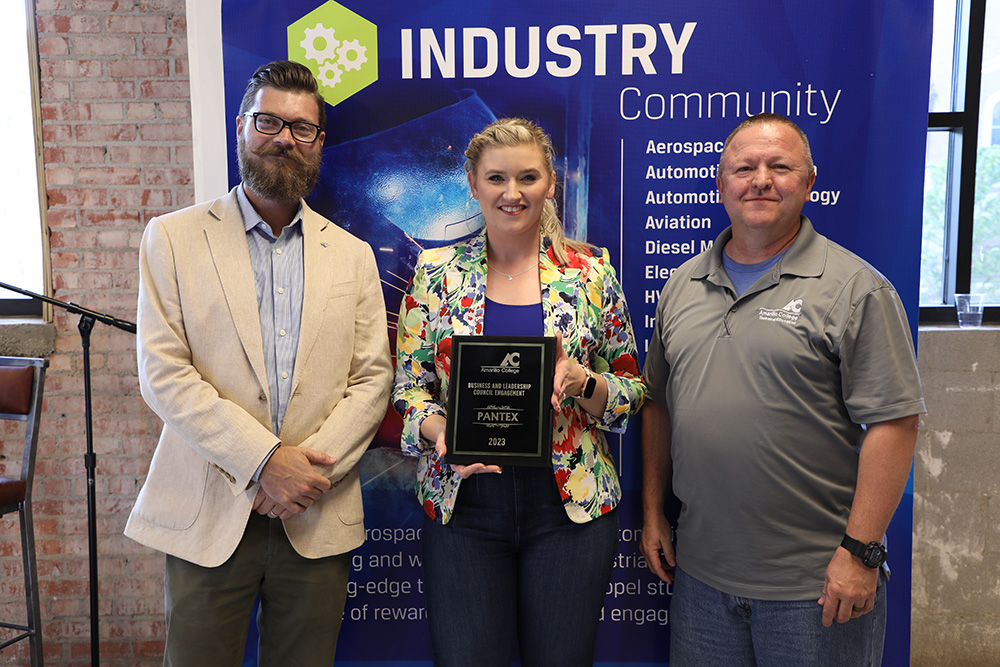
Pantex was recently honored with the Business and Leadership Council Engagement Award from Amarillo College (AC). This award was in recognition of Pantex’s diligent efforts over the past year to support a wide range of AC's Business and Leadership Councils (BLC), including manufacturing, computer information systems, engineering and physics, and chemistry.
“We are thrilled to honor Pantex with the prestigious Business and Leadership Council Engagement Award,” said Ryan Francis, Amarillo College Workforce Innovation Network coordinator. “This esteemed recognition is a testament to Pantex's active participation and unwavering commitment to engagement, as evidenced through their consistent attendance, outstanding representation at various BLCs, in addition to their valuable class visits.”
Amarillo College is ranked as the #1 college in the nation by the Aspen Institute, is a significant supplier of talent at Pantex, and the leader in university transfers for the Panhandle.
“BLCs present a vital opportunity for Pantex leadership to provide guidance and feedback to AC's programs and curriculum so that they are meeting industry needs,” said Zuleyma Carruba-Rogel, Pantex Educational Partnerships & Talent Pipeline Development recruiter.
Over the past year, Pantex has increased collaboration with AC through these BLCs to help AC design beneficial programs for students that prepare students to fill real needs at Pantex, other Nuclear Security Enterprise sites, and similar industries. Key Pantex organizations that supported the program include Operations, Mission Engineering, Infrastructure, High Explosives, and Information Solutions and Services.
“AC recognized our efforts to support and influence their programs, in addition to a range of info sessions, career fair support, classroom visits, and program events such as women in manufacturing, and new student orientation,” said Carruba-Rogel. “We certainly appreciate this recognition and look forward to our continued partnership and support.”
Pantex and Y-12 teams recognized for excellence in infrastructure
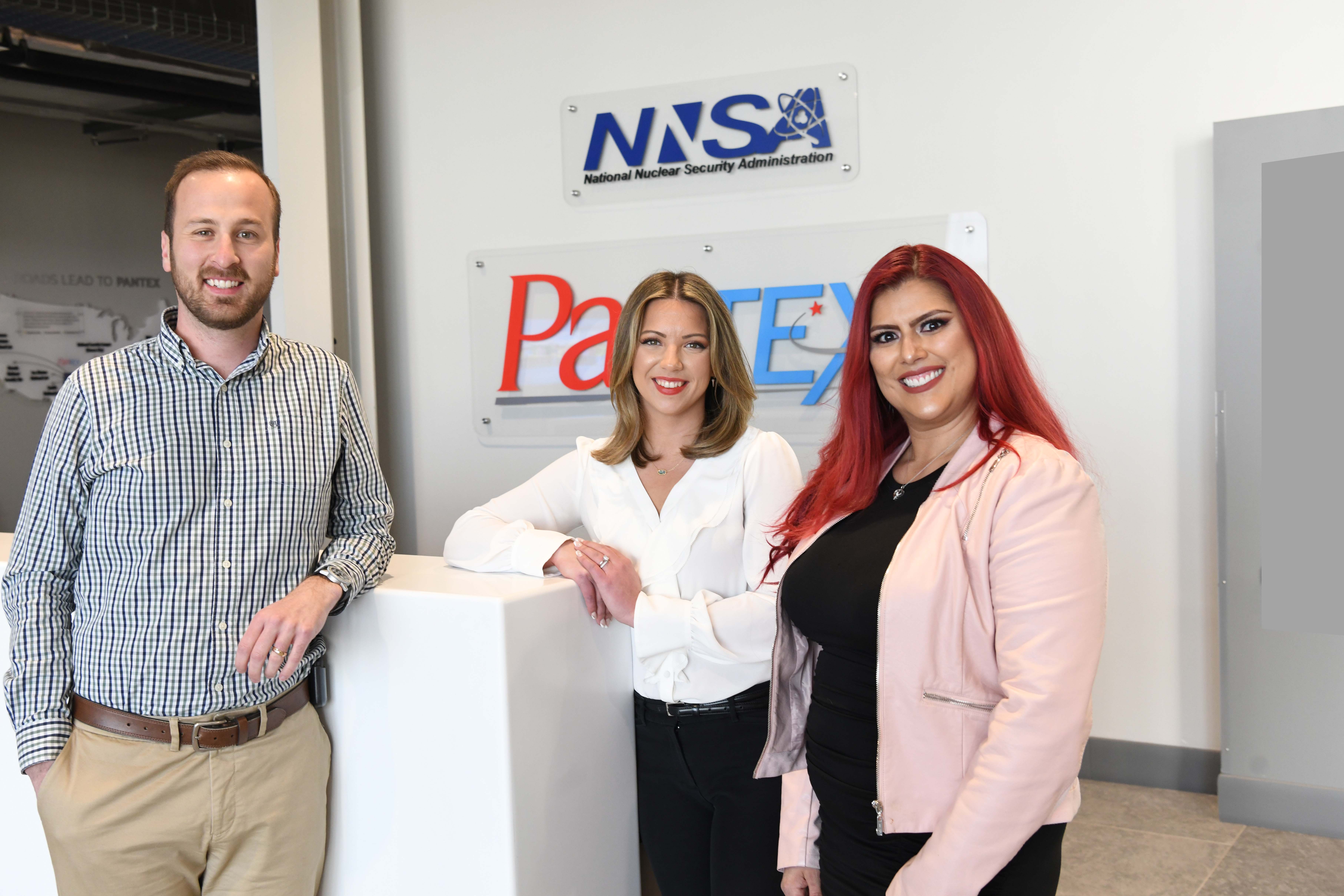
Amarillo, Texas — The National Nuclear Security Administration (NNSA) Office of Infrastructure recently recognized seven teams from the Pantex Plant in Amarillo, Texas and the Y-12 National Security Complex in Oak Ridge, Tennessee. The teams, made up of hundreds of employees from the NNSA Production Office (NPO) and Consolidated Nuclear Security (CNS), were honored with Excellence Awards for outstanding accomplishments during Fiscal Year 2022.
“The work done by these teams, and those who support them, will further the NNSA mission for years to come,” NPO Manager Teresa Robbins said. “Their commitment to excellence and creative solutions make them among the best in the Nuclear Security Enterprise.”
From streamlining routine maintenance tasks to installing essential machines for operations and finding environmentally friendly solutions, the winning teams’ work impacts day-to-day infrastructure tasks integral to serving the nation.
“Safety, a reliable infrastructure, and efficient operations are the heartbeat of our sites,” CNS President and CEO Rich Tighe said. “These award-winning projects highlight the outstanding dedication to the safe modernization of our infrastructure and ultimately to our important national security mission.”
At Pantex, three teams were recognized with awards. One was honored for completing a planned site electrical outage with a scope impacting the largest number of production facilities and personnel the plant has ever undertaken. Another team was recognized for replacing three high-risk chillers to provide a better work environment for critical mission support areas.
The third award at Pantex went to the High Explosives Science and Engineering project construction team, worked together with an environmental project team to relocate 15,000 cubic yards of excess soil on site, saving approximately 70,000 heavy truck miles, reducing fuel consumption by 12,500 gallons and reducing carbon dioxide emissions by about 130 tons.
At Y-12, four groups were recognized. One team removed a contaminated legacy building without impacting the environment or putting people at risk. The team’s efforts made way for continuing innovation and construction on-site. Another team earned accolades for shrinking a maintenance backlog by 66%, ensuring continued employee safety. Additional teams recognized at Y-12 included one that proactively planned for climate change and another that successfully completed a machine maintenance program despite multiple supply chain issues.
Consolidated Nuclear Security, LLC operates the Pantex Plant, located in Amarillo, Texas, and the Y-12 National Security Complex, located in Oak Ridge, Tennessee, for the U.S. National Nuclear Security Administration. Bechtel National, Inc. is the lead member of CNS; minority members include Leidos, Inc.; ATK Launch Systems, LLC; and SOC LLC. Pantex and Y-12 are key facilities in the U.S. Nuclear Security Enterprise, and CNS performs its work with a focus on performance excellence and the imperatives of safety, security, zero defects, and delivery as promised.
For more information on each site, visit www.pantex.energy.gov or www.y12.doe.gov. Follow Pantex on Facebook, X or LinkedIn. Follow Y-12 on Facebook, X, and LinkedIn.
CONTACT
Steve Myers
Communications
Office (806) 573.0490
Cell (806) 236.2826
Stephen.Myers@pantex.doe.gov
Pantex NA-90 Award Recipients
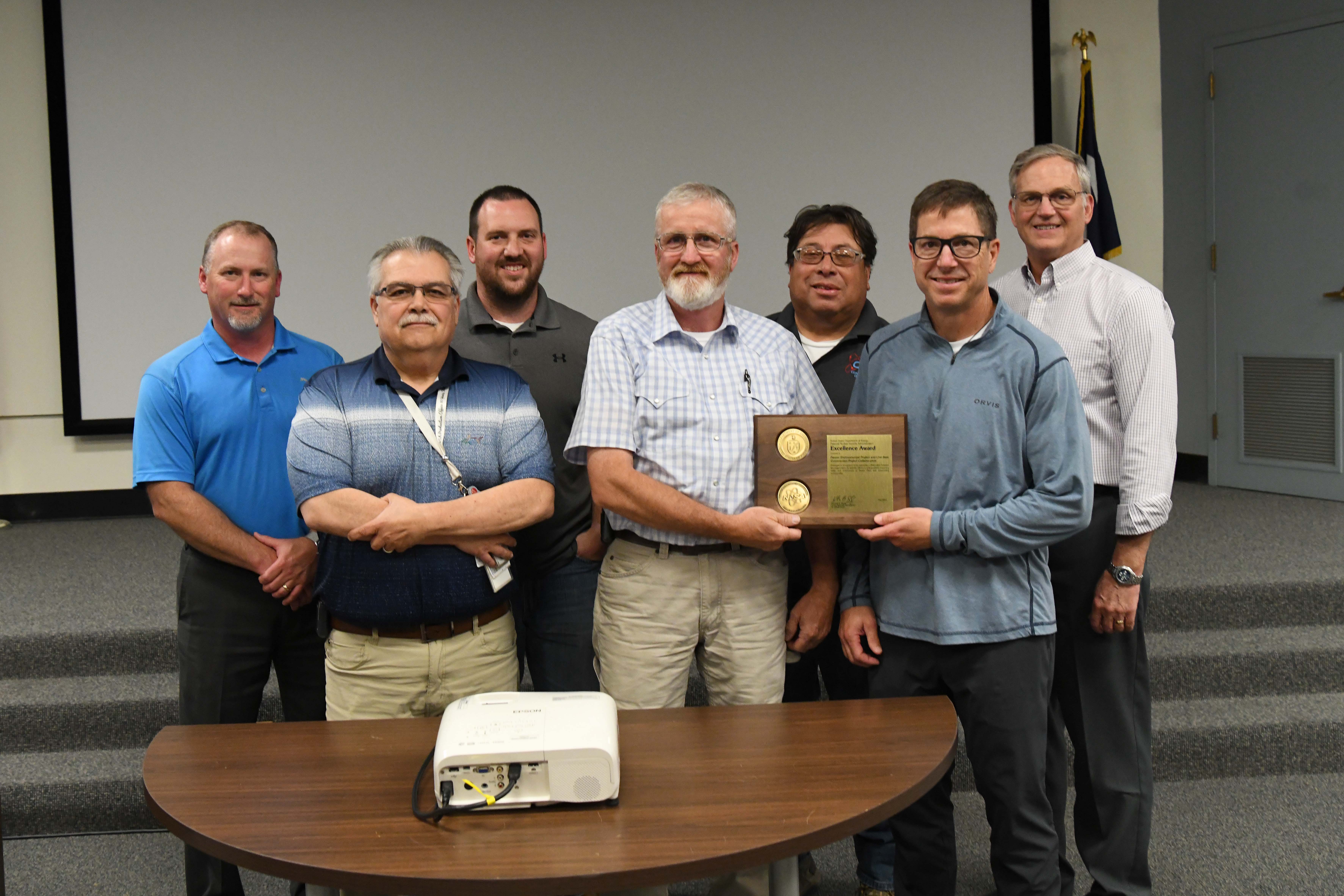
This Pantex High Explosives Science and Engineering project team relocated 15,000 cubic yards of excess soil on site, saving fuel and carbon dioxide emissions.
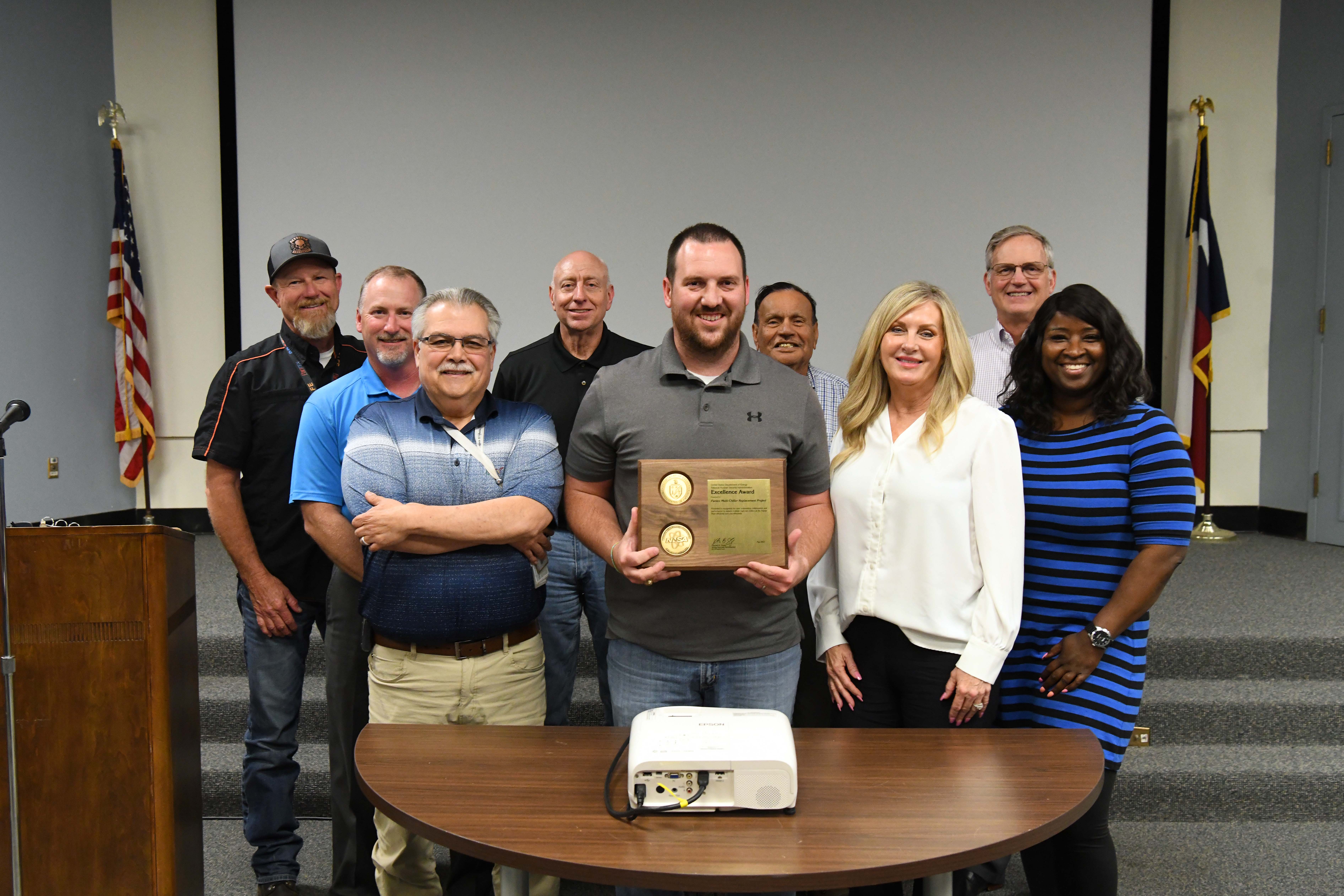
This group from Pantex replaced three high-risk chillers to provide a better work environment for critical mission support areas.

This Pantex group undertook the largest planned electrical site outage impacting the largest number of production facilities.
Weapon Intern Program offers insight, opportunity
To many CNS employees, the Sandia Weapon Intern Program, like much of the work at Pantex and Y-12, is shrouded in secrecy. From the name alone the uninformed could be forgiven for assuming the program is a pathway for aspiring young people into the United States’ nuclear weapons complex.
Yet, while WIP affords its alumni no end of career-advancement opportunities, the word “intern” scarcely captures even a portion of the reality of this yearlong adventure.
“The Weapon Intern Program, from my perspective, [is] more of a deep dive into the enterprise and almost a graduate-level course on the complex business we do,” said Josh G.
In short, this 11-month internship is among the Nuclear Security Enterprise’s best-kept secrets.
“I had heard about this program through several sources and knew a few people in my department who had participated in the past,” said Alaina H., a 2023 Pantex WIP participant. “I was really interested in the opportunity to visit the other sites that contribute to our nuclear deterrence and learn from [subject matter experts] across the complex. In particular, I was interested in visiting the [Department of Defense] sites to see where the finished product ends up and to learn about potential use cases and what factors the navy and air force care about most in the weapon designs.”
WIP was created in 1998 to accelerate learning by blending classroom and multimedia-based instruction from more than 250 SMEs. Participants complete both individual and team research projects, visit numerous NNSA sites, and have access to mentors who provide a direct link between the complex’s past, present, and future.
It’s an intriguing notion, but especially given everything facing today’s enterprise, why create a program that takes employees away from their jobs nearly an entire year? According to NPO's Yessica F., a Nuclear Explosives Safety program manager and Howard’s peer in the 2023 program, the answer lies at the crossroads of past, present, and future.
“Sandia’s responsibility associated with its nuclear weapons’ mission requires the continuing transfer of decades of nuclear weapon-related knowledge and experience to new generations of nuclear weaponeers,” she said.
I am Mission Success: David Turner
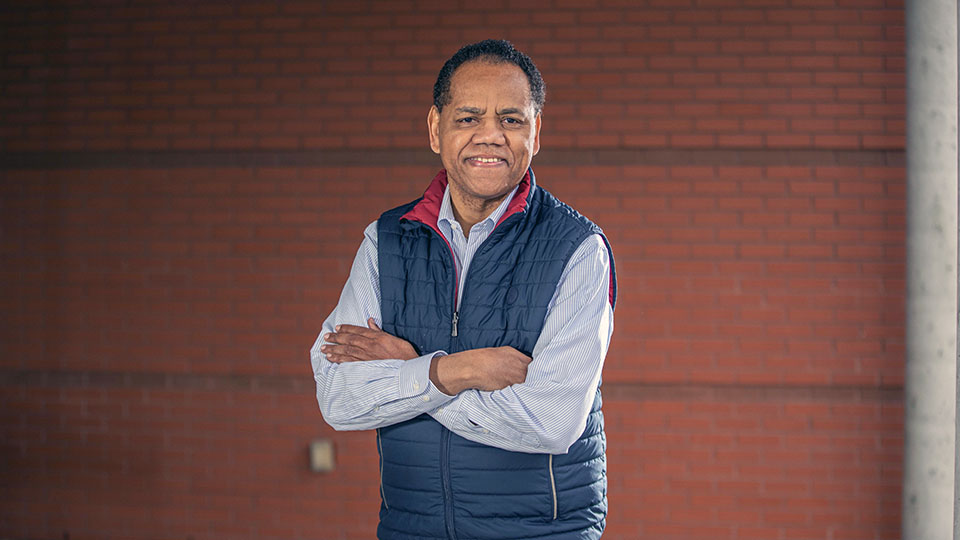
Duty. Honor. Country. It is a theme in David Turner’s life. From achieving Eagle Scout status as a young man to a 35-year military career concluding as a highly decorated retired brigadier general, Turner’s goals often derive from his desire to lead and serve.
“I feel as if I’m repeating that pattern in the work I’m now doing,” said Turner, who recently assumed the job of Vice President of Operations Support. “The mission we do for our country is so critical. It’s an honor for me to be a part of it.”
But Turner readily admits that he was not always the mastermind of his own destiny. Charting the course of his life has often involved the advice of mentors and teachers who saw something in him that he did not.
“You want to align yourself with people who have an interest in you,” he said. “They can see things in you that you may not and help you maximize whatever that may be.”
Who influenced you most in your life?
My grandmother was, without a doubt, a huge influence in my life. She was my Yoda. She was incredibly knowledgeable about so many things in life. I also had two mentors in my military career that were instrumental in guiding me. They still are involved in my life, and I continue to value their input.
What advice would you give to young people who don’t know exactly what they want to do?
Be open to advice and suggestion. I didn’t even know what an Eagle Scout was, but my best friend’s mother told me I would be one. I went home and looked it up, and I decided that I actually would become an Eagle Scout. I not only made Eagle Scout, but I held every possible leadership level in the Boy Scouts. I have never regretted listening to that suggestion. I also believe the Science, Technical, Engineering, and Mathematical (STEM) programs offer so many ways to learn about potential futures
Pantex commemorates ‘topping out’ HESE facility
CNS completes vertical construction of major line item project
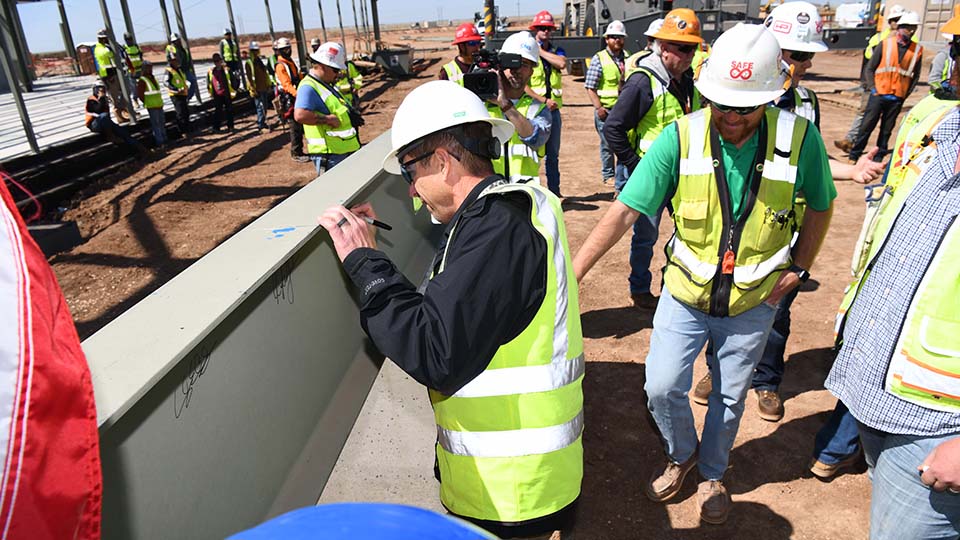
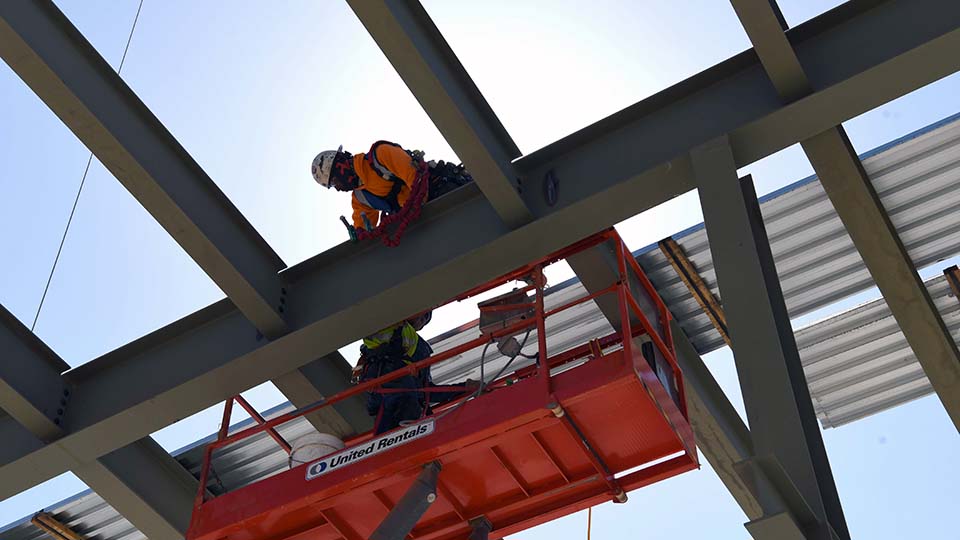
AMARILLO, Texas – Consolidated Nuclear Security recently completed “topping out” the High Explosives Science and Engineering (HESE) facility at Pantex. Topping out was achieved as the construction crew placed the final steel beam on the Technology Development and Deployment Lab, one of three structures for the 72,762-square-foot complex.
“It is exciting to watch this vital facility take shape,” Pantex Senior Director for Project Management Russell Daniel said. “Our project team, in partnership with the National Nuclear Security Administration (NNSA) and our construction subcontractor Hensel Phelps, has worked extremely hard to reach this milestone.”
A Congressional Line Item project, the HESE will replace 15 obsolete facilities at Pantex, the average age of which is 68 years old, and support the Pantex High Explosive (HE) Center of Excellence for Manufacturing mission for NNSA.
“Congratulations to the HESE construction project team for reaching the significant milestone of placing the final steel beam,” said Monty Cates, Explosive Technology Operations senior director. “The people in Explosives Technology Operations are committed to doing our part for the Pantex’s Global Security Mission. We appreciate all the hard work getting the project to this point, and are greatly encouraged by the progress on a facility that ensures the high explosives mission is sustained for the next generation. It is awesome to see a hopeful vision becoming a tangible reality.”
The HESE facility will provide laboratory space, classified and unclassified office and meeting areas, and a shower and change-out area for HE Operations personnel all in closer proximity to HE manufacturing operations at Pantex.
“This is part of our ongoing efforts to modernize Pantex and provide state-of-the-art amenities for our high explosives scientists and engineers.” said Colby Yeary, Pantex site manager. “The facility will qualify new HE and assess legacy HE returning from the nuclear weapons stockpile as well as help develop and sustain high-quality scientific staff; support computational and experimental capabilities; and support development of additional evaluation and diagnostic tools.”
Consolidated Nuclear Security, LLC operates the Pantex Plant, located in Amarillo, Texas, and the Y-12 National Security Complex, located in Oak Ridge, Tennessee, for the U.S. National Nuclear Security Administration. Bechtel National, Inc. is the lead member of CNS; minority members include Leidos, Inc.; ATK Launch Systems, LLC; and SOC LLC. Pantex and Y-12 are key facilities in the U.S. Nuclear Security Enterprise, and CNS performs its work with a focus on performance excellence and the imperatives of safety, security, zero defects, and delivery as promised.
For more information on each site, visit www.pantex.energy.gov or www.y12.doe.gov. Follow Pantex on Facebook, X or LinkedIn. Follow Y-12 on Facebook, X, and LinkedIn.
CONTACT
Steve Myers
Communications
Office (806) 573.0490
Cell (806) 236.2826
Stephen.Myers@pantex.doe.gov
Unsung heroes: Infrastructure crew provides vital, if unseen, service to colleagues

Pantexans arrive on-site to safe streets and sidewalks, even amid harsh Panhandle weather. Few stop to think about the men and women who report hours before them—and often stay many hours after they leave—to keep their work environment safe and well maintained.
Extreme weather is a familiar occurrence in the Texas Panhandle. Longtime Pantexan Harvey Bellamy has seen his fair share of storms and their aftermath, including National Guard snow rescues and severe windstorms that toppled buildings.
“Before our present hardened guard stations were built, we had temporary stations, basically portable buildings at the east and west gates,” he recalled. “During one severe-wind event, the west station was blown over–with a guard in it!”
These days, Pantexans arrive on-site to safe streets and sidewalks, even amid harsh Panhandle weather. Few stop to think about the men and women who report hours before them—and often stay many hours after they leave—to keep their work environment safe and well maintained. For the staff of Infrastructure’s Site Services team, going unnoticed is almost a badge of honor—a signal their job is correct and complete.
“We watch the weather every day,” said Quinton McNabb. “As things progress and it looks like it’s going to be a significant weather event, we make sure we have everything we need. Then, as it gets closer, we look at how many personnel we’re going to need.”
Much like their relative anonymity, advanced planning comes with the territory. Occasionally, however, the team has to adapt to evolving situations more quickly.
“Sometimes, you just have to jump on it because weather moves in so fast out here,” explained Irene Lewis, yard crew manager and one of about a dozen or so employees—about half the full team—gathered in an upstairs breakroom. “We had one storm when we used up our entire year’s worth of [ice-melt] product in one week! We got the plant ready at 1, 1:30 in the morning, and it just got covered in ice all over again.”
Lewis’ memory of that storm a few years ago perfectly highlights Site Services’ dedication to their colleagues and the Pantex mission.
“We came out Sunday morning to get ready and didn’t get to leave until Thursday,” she said.
Her colleague Kurt Cockrell nodded.
“People don’t know that we’re out here as long as we are, especially during the winter,” he said.
Voicing his agreement, Brad Johnson ticked off a list of items that must be attended to before shifts change during winter-weather events.
“We get our equipment ready and go prep the [plant] roads,” he said.
Paying special attention to intersections, turns, and sloping roads, Johnson said the team then turns to sidewalks, applying a sufficient covering of granular ice-melt.
As days lengthen and temperatures rise with spring’s approach, severe-storm season will soon follow. With those storms will come new challenges for these men and women, many of whom will maintain the condition of grassy areas and ditches, as well as address leaky roofs caused by the inevitable Texas-sized hail.
“Last summer, we all stood out here and watched our cars get completely pulverized,” recalled Lewis with a mix of both humor and lament.
It’s an event which draws wry chuckles now, but each staffer knows severe weather on the High Plains is no joking matter. On Labor Day weekend of 1967, a series of five tornadoes struck Pantex, destroying some 50 power poles, numerous ramps and roofs, and shattering an incredible number of vehicle and building windows. Strong wind storms again left devastating impacts on the site in 1969 and the 1983 event Bellamy remembered. Each incident left this group’s predecessors grateful for their safety but with huge messes to clean up.
Yet, for all their hard work, this is not a team that asks for attention or accolades. The pride of a job well done is thanks enough. They work hard in the day-to-day providing safe roads, digging trenches, and filling sand bags. When situations really escalate, they rise to the occasion. During wildfire season, the crew can be found cutting fire breaks, refilling the fire department’s grass rigs, or refueling fire trucks on the go.
Of course, there’s one thing this crew does wish employees would take to heart.
“Give us room to do our job, either walking or driving,” Cockrell said.
Lewis explained employees will, at times, crowd their heavy equipment, creating a potential hazard if the machine’s operator should need to back up.
“People on tractors have a problem with employees walking behind the equipment,” she said.
Drawing echoes from his peers, Travis Reed said it’s hard to watch other employees make careless decisions that frustrate hours of hard work.
“We spend hours and hours putting down ice melt, to watch people walk [in an untreated area], creating a hazard,” he said.
Much like the old postal creed involving snow, rain, and gloom of night, the men and women of Pantex Infrastructure stand ready both day and night to ensure their peers accomplish the mission, safely.

Infrastructure’s Site Services team provides safe roads, digs trenches, fills sand bags, and much more.
Always serving

Chafin H. pulls double duty when it comes to serving others; he works at Pantex and is a lieutenant colonel (select) in the U.S. Air Force Reserve.
Once a month, Chafin H. loads up his Suburban and points the truck north toward Colorado Springs.
Chafin is a project manager in Construction Projects at Pantex, but he’s also a lieutenant colonel (select) in the U.S. Air Force Reserve at Peterson Space Force Base in Colorado Springs. And while the trip usually takes about 6 hours and covers more than 350 miles, there’s not a lot of distance between the two missions he performs: National security is the priority.
“For U.S. veterans, a career at Pantex or Y-12 is a continued service to our nation. At no other time in history has our national security been under greater threat. By working at Pantex or Y-12, we help ensure the reliability of our nation’s greatest deterrence against authoritarian aggression—the U.S. nuclear triad,” said Chafin, who has been an instructor pilot in the Air Force Reserve for 8 years after 9 years of active duty service.
Pantex and Y-12 often are sought-after vocations for those who have or continue to serve in our armed forces. It’s no surprise that 29% of the Pantex workforce and 18% of the Y-12 workforce have former military experience.
Like Chafin, more than 30 remain active in the armed forces, often through the reserves, serving double duty for the nation.
“Serving in the military and working a full-time civilian job is tough and very busy,” said U.S. Navy Reservist and Y-12 Quality Technical Procedures Specialist Scott Bruneel. “We are always on the go, but most of us wouldn’t change a thing. I am very proud to have the opportunity to wear our nation’s uniform, but we are just regular people who have had the opportunity to help our country the best way we know how.”
Why I serve
“I choose to serve because I enjoy the people. I’ve been in 10 years now and have worked with a lot of really great people and have made some lifelong friends. I really enjoy being able to help my younger soldiers sort through life and grow into competent adults. A lot of these guys are 18 and fresh out of high school and don’t have a strong family support system. For some of them, the military is the closest thing they have had to a family. So being able to be that support system for them and help bridge the gap means a lot.” —Jonathan Craig
“I chose to serve for the community on which the military is built upon. The teamwork, adventure, and ability to learn something new drew me in to continue my education both far and wide.” —Allison Derthick
“The choice of military service is not for money. Military service pay is inadequate compared to civilian careers. The choice of military service is not for comfort. Military lifestyle can be brutal and terrifying with extended combat deployments. I chose military service at age 18. My determination was based on my strength and ability to fight against U.S. constitutional threats, foreign and domestic.” —Chafin H.
In recognition of Armed Forces Day, celebrated on May 20, some of our peers shared how their roles at the sites allow them to continue service to our nation.
“The operation and functionality of our sites have a direct impact on national security,” said Jonathan Craig, an engineer in the Facility Design Group at Y-12 and a first lieutenant in the Tennessee Air National Guard. “If the operational status of the facilities and the sites is impacted, then we may miss key objectives, which have second and third order effects.”
It is clear those who continue to serve in the armed forces while they work at Pantex or Y-12 do so to support protecting our nuclear deterrent.
“In the Army, I dealt with nuclear targeting, nuclear disablement, and counterproliferation,” said Jimmy Matthews, a lieutenant colonel in the U.S. Army, who is a SkillBridge intern working in Y-12 Product Manufacturing Engineering. “At CNS, I can support the other end of our nation’s nuclear deterrent and assist in the training of other DOD elements. I continue to serve because I enjoy the challenge, and I feel as though I am supporting my country.”
Bruneel thanked CNS and his colleagues for supporting those who remain active in the armed forces.
“Y-12 and CNS have been the most supporting companies I have worked for since transitioning from active duty to the reserves,” Bruneel said. “I know that my team always has my back when I have to be out on orders for the Navy. I’m able to complete my training and return seamlessly.”
Mike Fierley, a master sergeant with the U.S. Air Force National Guard and an instructor in Production Training, agrees the support of the company, coworkers, and even DOE are important.
“I have had several supervisors support me in my role to serve our nation. I’m also thankful to our DOE headquarters leaders who feel strongly in supporting us serving our nation,” Fierley said.
U.S. Army National Guard, Second Lieutenant Robert Mehlhorn and Y-12 Project Controls scheduler, added, “I definitely feel like working at Y-12 allows me to continue to serve the nation. When I come to work, I get to actually see America’s nuclear deterrent actively being used. From the history of the plant to the individual projects and individuals who make things happen, it is incredible to see.”
His peer Allison Derthick, a captain in the Tennessee Army National Guard and a Project Controls scheduling associate, said, “My role at Y-12 has allowed me to continue to serve the nation through providing the products to which we are interfacing with foreign nations. By doing so, I’m understanding their capabilities and threats they can bring to the world.”
How the service molded me
Through life experiences, we grow and become the people we are now. For these soldiers, their time in the armed forces helped mold them, preparing them for their careers in the military and at Pantex and Y-12.
“Being in the guard has helped me become more confident and able to think on the move,” Mehlhorn said. “A popular saying is that ‘No plan survives first contact,’ so being able to prepare contingencies and to think and adjust on the move has been a very valuable skill that the Army has taught me. I personally like to remind myself that I may not be able to control every situation, but I can always control how I react to it.”
“The National Guard helped me develop a positive self-improvement mentality and taught me to aim for excellence in all I do,” Craig said. “I learned to get comfortable with being uncomfortable and to bounce back when you hit a wall and keep moving forward. It changed the way I view the world and taught me to appreciate the small things. It has made me into a better leader, a better follower, and a better communicator. All these aspects turned me into a better friend, family member, and (soon to be) husband.”
Bruneel agreed his service made him better. “After graduating college, I still had not grown into the person I am today. The Navy helped me become a better husband, a better father, and a better person all around. It has helped me develop into a leader, as before I was just a follower.”
What civilians should know about those who serve
Whenever America has been at combat, there are those who are for and those against the conflict. Our active service members would like civilians to take the following advice.
“Military service can put a great deal of stress on service members and their family,” Matthews said. “Support the military during peacetime so we can display a strong conventional deterrent, which will hopefully let us avoid conflict. Support the military during combat deployments so we can return to peace. And of course, provide the reliable nuclear deterrent on which our national security strategy relies.”
Pantex named Employer of the Year by WTAMU’s Engler College of Business

AMARILLO, Texas – As one of the largest employers in the Panhandle of Texas, working at Pantex is the end-goal for many local university students. In recognition of its draw and excellence, Pantex was recently named Employer of the Year for West Texas A&M University’s Paul and Virginia Engler College of Business. This award recognizes employers in the community for exceptional contributions to the Engler College of Business, and commitment to promoting workplace excellence.
“Pantex has strongly committed to our students by offering high-quality internships and employment opportunities,” said Dr. Amjad Abdullat, Dean of the WTAMU Engler College of Business. “They have provided our students with valuable work experience and helped prepare them for successful careers in the business world.”
Pantex has a history of collaboration with West Texas A&M University and its students. Over the last two years, Pantex leadership and the College implemented a strategic talent pipeline to employ WTAMU students. The collaborative team led information sessions, and from these efforts alone, Pantex was able to hire 15 Buffs including six project controls representatives and five project controls summer interns, two of which have converted to Pantex employees and another two slated to start their internships this coming summer 2023.
“The support from internships and permanent positions has helped us create exciting opportunities for Buffs while filling critical talent needs in our organizations,” said Colby Yeary, Pantex Site Manager. “This partnership helps us ensure we have vibrant talent to support our national security work now and into the future.”
Pantex employs more than 4,300 full-time personnel to fulfill its vital mission to ensure the effectiveness of the U.S. nuclear stockpile in support of the Nation’s nuclear deterrent. This unique mission requires unique skills, so Pantex reached out to their partners at WTAMU to create the mutually beneficial programs that serve both students and Pantex’s mission.
“Pantex has been a dedicated partner to our College, providing exceptional support to our programs and promoting our values and mission,” said Abdullat. “Their commitment to diversity, equity, and inclusion in the workplace has also been exemplary.”
“We’re grateful for this recognition from WTAMU, and we are excited to continue creating opportunities for students and to leverage their talents toward our important mission of nuclear deterrence in service of our nation and allies around the world,” said Yeary.
For more information about Pantex’s jobs and internship opportunities, see pantex.energy.gov/careers.
Consolidated Nuclear Security, LLC operates the Pantex Plant, located in Amarillo, Texas, and the Y-12 National Security Complex, located in Oak Ridge, Tennessee, under a single contract for the U.S. National Nuclear Security Administration. CNS member companies include Bechtel National, Inc.; Leidos, Inc.; ATK Launch Systems, Inc.; and SOC LLC. Pantex and Y-12 are key facilities in the U.S. Nuclear Security Enterprise, and CNS performs its work with a focus on performance excellence and the imperatives of safety, security, zero defects and delivery as promised.
For more information on each site, visit www.pantex.energy.gov or www.y12.doe.gov. Follow Pantex on Facebook, X or LinkedIn. Follow Y-12 on Facebook, X, and LinkedIn.
CONTACT
Steve Myers
Communications
Office (806) 573.0490
Cell (806) 236.2826
Stephen.Myers@pantex.doe.gov
CNS awards STEM grants to Texas schools
Amarillo, Texas. —The sky is the limit for science, technology, engineering, and math educational efforts for five schools in the Texas Panhandle. Through $1,000 grants provided by Consolidated Nuclear Security (CNS), the managing and operating contractor for Pantex, five area schools will soon be advancing STEM education with projects ranging from robotics to drones.
These grants fund STEM activities in the classroom and represent one of the many ways Pantex is investing in development of the future workforce. This year’s grant recipients and projects are as follows:
- Boys Ranch High School, Becky Gaffney (Teacher 9th-12th grade). Students will use four programmable drone sets to learn piloting, foundations of coding, and how to use the engineering design process to solve real-world challenges. Students will experience the role that technology and automation play in our world, and market themselves and the application of their skills to various career fields.
- Clarendon High, Timothy Leeper (Teacher 9th-12th grade). These students will also study drones and learn about education opportunities and occupations related to operating and designing unmanned aerial vehicles (UAVs). Students will be also be qualified to take the Federal Aviation Administration’s (FAA) Unmanned Aircraft Systems Drone Knowledge Test, receiving a 2-year license for UAV operations in a variety of fields.
- Fort Elliott CISD, Tori Coulter (Elementary Technology). This small, rural school has already implemented robotics and engineering into the curriculum, and will use its grant to increase these programs and advance STEM opportunities for upper elementary students. This grant will help purchase coding design skill cards, coding robot sets, and STEM Bins.
- Pampa High School, Vanessa Ontiveros (Teacher, 9th-12th grade). This program will instruct students how a computer works and how to repair a Personal Computer. It can be downloaded onto classroom computers, supporting an unlimited number of users. The application will instruct Principles of IT, Computer Maintenance, and Practicum of IT classes, using gamification to apply gaming strategies, improve learning, and create an engaging environment.
- Rogers Elementary, AISD, Alma Torrez (STEM Teacher, K-5th grade). The purpose of the project is to offer students more opportunities in critical thinking, problem solving, and creativity. They will be tasked to collaborate with their peers, improve social skills, and work together through engineering and coding challenges. Students will gain knowledge of the four pillars of computation thinking: decomposition, pattern recognition, abstraction, and algorithms.
The goal of the grants is to foster advancement of STEM activities in the classroom and to help develop Pantex’s future workforce. This is the second year that Pantex has offered STEM classroom grants to Amarillo and the top 26 counties of the Texas Panhandle.
Dozens of submissions were received and evaluated by a panel of knowledgeable employees at Pantex. The group carefully reviewed all the applications and narrowed the impressive list down in order to recommend the five winners.
“To help increase the number of young men and women entering STEM fields, Pantex has offered region-wide grants for the last couple years,” said Darla Fish, Pantex education outreach specialist. “Often times, these successful students become part of the Pantex workforce as we are continually searching for talented professionals to join us in our ongoing mission of securing the nation.”
Consolidated Nuclear Security, LLC operates the Pantex Plant, located in Amarillo, Texas, and the Y-12 National Security Complex, located in Oak Ridge, Tennessee, under a single contract for the U.S. National Nuclear Security Administration. CNS member companies include Bechtel National, Inc.; Leidos, Inc.; ATK Launch Systems, Inc.; and SOC LLC. Pantex and Y-12 are key facilities in the U.S. Nuclear Security Enterprise, and CNS performs its work with a focus on performance excellence and the imperatives of safety, security, zero defects and delivery as promised.
For more information on each site, visit www.pantex.energy.gov or www.y12.doe.gov. Follow Pantex on Facebook, Twitter or LinkedIn. Follow Y-12 on Facebook, Twitter, and LinkedIn.
CONTACT
Steve Myers
Communications
Office (806) 573.0490
Cell (806) 236.2826
Stephen.Myers@pantex.doe.gov
I am mission success: Forrest P.

Take 5 minutes and learn about CNS's Forrest P., a Pantex production technician. All views and opinions are the employee’s own and do not necessarily reflect those of CNS.
“It doesn’t look right.”
When a Pantex production technician utters words like that, people pay attention. The cost of even a single mistake is simply too high.
“We received some shim stock, and it didn’t look right,” explained Forrest P., who has been a production technician at Pantex for most of his 12-year career. “It was the wrong thickness from what we were normally using.”
Forrest obtained more stock to verify there was, in fact, an issue. When the second batch came in with the same discrepancy between the labeled specification and what he knew from previous experience, Forrest and his coworkers reached out to 35 Account to begin an investigation and, ultimately, correct the problem.
Someone without Forrest’s years of experience might be tempted to dismiss the CNS directive to maintain a questioning attitude, yet such a mindset is truly foundational to the work at Pantex. After more than a decade as a Pantexan, it has become a way of life for Forrest, a small facet of the work that fills him with patriotic pride.
“I’ve always had high patriotism,” he said. “I see the weapons when they’re completed, and I get a satisfaction in doing my job, providing quality.”
Building America’s nuclear deterrent at Pantex was unimaginable for someone who once envisioned himself pursuing a career in real estate and development, but relatives working at the plant presented a positive image in Forrest’s mind.
He was eager to land a Pantex job and get to work. Forrest said success at Pantex hinges on finding the right motivation and bringing diligence to each day’s activities.
“It’s not something for everybody,” he acknowledged. “You’re stuck in a building, and it’s dark. But you’ve got to enjoy what you’re doing.”
And Forrest, who dreams of one day retiring to enjoy life in a log cabin in the mountains, does indeed relish his work.
“I’ve always enjoyed a challenge,” he said, “and this has been a challenge I enjoy.”
Why are you mission success?
What I do is for the protection of the United States — and my family.
What CNS principle drives you to be successful, and why?
Just personal satisfaction, I’m kind of a perfectionist.
What’s your favorite outside of work activity, and why?
I build and restore classic cars. I have a 1936 coupe and a ’55 Chevrolet Nomad.
What is your favorite aspect about your work environment? How does that part of your job or work environment let you know the mission is being met?
Success: When we’re finished and we sew up the unit and everything’s done properly, there’s just a satisfaction.
As an employee, what do you want to be remembered for?
I took pride in what I did and did everything properly.