



News
Infrastructure upgrades come to Pantex, Y-12

Thanks to the CNS General Workplace Improvement Program, the Pantex and Y-12 sites have received several upgrades.
Investments have been made to revitalize aging infrastructure at both sites. The CNS General Workplace Improvement Program, which annually identifies, prioritizes, and executes projects in common areas to better quality of life for employees, has been working on several upgrades.
At Pantex, improvements underway range from new digs for guards to a fix that’s sure to be a bright spot.
The installation of a new guardhouse is set to be completed in September at the Building 16-19 portal entry.
“The existing one is somewhat small and cramped,” said Program Manager Todd Clark. “The new one is probably double the space. This will be a bigger building to more comfortably house personnel and equipment.”
Clark is also overseeing installation of windbreaks at the east and west entry portals. The aluminum alloy booths are heated and will offer protection from extreme wind and cold weather conditions at the posts. They will be used by guards when weather conditions warrant and morning portal activity is high, Clark said. Construction has already started at the west gate. Projected completion is September 30.
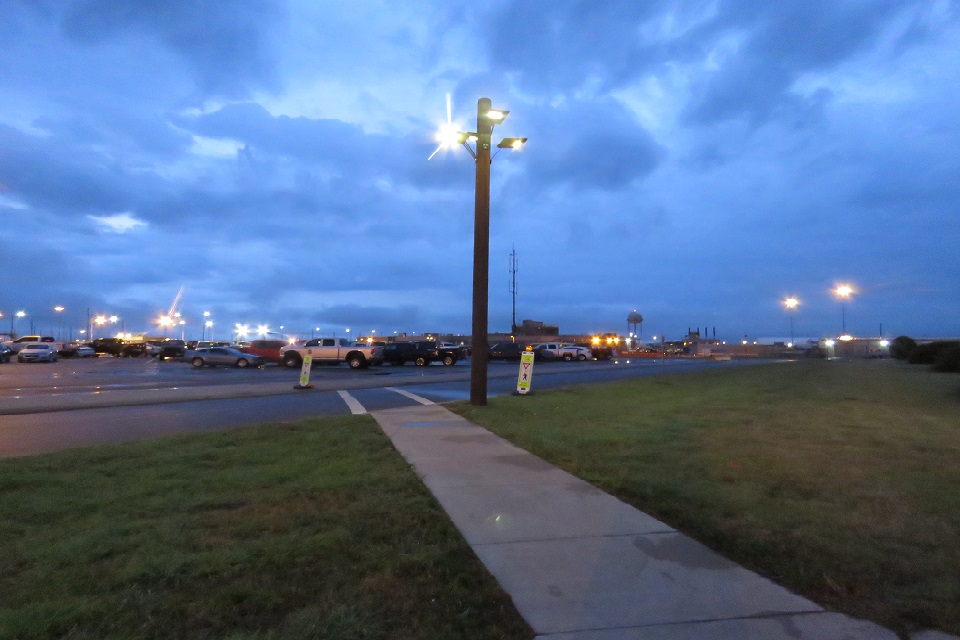
Solar lights have been placed at crosswalks and provide a brighter path for Pantexans traveling from an overflow parking lot.
Another project makes the Building 12-70 parking lot brighter and safer. Solar lights have been installed by construction and maintenance crews at two crosswalks, which workers use to travel from an unlit overflow parking lot.
“Employees must cross the road at two points to access the plant,” Clark said. “The crossing is a potential safety hazard in low lighting conditions. The lights will create safer conditions and better visibility for employees.” Construction was completed in July.
While these projects focus on outdoor changes, other improvements at Pantex tackle interiors.
In one building, four restrooms are slated to be remodeled by September. The renovations include new floors, toilets, urinals, partitions, sinks, exhaust fans, fresh paint, and improved heating and cooling capabilities.
Program Manager Dustin Broom said, “Personnel will have adequate restrooms and a conducive work environment that improves quality of life.”
Also, office area modifications are in the works at another building. Among the changes are new flooring, paint, ceiling tiles and roof, electrical configuration, and a conference room system for improved meeting and videoconferencing capabilities.
“This refurbishment will improve employee habitability and provide adequate office space for personnel,” Broom said.
Y-12 has made an effort to create a better environment for employees as well.
“Workplace improvements are essential to the current and future of the Y-12 site,” said Program Manager Chad Kitts. “The Maintenance and Repair Program strives to complete General Workplace Improvement projects each year to improve quality of life for the Y-12 workforce.”
At Building 9212, outdated flooring in the office and cubicle areas has been replaced with overlay flooring; a base has been installed, which will facilitate easier cleaning and more sanitary conditions. “The effort updated the facility’s habitability to today’s standard,” Kitts said. Also, the walls in the mezzanine men’s restroom in Building 9204-02 received a paint job.
A crane replacement will deliver safer work conditions at Building 9215. The machine includes a hoist with a wireless remote control. This improvement removes workers from exposure to the molten salt bath. The planning phase is completed, and the execution phase is in progress. This project is slated to be finished by February 2022.
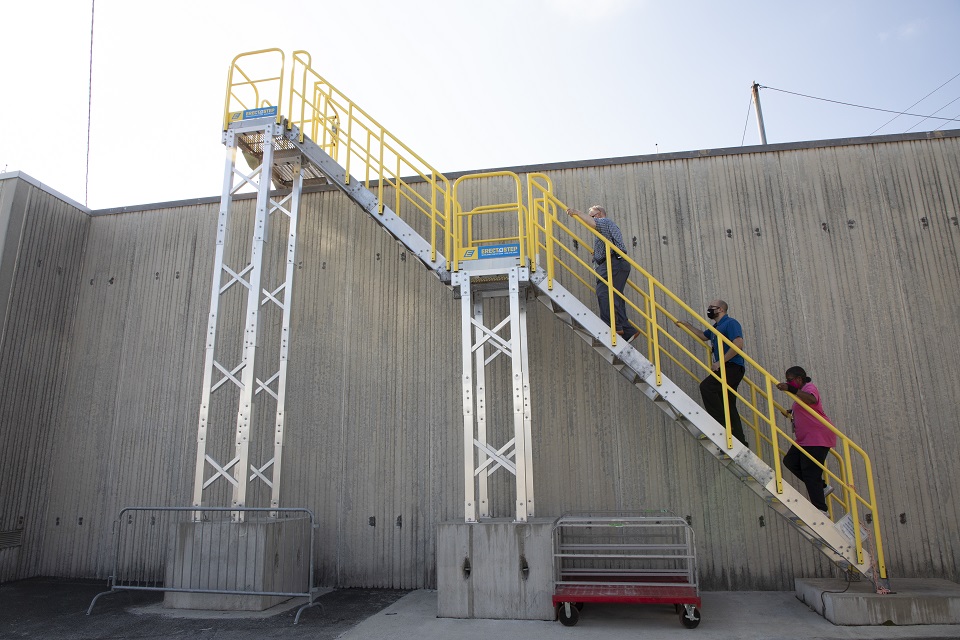
A roof access staircase at Y-12’s Building 9720-05 makes maintenance and surveillance safer for workers.
Steps in the right direction have been taken at Building 9720-05. A roof-access staircase was installed June 2020. It allows safe access to the roof and enables workers to efficiently complete surveillance and maintenance activities.
“The staircase provides maintenance personnel and other employees with safer and easier access to rooftop equipment,” said Program Manager Beverly Ward. “We have also eliminated the cost associated with erecting and removing temporary access and fall protection.”
Other projects are in various stages of planning and funding, so more workplace improvements will be implemented at Pantex and Y-12 in the months ahead.
Patriotism has deeper meaning at Pantex Plant
As the nation approaches Patriot Day, the memories created by the attacks on September 11, 2001 will forever be engrained in the minds and hearts of Americans, and those events forever bound the nation together in Patriotism. The memories of that day will never be forgotten, and each year the anniversary of the September 11, tragedy brings Americans together to remember the bravery of both first responders and everyday heroes.
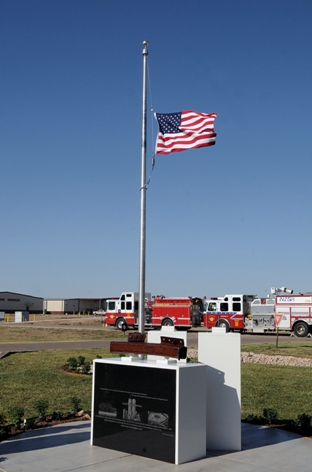
As lasting tribute to those first responders and everyday heroes, a memorial with a connection to the 9/11 tragedy was built right here at the Pantex Plant. That connection? A piece of steel from the World Trade Center.
This steel was incorporated as part of a permanent memorial monument to those lost on 9/11 and can be found outside of the Pantex Fire Department.
“It is extremely appropriate that we place this memorial in front of the building that houses our first responders, because it serves as a symbol of our gratitude for the service they provide to this Plant,” Mark Padilla, Assistant Manager for Programs and Projects with the NNSA Production Office (NPO), said at the monument’s dedication in 2013. “It also serves as a bridge between our first responders and the first responders who gave their lives on that fateful day.”
Plans to create the monument at Pantex began in 2009 with a letter to the Port Authority of New York and New Jersey requesting a piece of the World Trade Center for a memorial monument. Once onsite, the steel was cut onsite in Pantex’s Machine Shop.
“It is important that we can visually see something tangible and realize that what we do at Pantex is important to our freedom and the American way of life,” said Donovan Morgan, retired Pantex Fire Department battalion chief, who spearheaded the memorial initiative.
Craft Supervisor and member of the Navy Reserve John Herrera oversaw work done on the steel in the Machine Shop. “I revere the World Trade Center steel just as I would a piece of steel from the USS Arizona,” he said. “On the USS Arizona, we had military personnel from the Navy and the Marines die on board when it sank. At the World Trade Center, we had civilians die from the deliberate attack.”
“During the attack at Pearl Harbor, the sleeping giant awoke,” said Herrera. “During the attack at WTC, it united all fellow Americans, both civilians and serviceman, as brothers and sisters. It changed the way we live and made us more aware of the existence of terrorism around the world. As I walk past the WTC memorial, I will remember the civilians that died on that day and the dark moments this nation has endured.”
In addition to the monument in front of the Pantex Fire Department, two other pieces of steel from the World Trade Center are on display at the NNSA Production Office onsite at the Pantex Plant and at the Pantex Visitor Center.
Each of these monuments and displays is a permanent reminder of the lives lost on September 11, 2001, and the patriotism of all Pantexans and the roles we play in national security.
9/11 Memorial at Pantex (2: 15)
Below are the reflections and remembrances on September 11, 2001, from some of Pantex’s first responders.
On September 11, 2001, my wife and I were on our way to the Chicago O’Hare International Airport returning home from vacation. On our way to the airport we heard the gut-wrenching news that the Towers had been struck and that the United States was under attack. After returning home and to work as a firefighter, I noticed that the relationship between the public and their local firefighters had grown in response to the 343 brave firefighters that lost their lives while trying to save others.
— Jamie Hall, Firefighter, Pantex Fire Department
On the day that the Twin Towers fell, I was eating breakfast with my pregnant wife and baby boy. As I looked into my son eyes, I couldn’t help but consider the many children waiting at the door for a parent who would never return. I watched as Fire, Police and EMS freely gave their lives in service to others. On that day, we were a nation that lost its innocent but renewed its allegiance. Out of the rubble a nation was forged, once again we became the “United” States of America.
— Joshua Brown, Captain, Pantex Fire Department
The Pantex Fire Department was completing daily readiness checks of apparatus, communication equipment, and personal protective equipment. I was in the department’s training room when a firefighter came and said an aircraft crashed into a New York skyscraper. It was a very hard and traumatic day for America. America and the world lost many precious lives that day, and continue to lose 1st responders and civilians today due to the contamination and exposures they encountered during the response and cleanup endeavor.
— Bill Ho Gland, Assistant Chief, Support, Pantex Fire Department
I think it hit the members of the firefighter brotherhood harder than most can imagine because when we watched those towers fall, we knew that there would be several firefighters killed and we felt the pain of loss personally. I have spent a lifetime caring about the well being of people I do not know, and that was what those 343 brave souls were doing that fateful day.
— Tony Dompe, Battalion Chief, Pantex Fire Department
How easily our lives can be taken from us. I will always remember that a lot of people died that day, and I will never forget that 343 firefighters died that day.
— Steve Lasher, Firefighter/Paramedic, Pantex Fire Department
In the aftermath, people from all aspects of life, regardless of race, religion, or political affiliation, reached out to support those in need with complete disregard for their own safety. It was truly a remarkable example of the spirit and devotion of all Americans.
— Jeremy Baker, Paramedic, Pantex Fire Department
What I most remember about that day is the feeling of helplessness. As a first responder, it is the hardest thing in the world not to help when help is needed. I guess we all helped in our own way by ensuring we fulfilled our firefighter responsibilities at home.
— Timothy Hunter, A Shift Battalion Chief, Pantex Fire Department
This article was originally posted on Sept. 11, 2019
NNSA Release: NNSA looks to recruit the next generation of nuclear security talent and hire thousands annually
Navigating the labor market can be a challenge, but it’s one NNSA's Office of Management & Budget is prepared to meet. With more than a third of the nuclear security enterprise’s workforce eligible for retirement within the next five years, attracting and recruiting top talent is a high priority for NNSA.
Read the full press release on the NNSA website.
Studies of migratory birds continue at Pantex
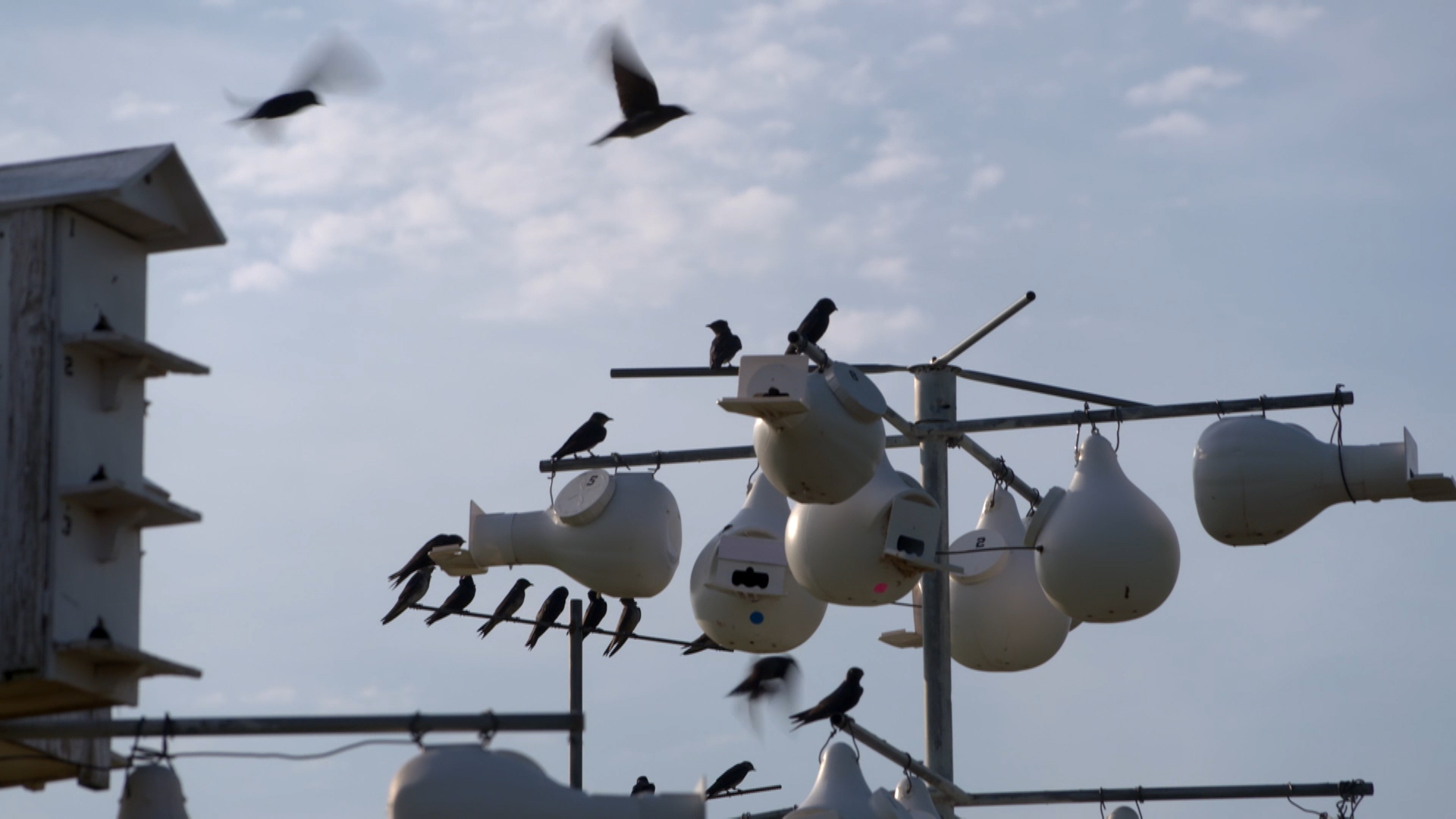
The purple martin is one migratory bird species Pantex biologist Jim Ray researches.
Back in 2019, the Council for the Conservation of Migratory Birds awarded Pantex and the U.S. Department of Energy/National Nuclear Security Administration the Presidential Migratory Bird Federal Stewardship Award. That award recognizes a project conducted in partnership with a federal agency that contributes to migratory bird conservation efforts.
The Pantex work was led by biologist Jim Ray of the Environmental Compliance department. Jim’s project, in conjunction with universities and conservation groups, developed a migratory bird management and research program that demonstrated a commitment to on-site migratory bird protection, outreach and diverse research strategies, and conservation efforts through North, Central, and South America.
That award was just another acknowledgement in conservation efforts still being pursued at Pantex. Those on-going efforts include two newly published research papers on migratory swallows, specifically the purple martin, which is the main migratory bird being studied.
“Purple martins give us a perfect opportunity to interact with the public and display our commitment to the environment,” said Ray. “It started with banding and then we joined the collaboration led by the University of Manitoba. We are one of 18 sites that deploy (miniature) tracking devices but one of only two currently active in the south, including Florida.”
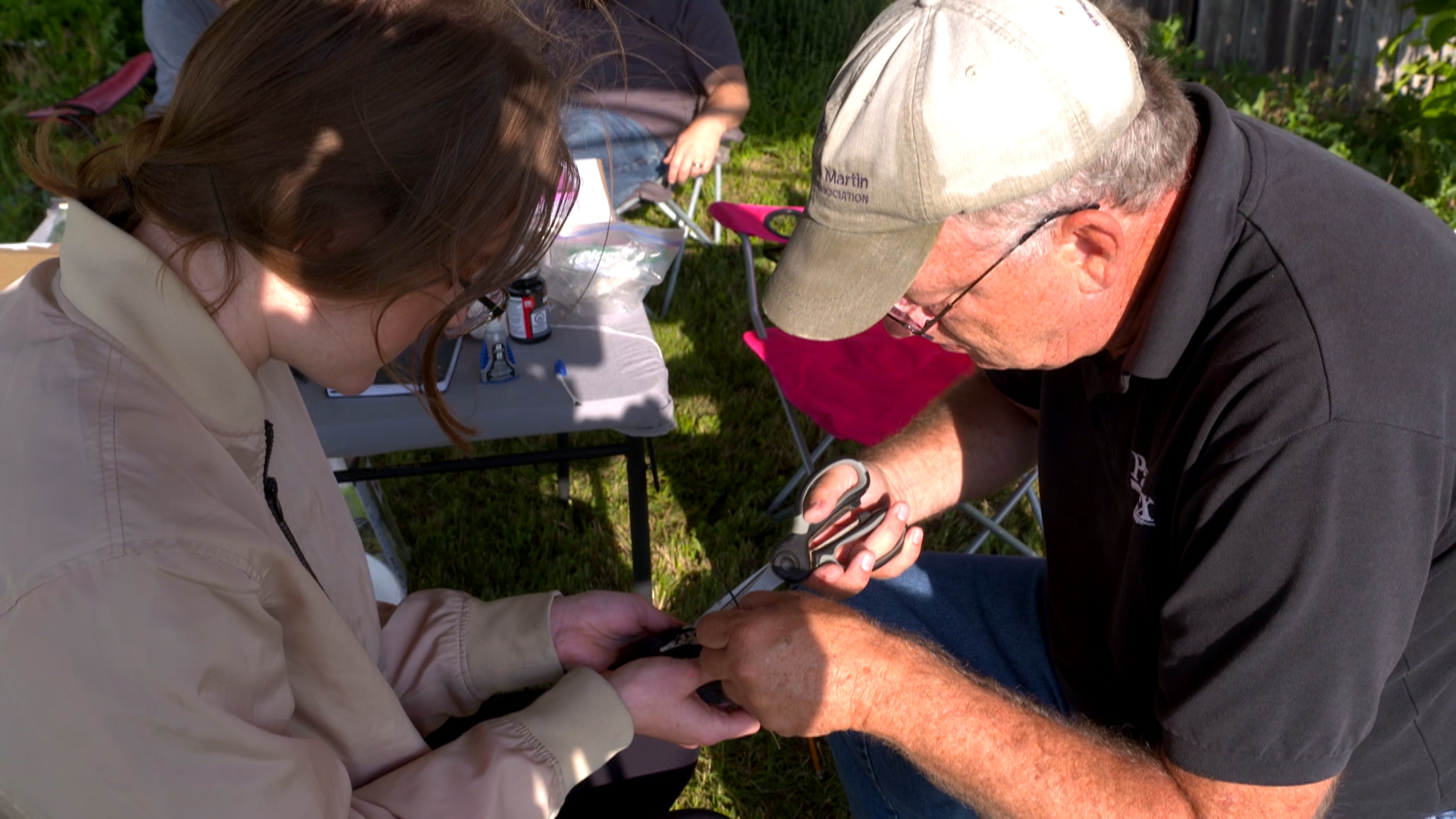
Pantex biologist Jim Ray and a student place a tracking device on a purple martin.
The newest set of research data focused on a couple of different sets of circumstances regarding migration. The first research found that the breeding latitude, specific sections of the country from north to south, is a significant factor in spring and fall migration timing, and the timing of nesting. This was revealed through analyses of data stored in data-loggers called light-level geolocators that were deployed on adult purple martins using tiny backpacks. Future studies will examine these timing patterns and climate change.

The second research examined migratory birds’ flight patterns. This time, using miniature Global Positioning Satellite backpacks, researchers got new data: confirming that more than 90% of the birds attempted open water crossings of the Caribbean Sea and the Gulf of Mexico, including night flight in about a third of those attempts. This kind of research, demonstrating night flight to help achieve time-and energy-savings through ‘short cuts,’ has never been attempted before.
According to Ray, “Geolocator and GPS technology allows—for the first time—an opportunity to study birds on a year-round basis, including in their wintering areas, and in the case of the purple martin, the Amazon River basin of Brazil.”
Ray added that possible future research may examine monarch butterflies, burrowing owls, and the effect of wind energy on bats.
Summer camp shares STEM knowledge
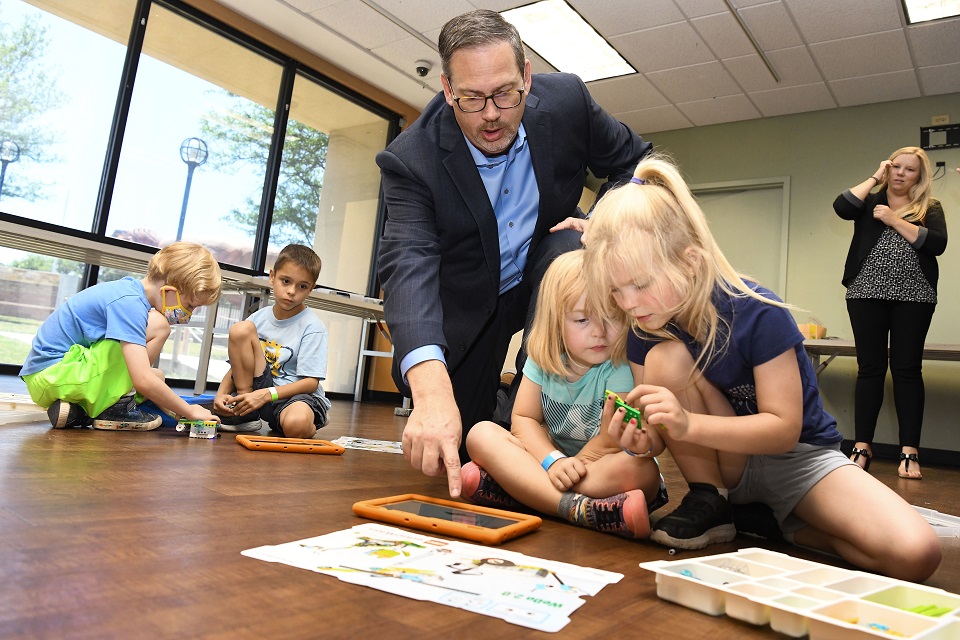
Pictured are several first graders with Pantex Site Manager Todd Ailes, learning about computer coding using equipment purchased in part by a $5,000 donation from CNS.
This summer, the Don Harrington Discovery Center was the place to be for kids from the Amarillo and Panhandle areas to have fun and learn about science through summer camps ranging from oceanography to engineering and some of the computer code in between. The camps took place from June 7 through July 23.
“Early coding skills are important for young children because they integrate problem solving, communication, and thinking,” DHDC Executive Director Wendy Taylor said. “Coding builds the foundation for a lifelong love of learning and exposures children to STEM careers like computer programming, robotics, and engineering. We are thrilled to teach children as early as three years old these skills during Coding Camp and other Discovery Camps this year.”
CNS donated $5,000 to help DHDC purchase some of the equipment needed to enhance this year’s camps.
NNSA Release: NNSA Sandia Field Office Manager Jeff Harrell retires after over 40 years of federal service
After four decades of federal service, NNSA Sandia Field Office (SFO) Manager Jeff Harrell retired July 31. During the week prior to his retirement, he celebrated his extensive career at a picnic held in his honor with the SFO employees who have been like an extended family.
SFO serves as the federal oversight for Sandia National Laboratories in Albuquerque, New Mexico, as well as its secondary site in Livermore, California, and other locations including the Kauai Test Facility in Hawaii; the Tonopah Test Range in Nevada; and activities in Carlsbad, New Mexico; Amarillo, Texas; and Minneapolis. As manager, Harrell was responsible for the overall administration of the management and operating contract and the operations of Sandia as well as the day-to-day administration of the SFO. He was also responsible for the stewardship of the NNSA Albuquerque Complex.
Read the full press release on the NNSA website.
Interns major in summertime learning
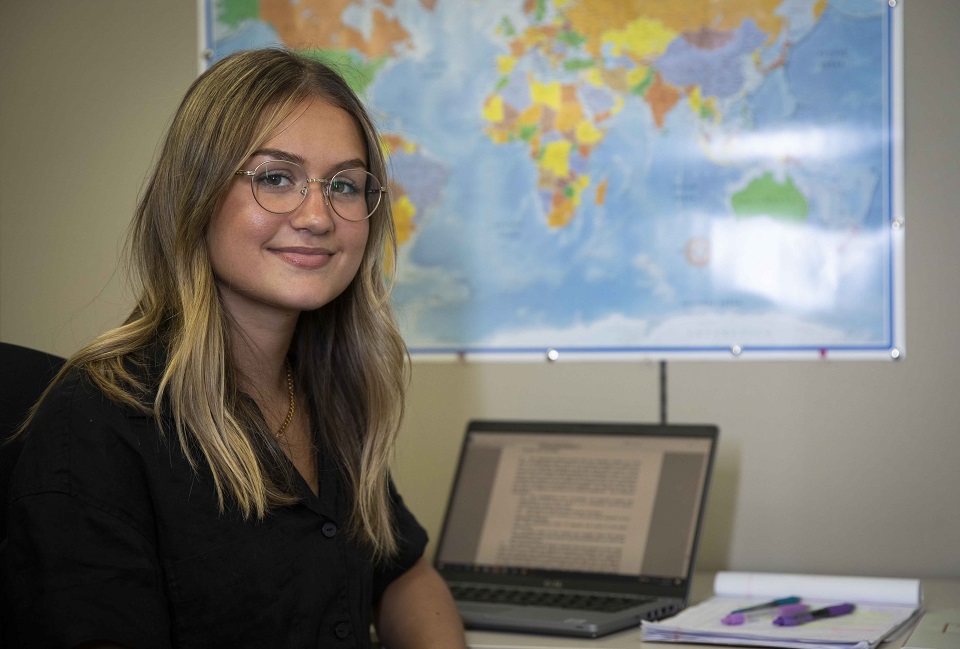
A political science major at UT, Asya H. is gaining knowledge about nuclear safeguards during her internship.
Asya H. comes from a family of engineers.
Her father, Ali, is a civil engineer and assistant director with Tennessee Department of Transportation; her brother, Arda, graduated in the spring with a mechanical engineering degree from the University of Tennessee in Knoxville. So, it seems she is a natural for the CNS Summer Internship Program.
However, Asya didn’t follow in her family’s footsteps and engineered a different path to her internship and arrived a UT political science major.
“My dad is a math whiz,” she said. “He can solve calculus problems in his head. All that math and science goes over my head.”
The rising senior is among 51 CNS interns, who hail from 13 states and 25 colleges. Y‑12 boasts 36 interns, while Pantex hosts 15. With an almost 50 50 split among male and female participants, the majority of interns, 33, are engineering majors, followed by computer science degree seekers.
“The intern program is definitely growing,” said Cristy Landrum, a human resources recruiter at Y‑12. “We had 40 interns last summer. We’re excited to welcome the interns onboard.”
The program began June 7 and offers specialized professional development training, which enhances communication networking, career goal setting, and professionalism. Each intern has a defined work scope and a summer project, which will be showcased at an expo August 10. The program ends August 12.
In summer 2020, the program went virtual because of the COVID‑19 pandemic. This year students have the choice of onsite, remote, and hybrid participation.
The lone political science major (with emphasis on international affairs) in the program, Aysa is going the hybrid route, spending a couple of days on site at Y‑12. Her goal is to become a lawyer and specialize in international nuclear law.
“It’s a very niche kind of field,” she said. “I have a lot to learn. I’m reading lots of legal documents,” which she is doing under the guidance of internship mentor Hannah Hale, a program manager within Global Security and Strategic Partnerships at Y‑12.
This summer, Aysa is primarily working with NNSA’s NA 241, Office of International Nuclear Safeguards. Within the office, she supports NA 241’s International Nuclear Safeguards Engagement Program — whose mission is to work with partners from around the world as they adopt and implement international nuclear safeguards agreements — a pivotal part of the nuclear non nonproliferation regime. For her summer project, she will participate in and support a virtual workshop about import and export reporting requirements under a safeguards agreement with 13 Middle Eastern states.
Kennedy V. is focusing on explosives technology at her third summer stint at Pantex.
A great introduction
As a three‑time intern at Pantex, Kennedy V. has gained a lot from the program.
“It has helped me develop my networking skills and grow as a scientist and engineer,” said the first year West Texas A&M University graduate student. “It’s been great. The hands on experience at West Texas A&M is limited, so coming to work in the Pantex laboratory, I was excited to gain more knowledge using the technology I learned so much about during my undergrad.”
This summer, Kennedy will examine things that go boom, but not really. She is an intern in Explosive Technology in High Explosives and Materials Testing.
“My project will involve the analysis of LM 17 mock composition, using a near infrared spectrometer,” she explained. “The mock material acts as a non‑energetic simulator for inclusion in test assemblies, where actual explosives would be hazardous or unnecessary.”
The composition of the mock explosive should react similarly to its real counterpart without detonation.
The process is only one stage of explosives testing, which has improved over time.
“Once developed, the near infrared technique should only take a couple hours to get composition results,” Kennedy said. “Newer methods have advanced this process to a few days, and there was even a time when it took multiple weeks.”
Kennedy, who also has an undergraduate professional chemistry degree, said “I love explosive technology. It’s a great introduction into the engineering world.”
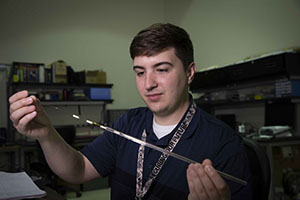
Y‑12 intern Joshua W. holds the sensors used in the ChIMES (Chemical Identification by Magnetoelastic Sensing) Sensor Miniaturization project.
Keeping it current
Intern Joshua W., a senior at Texas Tech University, has returned for his second summer at Y‑12.
“It has been a really great time,” said the electrical engineering major. “The technology is crazy. You learn a lot of stuff in school, but to actually see it play out in a real application is so different.”
Last summer, Joshua’s project was ChIMES (Chemical Identification by Magnetoelastic Sensing) Sensor Miniaturization. The technology differentiates types of and amounts of chemicals present in a system. Chemicals can be sensed through metallic and nonmetallic barriers. When a sensor that is attached to a magnetic wire is exposed to chemicals, the tension applied to the wire changes. This change alters its magnetic properties. For the project, Joshua’s objective was to help transform the tabletop device into a more portable version.
For summer 2021, “It’s a new project, same device,” Joshua said. “There’s still a lot of work to do.” This time he will focus on the device’s sensors.
“I’m going to learn how to fabricate the sensors for target materials,” he explained.
Also, Joshua hopes to install a new circuit board on the device. He has worked on the board for months as a research at Texas Tech.
“I’m integrating the board with a system that’s already built,” he explained. “I’m implementing lab work with a real project. I built this thing and [I am] not sure if it will work on the real device.”
Joshua acknowledges that many hands and minds have touched the ChIMES project.
“There is a long line of interns who have been working on this,” he said. “I’ve just added some of my own flourishes.”
Recognizing our IT systems administrators
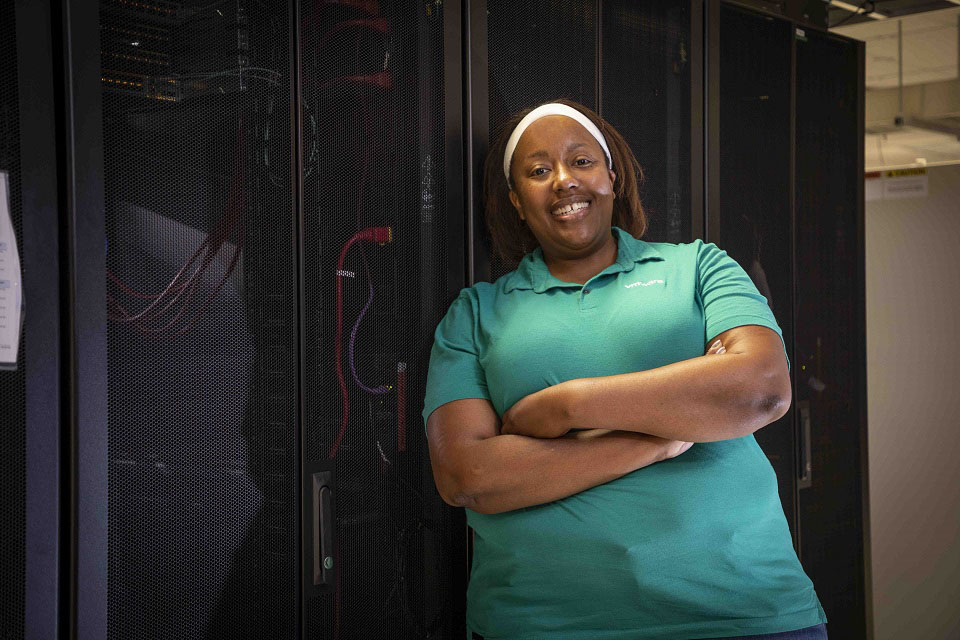
Kami Bush, who supports CNS’s VMware virtual infrastructure, stands in front of a Y‑12 server rack in Building 9117.
Think about your daily routine for work. Often, technology plays a role that is front and center. As a collection of hardware, software, applications, and networks, it has undoubtedly grown to serve as a gateway to how we connect with others, find information, track data, or essentially solve problems.
As end users, we infrequently question how or why technology works; it only matters that it does. Yet, behind the secured doors of an internal server room or the screen of a computer supervising our CNS network is an IT systems administrator ensuring that we’re operational and online.
“Our team of administrators are critical to how we connect and perform as an enterprise,” said Brad Burdett, director of IT Operations, who leads a team of more than 50 systems administrators.
From monitoring computer servers and data storage, maintaining virtualization and VPN capabilities, deploying new applications, to solving unplanned system outages, Information Solutions and Services’ systems administrators touch every point of technology at Pantex and Y‑12.
“The most essential skill an IT systems administrator can have is critical thinking,” said IT systems administrator, Kami Bush, who specializes in hardware, storage, and virtualization at Y‑12. “Planning a deployment, creating architecture, or troubleshooting a problem all require critical thinking skills. It’s important that we’re able to see not only the ‘forest,’ but also the ‘trees’ within.”
Keeping attention to detail, the scope of IT systems administrators requires that they look beyond the big picture and into to the ”trees” to monitor operational risks to existing and newly procured hardware, software, or applications connected to our internal network. With more than 2,000 servers and 2,4000 applications connected to the network, it is no easy task.
“The most challenging part of my career is keeping up with the technology. As soon as you get well‑versed in a version or architecture, a new one that is more efficient or powerful replaces it,” Bush said. “That constant advancement means you never get bored, but you also are always challenged to read up on the cutting edge as it will eventually be the new normal.”
Ask any systems administrator and most will agree that change is inevitable in technology. After 15 years at Pantex, IT systems administrator Edmond Keller has served witness and contributor to its growth at the site.
“I have been in the technology industry since 1985. While that does not quite qualify me as ancient in the industry, I am a bit of a dinosaur,” Keller said.
For point of reference, 1985 was also the year the .com domain was born.
“The technology industry consistently reinforces that when you think you have something figured out, there will be an event or situation which proves you really don’t know what you think you know. It is guaranteed humility training,” he said.
Entering the era of digital transformation across our nation and our sites, technology will continue to evolve to better serve the lives and work of our people. As we move from wired to wireless or cords to clouds, you can guarantee that an IT systems administrator will be behind it. In recognition of the 22nd annual IT Systems Administrator Appreciation Day this year, we thank all of you for your work and dedication at Pantex and Y‑12.
Pantex, Y-12 honored for sustainable electronics procurement with 2021 EPEAT Purchaser Awards

Amarillo, Texas — The Pantex Plant and Y-12 National Security Complex have been recognized as winners of 2021 Electronic Product Environmental Assessment Tool (EPEAT) Purchaser Awards. Consolidated Nuclear Security operates both sites under one contract for the National Nuclear Security Complex. The awards were formally announced at a virtual ceremony on July 28, 2021. They are given each year by the Global Electronics Council, which celebrates leaders in sustainable electronics procurement.
Pantex received the three-star award while Y-12 received the four-star award for procurements of Information Technology products, which included purchasing electronics with the EPEAT ecolabel in the following categories: computers and displays (including desktops, notebooks, workstations, integrated systems, and tablets); imaging equipment (copiers, scanners, multi-function devices); mobile phones; and servers.
The products are considered more energy efficient, less toxic, longer lasting, and easier to recycle than products that do not meet EPEAT criteria, while addressing labor and human rights issues along the entire supply chain.
CNS received calculations from the Global Electronics Council of the environmental impact reduction associated with EPEAT-registered purchases last year.
- Greenhouse gas reduction was equivalent to taking 287 average US passenger cars off the road for a year.
- Energy savings were equivalent to the average annual consumption of 528 US households.
- Solid waste reduction matched the annual waste generated by 68 average US households.
According to the Global Electronics Council, the combined cost savings for 6,730 products purchased in 2020 at Pantex and Y-12 was $280,778.
Consolidated Nuclear Security, LLC operates the Pantex Plant, located in Amarillo, Texas, and the Y-12 National Security Complex, located in Oak Ridge, Tennessee, under a single contract for the U.S. National Nuclear Security Administration. CNS member companies include Bechtel National, Inc.; Leidos, Inc.; ATK Launch Systems, Inc.; and SOC LLC. Pantex and Y-12 are key facilities in the U.S. Nuclear Security Enterprise, and CNS performs its work with a focus on performance excellence and the imperatives of safety, security, zero defects and delivery as promised.
For more information on each site, visit www.pantex.energy.gov or www.y12.doe.gov. Follow Pantex on Facebook, X or LinkedIn. Follow Y-12 on Facebook, X, and LinkedIn.
CONTACT
Steve Myers
Communications
Office (806) 573.0490
Cell (806) 236.2826
Stephen.Myers@pantex.doe.gov
CNS Community Investment Grant awards $100k to local organizations
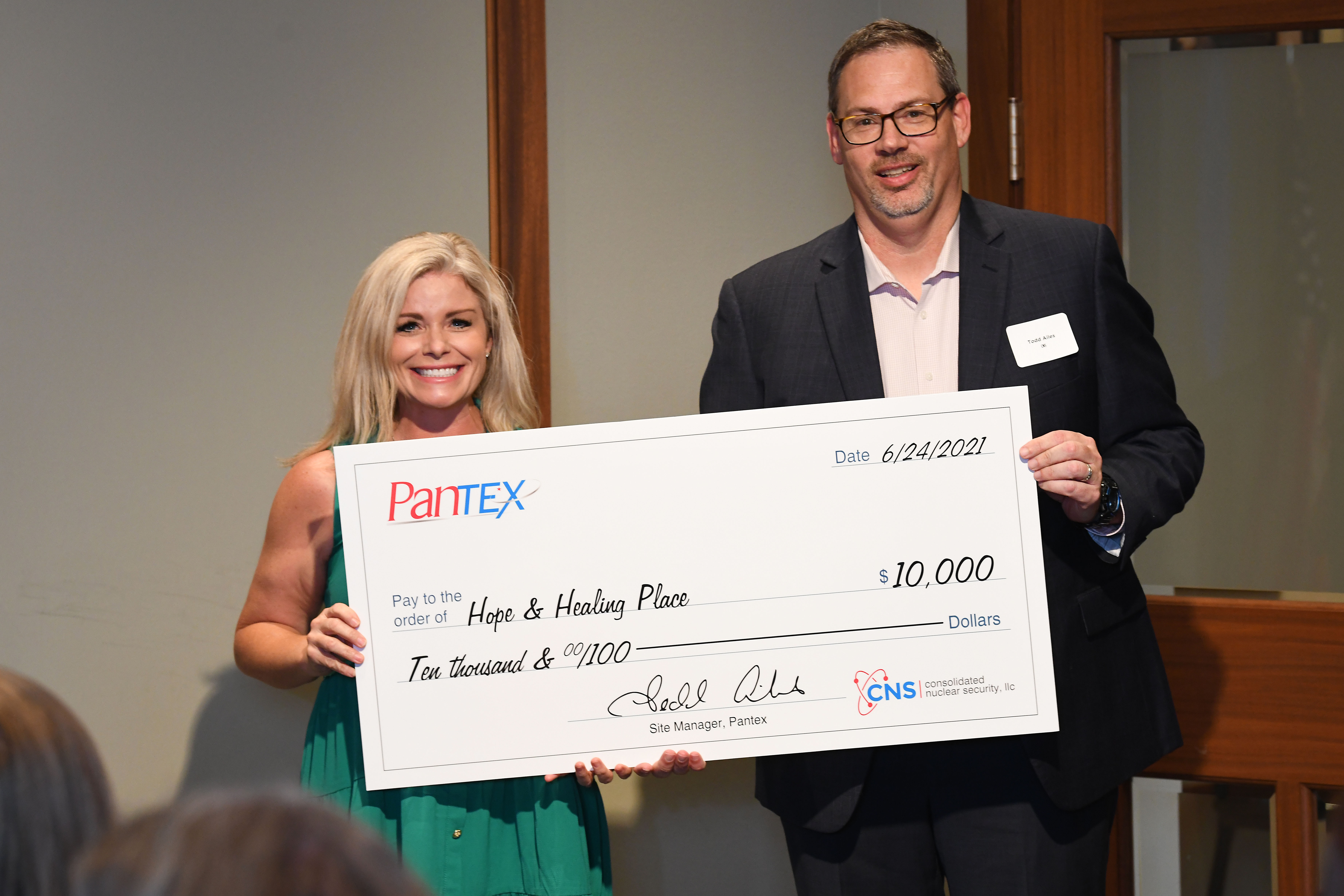
Fourteen Panhandle non-profits were awarded a total of $100,000 from the Consolidated Nuclear Security Community Investment Fund at a June 1 ceremony.
This fund is a partnership between Consolidated Nuclear Security, the management and operations contractor of the Pantex Plant, and the Amarillo Area Foundation. In its six years of existence, over $960,000 has been awarded to more than 50 area organizations.
“We are proud to be part of the Panhandle community, and proud to be connected with so many of you that work so hard to improve the lives of those who live here by providing services, opportunities, and hope,” Jason Bohne, CNS Senior Director of Communications said. “It is truly an honor to partner with the community through these grants, and we sincerely appreciate all that you do.”
This year’s recipients are:
- Amarillo Children's Home - $10,000 to support direct care costs for the Change the Ending Program for foster children
- Another Chance House - $5,000 to provide program support for food, health and wellness needs for men who are homeless or at risk of homelessness
- Buckner Children and Family Services - $6,700 to support FYI Foster Care Youth Program that provides training and preparation for adult living (PAL) life skills for individuals who are aging out of the foster care system
- Driskill Halfway House - $3,000 to support the Oasis and Independence Program for women overcoming addictions with washers, a refrigerator, and outside supplies
- Elizabeth Ruth's Home - $6,000 to support the ERH Experiential Learning Program for autistic individuals
- Faith City Mission - $3,500 to provide for basic needs for the homeless such as food, shelter, and clothes
- Family Support Services - $5,000 to support the Local Outreach for Survivors of Suicide Program, with counseling, site restorations, and short‐term accommodations
- Guyon Saunders Resource Center - $7,800 to support the Helping the Homeless Program by covering GED program costs and computer room costs related to client use for social services, employment, and housing
- Hope and Healing Place - $10,000 to provide scholarships for participants in the Generations Family Program which helps children and families walk through the grief process
- Junior Achievement of the High Plains - $10,000 to support the Biztown Program with IT equipment, such as tablets, servers, phones, and electrical equipment for student simulations as they run mock businesses
- Maverick Boys and Girls Club - $9,000 to provide for Snapology and STEM materials for students
- Mission Amarillo - $10,000 to support the 365 Dad Program with startup curriculum and supplies
- Panhandle Orphan Care Network - $10,000 to support the Moses Closet Expansion with clothes, diapers, and supplies for families receiving placement of new foster child(ren)
- Ronald McDonald House Charities of Amarillo - $4,000 to support the 2021 House Security Service of a security guard during the 6 months of transitioning back into a newly constructed house while volunteers are on hold until COVID restrictions are lifted
CNS first met with the Amarillo Area Foundation in 2014 to work together to establish an innovative and effective method for contributing to the community in a way that would also better engage Pantex employees. Continued conversations led to creation of the Pantex Community Investment Fund.
A committee of Pantex employees reviews and recommends the grants that will be awarded from the Community Investment Fund. Committee members are chosen to serve two-year terms to represent all Pantex employees.
“Along with performing their day jobs as experts in their fields, contributing to Pantex’s success in meeting its national security mission, each of these employees has volunteered their time and expertise in an effort to benefit their community,” Bohne said.
Eleven committee members were also recognized for their service during the ceremony.
Seven completed their two-year term on the committee this year. During their time on the committee, 26 nonprofits in the Texas Panhandle received $221,500 in grants, helping those organizations to expand or continue their missions.