



News
Boy Scouts tour Pantex
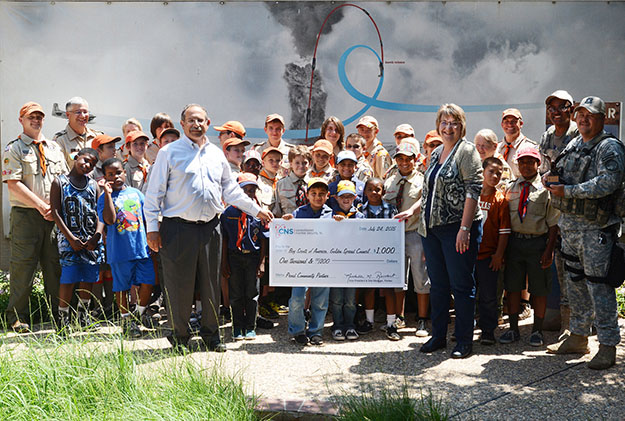
About 40 Cub and Boy Scouts from Amarillo recently had the chance to tour the Pantex visitor’s center and learn more about the history of the plant and its mission.
The scouts, from Troops 86 and 702, are part of the Golden Spread Council, and executive scout assistant Bob Altman said this kind of opportunity will have long reaching effects.
“We’re thrilled to be able to come out here. These young men are excited to be here, and you never know what seed was planted in the minds of these scouts. They may even work out here someday. This is really a great opportunity for them.”
Along with the tour, the Golden Spread council received a check for $1,000 from Consolidated Nuclear Security in support of their organization.
CNS supports Girl Scout Luncheon
Consolidated Nuclear Security, LLC was a proud corporate sponsor of the recent Women of Distinction award luncheon hosted by Girl Scouts of Texas Oklahoma Plains. The event is an annual celebration of influential women in the Texas and Oklahoma Panhandles who support Girl Scout leadership programs.

Pantex Site Manager Michelle Reichert (third from right) was joined at the Girl Scouts Women of Distinction award luncheon by Pantexans Jessie Phifer, Halianne Crawford, Brandy Ramirez, Courtney Waddell, Mig Owens, Rebecca Heinen and Christa Glasgow
Savannah Gates, a former Pantex process engineer, was honored with the Discover Award for her work on a tiny house project. Gates, along with Pantex engineers Rebecca Heinen, Brandy Ramirez and Courtney Waddell, joined forces with Girl Scouts and community volunteers to turn an old camper into a tiny home for a woman in need. Pantexans have also demonstrated their commitment to Girl Scouts through the S’More Engineering and Smart Cookies programs.
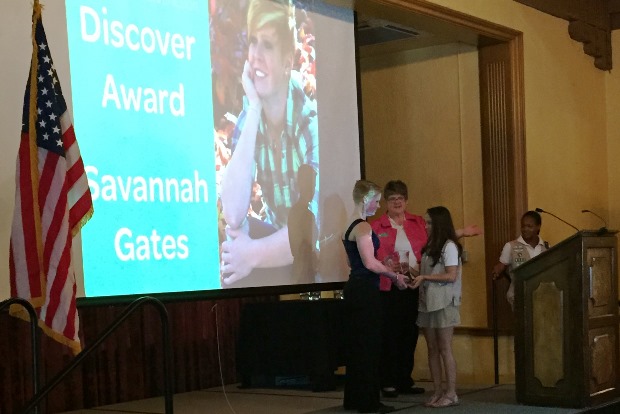
Savannah Gates, former Pantex engineer, accepts the Discover Award at the Girl Scouts Women of Distinction Award luncheon.
Pantex Hiring Event A Success
Consolidated Nuclear Security, LLC (CNS) managing and operating contractor of Pantex, held a hiring event Aug. 8 at the Amarillo College Business and Industry Center. Thanks to partnerships with the Texas Workforce Solutions Panhandle and Amarillo College, the first‑of‑its‑kind hiring event for Pantex was a success.
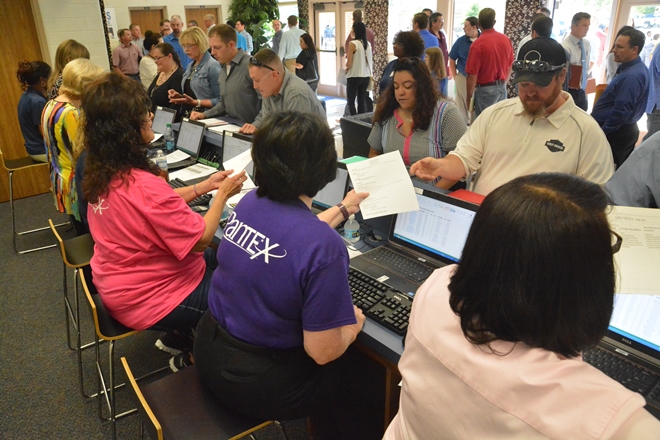
Workforce Solutions Panhandle helped spread the word through social media that Pantex was looking to fill more than 100 open positions. Would be job‑seekers from as far away as Florida and Arizona made their way to Amarillo for the chance of landing a job at Pantex.
Hiring managers screened and interviewed candidates for jobs in accounting, engineering, emergency management, information technology, maintenance, medical, production, quality, radiation safety, supply chain and utilities.
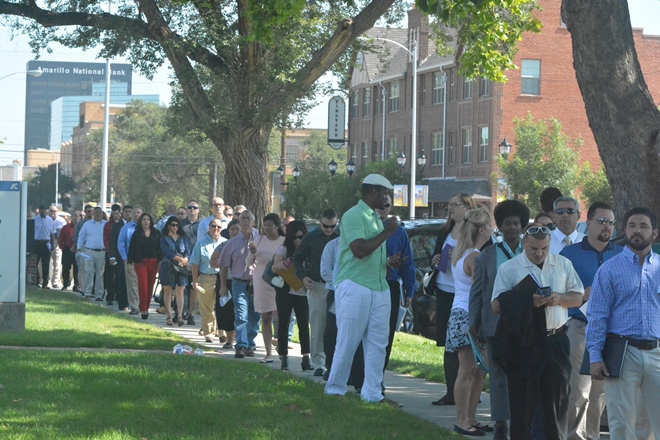
CNS Director of Workforce Strategies Heather Freeman said they were very pleased with the turnout, with potential employees lining up in droves for a Pantex job.
“The event was a success because we were able to meet and interview so many local, regional and out‑of‑state candidates. Hiring managers conducted about 175 interviews on‑the‑spot,” she said. These new jobs would add to the 3,100 people the Plant already employs.

Job offers have already been extended and accepted for several positions. In fact, the majority of offers are expected to be sent out within the next two weeks.
“We were very pleased with the response to the event and expect to make offers over the next two weeks from candidates we interviewed at the event. Additionally, we have begun scheduling on‑site interviews for candidates we met at the event, but were not able to interview that day,” added Freeman.
Plans for future hiring events haven’t been finalized yet, but with the amount of interest shown at the initial offering, organizers will consider holding more of these events to find qualified candidates to help carry out the important Pantex mission.
“We will definitely consider doing like events in the future,” Freeman said.
CNS names Guess Director of Nuclear Safety Oversight
Ken Guess recently joined Consolidated Nuclear Security, LLC as the director of Nuclear Safety Oversight. A 25-year submarine officer in the U.S. Nuclear Navy, Guess’ most recent position was as Power Ascension Test Director in the Operational Readiness department for the Tennessee Valley Authority’s Watts Bar Nuclear Unit 2.
“I’m excited to be starting a second career here,” Guess said. “Organizations that have aging infrastructures like Y-12 and Pantex have challenges. My goal is to continue the focus on the mission, ensuring we’re all doing the best job we can for the security of our country.”
Bill Heineken, director of Nuclear Operations Support, said, “I enjoyed that Ken has been an end user of both Pantex and Y-12 products. While in charge of those products, he had complete confidence in their quality and efficacy.”
Guess said, “As a strategic weapons officer on a missile submarine, we were ready to execute. I never even remotely doubted that the weapons systems would work as advertised.”
Heineken said, “Ken’s role is to integrate and execute the nuclear safety role and conduct of operations at the enterprise level. In searching for someone to hold this role, we wanted to make sure we had the right person to meet this challenge.”
Guess earned his bachelor of science and master’s degrees in electrical engineering from the University of Tennessee, Knoxville, and the University of Houston, respectively. He also earned technical nuclear power certifications from the Navy Nuclear Power School and Nuclear Propulsion Training Unit.
CNS Hosts Pantex Hiring Event
CNS partners with Workforce Solutions Panhandle and Amarillo College
AMARILLO, Texas – Pantex is partnering with Workforce Solutions Panhandle and Amarillo College to host a Pantex hiring event August 8, 2015. Representatives from Consolidated Nuclear Security, LLC, (CNS), managing and operating contractor of the U.S. Department of Energy/National Nuclear Security Administration’s Pantex Plant, will be on hand to screen and interview professionals and skilled trade workers.
Interested applicants should plan to attend the open house event from 10 a.m. to 3 p.m. at the Amarillo College Business and Industry Center, 1314 S. Polk Street.
Attendees should dress business casual and bring copies of their resume and be prepared to interview onsite. This event is open to individuals 18 years or older.
Interested applicants should visit www.pantex.com/careers to create a profile and apply for open positions.
Consolidated Nuclear Security, LLC (CNS) operates the Pantex Plant, located in Amarillo, Texas, and the Y-12 National Security Complex, located in Oak Ridge, Tennessee, under a single contract for the U.S. National Nuclear Security Administration. Pantex and Y-12 are key facilities in the U.S. Nuclear Security Enterprise, and CNS performs its work with a focus on the performance excellence and the imperatives of safety, security, zero defects and delivery as promised.
For more information on each site, visit www.pantex.energy.gov or www.y12.doe.gov. Follow Pantex on Facebook, X or LinkedIn. Follow Y-12 on Facebook, X, and LinkedIn.
Pantex and Y-12 piloting BUILDER as Centers of Excellence
Pantex, Y-12 and Lawrence Livermore National Laboratory recently completed the first phase of a software program pilot, designated as BUILDER Centers of Excellence by the National Nuclear Security Administration.
The three sites were chosen by NNSA in 2013 to pilot the program that helps facility managers and maintenance managers decide how best to maintain building infrastructure. The first phase was completed this spring and phase two should be completed this fall.
The BUILDER Sustainment Management System was developed by the U.S. Army Corps of Engineers to aid the U.S. Army in managing its 160,000 buildings. The goal of BUILDER is to equip building managers to proactively respond to infrastructure maintenance needs and thus reduce the chance of unexpected component breakdowns and system failures. The Department of Defense adopted the BUILDER program, and it’s also being used by the U.S. Marine Corps and Navy.
NNSA plans to roll out BUILDER to all its sites where the critical nature of the national security work makes preventing facility system failures and breakdowns imperative.
“Everything in a building has an estimated life. BUILDER allows us to track when components were last replaced and know when they will need to be replaced again,” Y12 Site Master Planner Jane Nations said. “This effort will greatly improve NNSA’s ability to more accurately determine maintenance and recapitalization costs across the complex, and improve how NNSA prioritizes all of the facilities as a whole.”
Nations said CNS was chosen as a pilot because of the willingness of its team members in Program Integration and Infrastructure to test and implement new initiatives.
CNS completed the first phase of implementation, which entailed inputting data for mission critical facilities in March of this year. Phase two will be completed this fall, fully populating the system with all buildings in the inventory. Once this is completed, condition and functionality assessments will be performed and data entered. The goal by 2018 is to complete data loading on the total 345 facilities at Y12 as well as 620 at Pantex, then implementing the program to plan maintenance and repair projects.
Ultimately facility managers and maintenance mangers will use the BUILDER program to measure maintenance investment and condition index at facilities across all eight NNSA sites.
The Phase 1 and 2 process included the development of property data (e.g., year built, square footage, master equipment list and construction materials). More detailed information will be hand gathered such as system inventories and condition inspection results to complete the information for each facility record.
Pantex’s Steve Patterson, Infrastructure Facilities Services, said he and his team members are proud to work alongside their Y12 colleagues to assist NNSA with the implementation of BUILDER. He anticipates the program will allow for cleaner, leaner and more accurate data.
“With most sites facing limited resources and funding, accurate asset management information plays a critical role in property lifecycle management, maintenance budgeting, program missions and sustainment,” Patterson said. “Pantex is already seeing great potential with BUILDER.”
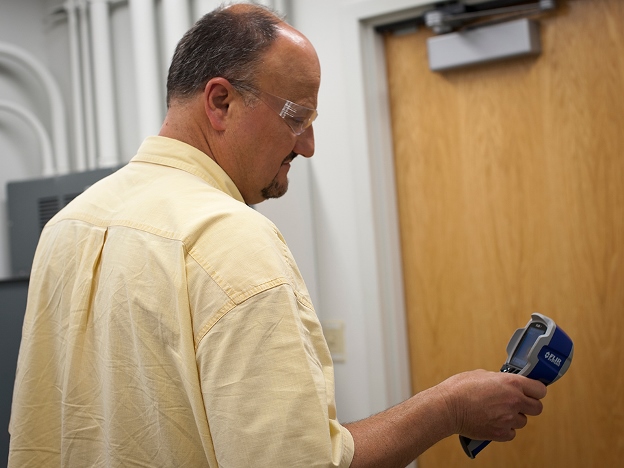
Electrical inspector Ken Miller demonstrates how a thermal imager is used during facility condition assessments, which provide data for the BUILDER Sustainment Management System.
Day in the Life of a Pit
With underground testing long out of the question, the health of the country’s nuclear weapons stockpile relies in part on pit testing conducted at Pantex. At Pantex’s Special Nuclear Material Component Requalification Facility, pits — a nuclear weapon’s heart — are probed for analytical data.
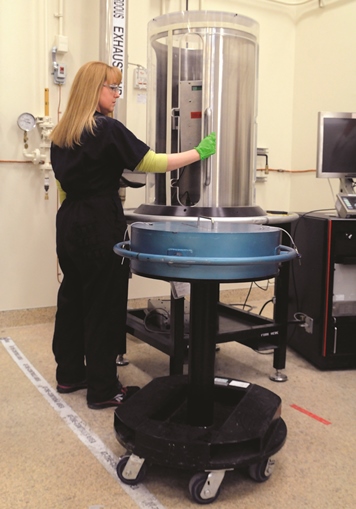 “When we obtain a pit, it is unpackaged, cleaned, visually inspected and weighed, and a leak check is performed to ensure it’s sealed,” Special Nuclear Materials Department Manager Randall Hodges said. “That’s when it goes to either the Laser Gas Sampling System for surveillance or the integrated pumpdown and fill station for requalification.”
Akin to a blood draw, the Laser Gas Sampling System enlists a laser to drill a hole into the pit tube the diameter of a human hair to obtain a small amount of gas. The same laser welds the hole shut, and the gas sample is transported to the gas lab where a determination is made about its composition.
A second process is comparable to a blood transfusion. The integrated pumpdown and fill station’s high‑energy laser drills a hole in the pit tube, the gas is replaced, and the laser welds the hole shut. These gas samples also head to the gas lab for analysis.
Both systems support the overall Pantex mission. Requalification allows a pit to stay in the stockpile; surveillance involves obtaining information on a pit, then sharing it with the national laboratories to help certify to the President that the nuclear weapons stockpile is at an extremely high level of quality.
“Our most important work involves the surveillance and reprocessing of nuclear material for nuclear weapons,” David Cole, Weapons Operations director, said. “It has to be very high quality given the lack of underground testing. We can’t build new, so we’ve got to take components that were not designed to remain in the stockpile this long and make them last longer.”
A pit’s visit to the Special Nuclear Material Component Requalification Facility involves much more than “blood work,” and the entire process can take four to five days. Microfocus X‑ray ensures that the pit’s weld is acceptable. Then, it revisits both the weigh station and leak test station.
Additional steps include the dye penetrant station, coordinate measuring machine and Tube Evaluation Test System. The pit is then re‑marked and its condition documented at the pit imaging station. Finally, it is repackaged and sent back to the warehouse for future use in another weapon.
A second Laser Gas Sampling System, referred to as LGS2, will soon double Pantex’s operational capacity, increase reliability and provide higher quality and more consistent welds.
“The laser in LGS2 is a newer technology system that runs off laser diodes rather than flash lamps, and produces more consistent operation as it ages,” Nate Davis, former Special Nuclear Materials Technical Department manager, said. “It also allows the use of fiber transmission of the laser rather than a complicated mechanical/optical train, which alleviates maintenance time involved in aligning the optics.”
A second requalification process, to be designed in house, is expected to be installed at the end of fiscal 2016.
Hub of the High Explosives Center of Excellence
The Pantex Plant manufactures high explosives to support the nation’s nuclear deterrent. Nuclear weapons require both high‑explosive charges and special nuclear material. Pantex’s experts manufacture the main‑charge high explosive by making the raw munitions powder, heating it in ovens and pressing it into a solid. The main‑charge high explosive surrounds the nuclear core, or pit, of a weapon.
For more than 50 years, the Pantex Plant has manufactured high‑explosive charges for every weapon in the nation’s nuclear stockpile. Much of that work is carried out in six aging facilities. But soon, high‑explosive operations will be conducted in the site’s newly built High Explosives Pressing Facility. The one‑of‑a‑kind HEPF will consolidate processes in a single modern facility, increase manufacturing throughput by 180 percent, and over the life of the facility, save $92 million in high‑explosive transportation costs.
For Lennon Mings, HEPF represents a quantum leap in high‑explosives operations. “This is a huge advancement,” said Mings, a high‑explosives pressing engineer. “While Pantex has always been at the forefront of pressing operations, HEPF will allow us to increase not only productivity but also our capability both in the size of explosive components and in improved process control, which equates to a better quality product.”
|
|
Mings and other Pantex engineers and technicians helped design the processes in the new facility so that equipment and tools are within easy reach, which drives efficiency, nearly doubles throughput without adding personnel and increases worker protection. Moreover, detailed information in the design model will aid in machine maintenance and repair.
Not surprisingly, the new facility will change how Mings does his job. “HEPF will be more reliable, which will free up my time to play a more active engineering role in operations,” he said. “I won’t spend nearly as much time troubleshooting issues with ovens and ancillary equipment that support pressing.”
In addition to more efficient processes and a revitalized infrastructure, other HEPF benefits include improved safety and reduced transportation costs. The 45,000‑square‑foot facility consolidates packaging, staging, pressing, machining and density operations, which decreases risks and costs associated with transporting a main‑charge high explosive from one building to the next.
“Because process facilities are scattered, today a main‑charge high explosive moves all over the site,” said Robert McClary, who heads up Pantex’s High Explosives Manufacturing organization.
“Every time you move it, there’s a risk … the potential to drop it or have a vehicle accident. With HEPF most everything is in one place, so we significantly lower that risk and save on transportation costs.”
Now that HEPF construction is complete, CNS personnel are prepping the facility for startup. Tooling is being moved in, network and security systems are being added and detailed procedures are being developed so that operations can begin by fall 2016. “We’ve got the keys to the building and now are readying it to make it operational,” McClary said.
Once operational, HEPF will be the hub of the Department of Energy’s High Explosives Center of Excellence for manufacturing.
“I grew up in Amarillo and for many years didn’t know the important role that Pantex plays in national security,” said Monty Cates, director of Explosive Operations at Pantex. “Now, as an employee, I can tell you we meet the mission daily. When we leave our homes in the morning to come to work, our goal is to protect our families and our nation. We know HEPF is key to securing America’s future.”
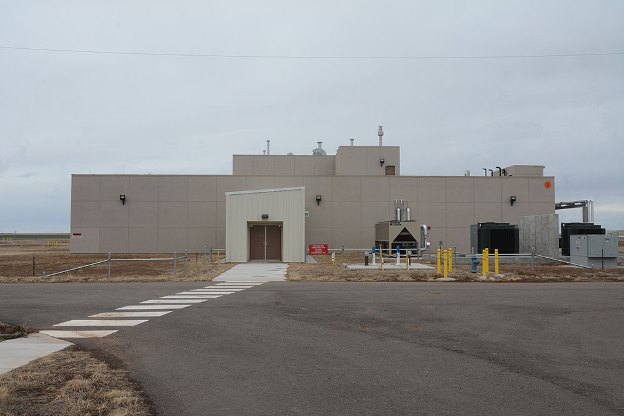
Building Makeovers - Vehicle Maintenance Facility
Operations began at the Pantex Plant in 1942, so it's no surprise many of the almost 650 buildings are in need of repair, renovations or refurbishment. Many of the issues with facilities were identified in the Quality of Life list that was developed after the Safety Culture Surveys in 2010 and 2011. Here’s an update on the Vehicle Maintenance Facility (VMF)at Pantex.
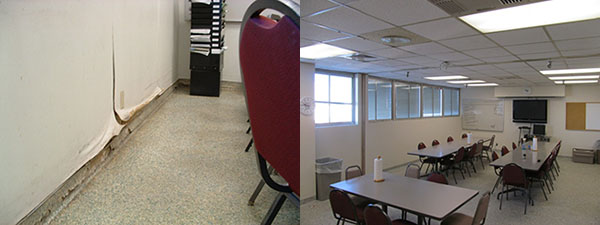
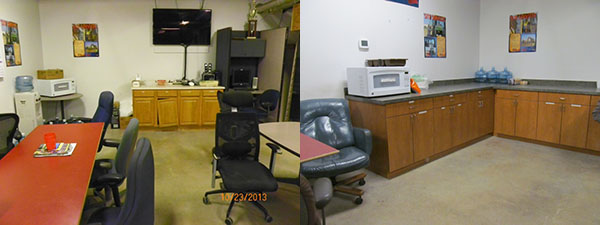
Although the VMF is a few decades newer than its predecessors, it has been in use since the 1980s – more than 30 years with no upgrades. In one break room, wallpaper was peeling and everything in the area seemed to stay damp. The kitchen area was completely overhauled with new cabinets, a sink and an oven. The mechanics break room was completely gutted and new dry wall was installed and painted.
Contractors also re-sealed the windows and replaced the floor. In addition, new filing cabinets were installed to honor requests to expand the storage in the break room.
The restrooms were equally problematic with dirt, stains and leakage. All the restrooms and shower facilities have been replaced completely. New flooring, dry wall, tile, lavatories, and plumbing were installed. The windows were re-sealed and some lockers were replaced.
Finally, an upstairs office was converted to a main conference room and smaller offices including new tile floor, painting and new cubicles. All the flooring, damaged or dirty ceiling tiles, and HVAC vents in the first and second levels were replaced.
The transformation was completed over seven months. The repaired areas look like new, and only products designed for longevity were used in the renovation.
VMF Men's Shower Before and After
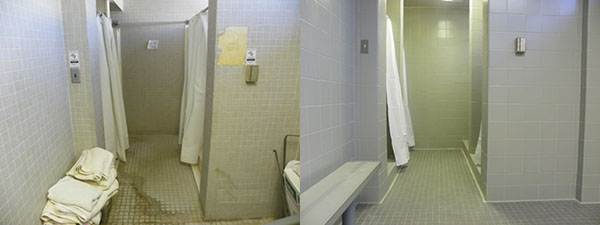
VMF Mechanic's Break Room Before and After
VMF Yard Group's Break Room Before and After
GWI Plan Ensures Focused, Consistent Approach to Improvements
Three years ago as part of the Quality of Life initiative, Y12 Production developed a standardized checklist for evaluating livability in the production facilities from criteria used by restaurants, schools and other public facilities. This systematic approach for renovations, using a standardized evaluation form, helped ensure equality across the facilities. Now, this evaluation method has been adopted enterprise wide and incorporated into the CNS General Workplace Improvement (GWI) Program Plan issued in January.
The intent of the GWI program is to identify, prioritize and execute activities that will improve the work environments at Pantex and Y12. The plan provides guidance for prioritization and execution of GWI projects and will be updated annually to define and communicate planned projects.
GWI Program Manager Jim Reilly said, “GWI investments provide basic human needs and help maintain or improve personnel safety. The GWI plan will ensure a focused and consistent approach to improving the workplace environments at both sites.”
GWI projects will concentrate on common areas, such as breakrooms, office areas, lunchrooms, restrooms, change houses, lobbies and parking lots, with improvements to lighting, HVAC systems, plumbing, carpentry, roof repairs, painting and walking surfaces. Renovations will be prioritized based on safety risk, severity of existing conditions, number of people affected, as well as future use.
In FY 2014, $9.3 million was invested in GWI, and both sites combined addressed nearly 500 GWI-related projects, which included direct employee concerns identified through the Pantex Safety Culture Advocates and the Y12 Employee-Driven Safety Campaign.
“The success of the GWI program is dependent on feedback from employees to identify scope and evaluate the effectiveness of completed improvement activities,” Reilly said. Currently, Y12 building managers and Atomic Trades and Labor Council safety representatives are reevaluating conditions in facility common areas by performing walk downs together and updating the 2012 ratings. A similar analysis is being performed at Pantex.
After the data are collected, the information from both sites will be evaluated and ranked by the Safety Culture Monitoring Panel to identify the highest-priority projects for the next fiscal year.
In FY 2015, several GWI projects are underway. At Pantex, six restroom/shower areas in Buildings 12-5, 12-5C and 12-6 are being refurbished, and the hot water system in Building 12-103, one of the plant’s primary change areas, is being replaced. Similarly, at Y12, the Post 8 pedestrian checkpoint has been enclosed to provide a climate-controlled area for personnel processing through the area. A second Y12 project involves reconfiguring the Building 9119 auditorium to provide a modern, large group meeting area inside the protected area.
“CNS is committed to investing in the GWI initiative to improve workplace conditions. The poor conditions in some areas that resulted from years of deferred maintenance, as well as everyday use, do not provide optimal working conditions. Such conditions lower morale and degrade the safety conscious work environment,” said Paul Wasilko, CNS Safety Culture program manager.
“Our goal is to strengthen our safety culture by addressing the needed improvements. These conditions cannot all be fixed overnight — but we now have a process in place to identify and prioritize the needed improvements.”