



News
Pantexans on the run for Amarillo
At a rapid pace and behind the scenes, Pantex employees are using their passion for running to benefit the Amarillo community.

Scott and Dee Weaver put on their running shoes to help Amarillo charities.
Dee Weaver, an accountant/financial analyst in the Finance and Business Operations Division, has been running competitively since middle school. “I always ran track in school and then back in 2000 I started running 5 and 10Ks,” Weaver said.
It doesn’t matter the size of the race; Weaver has run marathons in Chicago and Fort Worth, just to name a few, and even the Tempe Ironman, but one thing she really enjoys is being able to give back to the community. You can count on Weaver to send emails out to everyone reminding them about upcoming events, such as the Komen Race for the Cure or the TRI to Make a Difference triathlon held annually at Lake Tanglewood.
“I always send out emails letting everyone know about upcoming runs,” Weaver said. “And I always get tons of responses; some people can’t participate in the different events but still want to help. That’s something that never changes — Pantexans’ willingness to help others.”
Thirteen Pantexans competed in this year’s Tri to Make a Difference triathlon by swimming 400 meters, biking 10 miles and running 3.1 miles, all while helping raise money for the Children’s Miracle Network. During the summer, Pantexans also ran to help raise medical funds for a Pantexan’s family member who was battling cancer. “It was a last‑minute run, but many people were able to come together and raise more than $1,000 to help with the medical expenses for this little girl,” said Weaver.
Another member of the unofficial Pantex runners club is Steve Filipowicz, a Facilities Services senior manager. At age 61, he is currently training for his fourth ironman competition.

Steve Filipowicz runs in the TRi to Make a Difference Triathlon.
Much like Filipowicz, Rickey Hook, a facility manager for Waste Operations, enjoys the health benefits that running has to offer. “I was closing in on 50 and had never worked out regularly. I was 50 pounds overweight and took several medications to reduce my lipids and had taken an acid reducing drug for more than 20 years,” said Hook. “I was motivated by my wife, Vickie, to start working out, and not by her nagging or prodding me at all, but because she started and I saw the benefits to her.” Now at age 57, Hook is in excellent health, has lost 50 pounds and is no longer on medication.
Not only is running great exercise, but as Hook pointed out, it is a chance for you to bond with others, and that is something that Weaver enjoys about the activity. She and her husband, who also works at Pantex as a senior manager in Multi-Disciplinary Engineering, train together. “For me, it is so much more than just running — it is about the relationships you make along the journey. My husband, Scott, and I enjoy running and biking together. We help encourage and motivate each other to stay on track, keep pressing forward and cherish every mile together,” Weaver said.
One thing the three emphasize is that people interested in taking up running should take it easy and not get discouraged. “It took years to go from where I was to where I am now. It was a very gradual process but one that has been very gratifying,” said Hook.
Not only is running a physical activity – it is mental as well. “Training is all about building stamina. Sometimes you are out there and it hurts, but you have to push through it,” Filipowicz said. “The races at the Ironman distance, 140.6 miles, are won or lost in your mind. You have to learn how to push yourself through significant discomfort, and it can become very emotional.”
The informal Pantex runners’ club estimates their efforts for fiscal year 2015 have helped raise more than $5,037 by running various distances for local charities.
“I spend about 15 hours a week working out and training,” said Filipowicz. Not only does he enjoy running, but he uses it as a way to stay fit. “I won’t just work out for the sake of working out; running in different competitions gives me a reason to work out, and I need that goal to keep me going.” Apparently his method is working, because he has yet to have any health issues. “I’ve made it to 60 without needing any medications or having any health problems. I would like to keep going in that direction, and I think running is the main reason why I’ve been so healthy,” Filipowicz said.
Pantexans deliver ‘sunshine’ to single parents
A team of Pantex volunteers provided support to families in the Eveline Rivers’ Sunshine Cottages to put healthy meals on the table while the single parents prepared for finals. The cottages are housing for low‑income or homeless single parents who want to finish their education, work and raise their children in a safe environment.

Pantexans Caleb Rejino (left) and Danny Caverly, right, and Colin Caverly, Caverly’s son deliver meals to the Eveline Rivers Sunshine Cottages in Amarillo.
“Finals week can be a difficult time for anyone,” said Pantexan Caleb Rejino. “Eveline asked us to help the Sunshine Cottages by providing pre‑cooked or easy to prepare healthy meals. It is one less thing the parents have to worry about while studying for finals.”
Eveline Rivers, an Amarillo philanthropist, opened the Sunshine Cottages in 2001, with one home that was renovated into apartments. She now has six facilities with the goal to move “the whole family off the government system,” according to Eveline’s Sunshine Cottage website.
Residents of the Sunshine Cottages are required to take at least 12 hours of college classes each semester, work and ensure their children attend school. “These parents are working hard to finish their education and making sure their children learn by example,” Rejino said.
Rejino and members of his team delivered frozen casseroles and other items to the Sunshine Cottages Oct. 21. Rejino said nine members of the team cooked, and four anonymous Pantexans donated money to buy extra items.
The team was funded by Consolidated Nuclear Security. The Pantex Day of Volunteering was postponed so that both Y‑12 and Pantex can join forces next year. Some projects were approved for this year if the work couldn’t wait until 2016.
Pantexan Calvin Nelson secures recognition for expertise
Pantex’s own Calvin Nelson was recently awarded the 2015 Analyst of the Year for Transportation Security by the Department of Energy’s Nuclear Materials Information Program. The award, for which Nelson is the first‑ever Pantex recipient, recognizes outstanding analytic support to the NMIP.
 All transportation security analysts and criteria managers working in the program, including the national laboratories, submit nominations to the NMIP Program Management Office in Washington, D.C., where the finalists are selected. “Nominations are submitted based on an individual’s dedication, teamwork and diligence to the program,” said Tommy Butler, director of special programs. “For Calvin to be selected for this award is without a doubt noteworthy of his performance.”
NMIP is a Presidential Directive program, meaning it was one of a few programs that have been briefed to President Obama. Besides covering transportation security, NMIP also covers site security as well as materials properties.
Even with his 30‑plus years of experience at Pantex, Nelson was not expecting to win the award. “I was really surprised when I got the notification that I had been selected,” Nelson said. “It is a great honor, and I’m so proud to have the opportunity to work with some great folks at the labs and at DOE Headquarters. Also, it’s been great to bring some of these folks that I work with to Pantex and show them our unique capabilities.”
Going pink from Texas to Tennessee
From Texas to Tennessee, Consolidated Nuclear Security employees were in the pink for October. More than 100 employees, friends and family members participated in the Susan G. Komen Race for the Cure in the two locations while other employees wore pink and even dyed their facial hair.
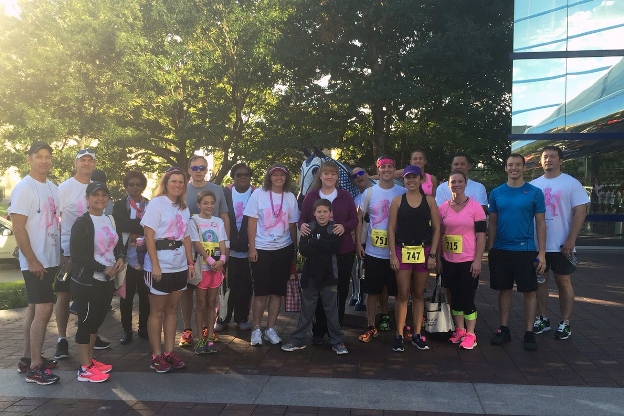
Pantex employees, friends and family members laced up their shoes for the Greater Amarillo Race for the Cure. CNS was a platinum sponsor of the event.
In Texas, about 75 Pantexans, friends and family members, including two breast cancer survivors, participated in the Greater Amarillo Race for the Cure. CNS contributed $2,500 to the Susan G. Komen Amarillo Affiliate as a platinum sponsor of the event and paid for employee registration. Curtis Chamberlain, a production manager, who ran in the event with his 11-year-old daughter, said it was a “good opportunity to spend quality time with her and support a worthy cause.”
In mid-October, Y-12 LiveWise hosted a women’s health fair and encouraged all employees to wear pink for breast cancer awareness. During the fair, employees could receive flu shots, participate in some health screenings and receive health information.

Employees, friends and family members from Y-12 prepared for the Knoxville Race for the Cure in the pre-dawn hours Oct. 24. (Photo by Big Orange Professional Photography)
A few weeks later in Tennessee, 33 Y-12ers joined the cause at the Knoxville Race for the Cure. CNS provided t-shirts for the runners in addition to covering employee registration fee. Shelia Scarfo of Y-12 participated with her two daughters. She said, “I walk with one of my daughters each year since my grandmother died from this disease, and my mother is a survivor.”
One Y-12 employee felt breast cancer awareness was worth significant attention and dyed his beard pink. Rodney Ryder, a lineman in Power Operations, dyed his beard pink noting “I have extended family members who are battling breast cancer.” When he went to a salon to inquire about dying it pink, the stylist agreed to do it (and provide any needed touch ups) for free, given the cause.
Ryder says all the teasing from co-workers is worth it. “When a woman tells me thank you or shares her story with me, I know my purpose of dying it was right. I’m thinking of doing it yearly,” he said.
Pantex Protective Force hailed as “well prepared, well trained”
In July and August, Pantex hosted the Office of Enterprise Assessments for a complete multi-topic inspection. The EA team consisted of approximately 100 subject matter experts in the topical areas of Safeguards and Security.
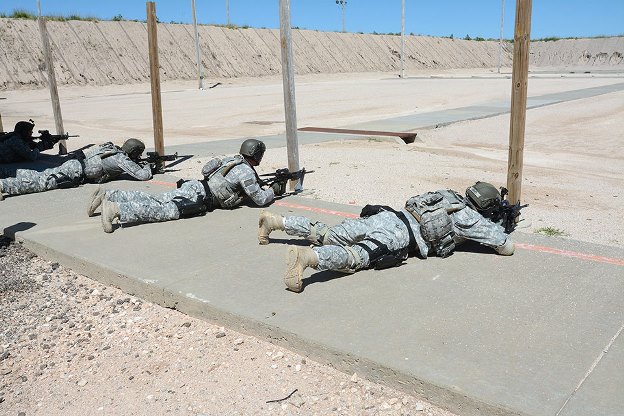
During the EA inspection, the Protective Force was required to perform a wide variety of tasks to demonstrate proficiency in protecting the site. During the inspection process, the Protective Force performed more than 250 limited scope performance tests. These tests included firearm proficiency, general knowledge testing, Special Nuclear Material recognition, use of deadly force, physical fitness proficiency and donning personal protective equipment. In most of these tests, the Protective Force performed at 100 percent according to the proficiency standards outlined in DOE Orders.
“During daily inspection update meetings, Protective Force management relayed comments that they had received by the EA team. Some of the comments included that the force was ‘well prepared,’ ‘well trained,’ ‘professional’ and ‘committed’ among other great remarks.” Audy Jones, Safeguards and Security Operations, said.
In the force‑on‑force portion of the inspection, the Protective Force was tested against a variety of simulated attack scenarios. These scenarios included an adversary team attacking the site at different hours of the day with a multitude of weapons using an array of tactics. The Protective Force was able to quickly recognize the threat to the site and, by following established plans developed within the guidelines outlined within the use of force policy, neutralize the adversary prior to them completing their mission.
“At the end of the exercise, the EA team stated that they should have videotaped the exercise as they had not witnessed this level of professionalism in an exercise at any of the sites they had visited previously. They went on to say that the bar has just been set for other sites.” said Michael Mitchell with Protective Force Operations and Training.
The EA team recognized the Pantex Protective Force their outstanding performance during the entire inspection. EA team members stated that Pantex is only the second site in the history of the inspection process to go through a complete multi-topic inspection and not receive any findings or issues in the final report.
CNS builds on AISD’s Robotics Program
CNS presents $20,000 check to AACAL
AMARILLO, Texas – Consolidated Nuclear Security, LLC (CNS) presented a $20,000 check today to students and administrators with the Amarillo Independent School District’s (AISD) robotics program at the Amarillo Area Center for Advanced Learning (AACAL).
“The donation from Pantex will allow students to extend their learning outside the classroom and practice the principles they’ve learned by applying them to real world complex problems. These projects are true engineering feats that build confidence in our students and allows them to continue to grow in their learning,” according to LeAnn Estep, AISD director of Career and Technical Education.
The donation will become a part of the AISD’s Project Lead the WayTM which is a nationally recognized pre-college engineering program offered at AACAL and Caprock High School under the science, technology, engineering and math (STEM) endorsement. Pantex is a long-time supporter of STEM education and is dedicated to investing in these programs.
“This provides Pantex an opportunity to encourage the next generation of scientists, engineers and technical professionals. We are pleased to have this opportunity to invest in the Amarillo school district’s efforts to further STEM education,” said Joe Papp, CNS director of Mission Engineering.
“Their gift is a perfect example of how blessed Amarillo ISD is to have such generous corporate partners. The money they have given will be used to advance our robotics program a step further and allow us to double the number of events in which our team will compete,” according to AACAL Principal Jay Barrett.
“Caprock High School is proud to partner with CNS Pantex and graciously accepts the generous donation on behalf of our robotics program. The donation will be used to provide our scholars with the needed funds to showcase their talents at more robotics competitions,” added David Bishop, Caprock High School principal.
The AISD currently supports the efforts of the Atomic Armadillos, 20-30 student team members who take part in yearly robotics competition.
Consolidated Nuclear Security, LLC (CNS) operates the Pantex Plant, located in Amarillo, Texas, and the Y-12 National Security Complex, located in Oak Ridge, Tennessee, under a single contract for the U.S. National Nuclear Security Administration. Pantex and Y-12 are key facilities in the U.S. Nuclear Security Enterprise, and CNS performs its work with a focus on the performance excellence and the imperatives of safety, security, zero defects and delivery as promised.
For more information on each site, visit www.pantex.energy.gov or www.y12.doe.gov. Follow Pantex on Facebook, X or LinkedIn. Follow Y-12 on Facebook, X, and LinkedIn.
CONTACT
Steve Myers
Public Affairs
Office (806) 573.0490
Stephen.Myers@pantex.doe.gov
CNS answers Food Bank’s request for assistance
CNS presents $10,000 check to Kids Café
AMARILLO, Texas – Consolidated Nuclear Security, LLC (CNS) presented a $10,000 check today to the High Plains Food Bank to help provide meals to students in the Panhandle area.
Executive Director Zack Wilson recently sent out an urgent request for funding for their Kids Café program. He stated that they have scaled back what they are able to offer to students in their after school programs, and if funding couldn’t be secured, many kids would find themselves without a hot meal.
"Kids Café is an opportunity to not only feed children, many of whom suffer from food insecurity, but also to focus on the importance of healthy ingredients that can still taste good when prepared with care.” shared Wilson. “It’s hard to focus in school when you’re hungry. Kids Café helps alleviate hunger, to ease at least some of the stress kids feel when food is not readily available.”
Representatives from CNS, managing and operating contractor of the U.S. Department of Energy/National Nuclear Security Administration’s Pantex Plant, presented the $10,000 check to the High Plains Food Bank to help in their time of need.
“For decades, Pantexans have supported numerous civic and non-profit organizations that serve our neighbors and the people of the Panhandle. It is in that spirit of giving and helping others that each and every Pantex employee should feel that they are a part of this gift to the High Plains Food Bank and the Kids Café,” said Pantex Deputy Site Manager Todd Ailes.
“Kids Café helps alleviate hunger, to ease at least some of the stress kids feel when food is not readily available. For just $2.00, the Kids Café can provide a hot, nutritious meal to a child. We are very humbled and grateful for this generous donation by CNS,” expressed Wilson. “This tremendous donation will continue to allow us to serve kids in our community, and grow the program to reach even more children.”
Consolidated Nuclear Security, LLC (CNS) operates the Pantex Plant, located in Amarillo, Texas, and the Y-12 National Security Complex, located in Oak Ridge, Tennessee, under a single contract for the U.S. National Nuclear Security Administration. Pantex and Y-12 are key facilities in the U.S. Nuclear Security Enterprise, and CNS performs its work with a focus on the performance excellence and the imperatives of safety, security, zero defects and delivery as promised.
For more information on each site, visit www.pantex.energy.gov or www.y12.doe.gov. Follow Pantex on Facebook, X or LinkedIn. Follow Y-12 on Facebook, X, and LinkedIn.
CONTACT
Steve Myers
External Communication
Office (806) 573.0490
Stephen.Myers@pantex.doe.gov
Building makeover at Pantex: three stations
Dating back more than seven decades, some of the Pantex buildings are in need of repairs. Recently, three stations received an overhaul as a Quality of Life initiative. Problems in these facilities included insulation, rusted doors and lights and non-functioning utilities.

“They were simply worn out. They were freezing cold during the winter, full of dust in the spring, and hot and full of bugs in the summer,” said Debbie Weeks with Infrastructure Projects.
The renovation team overcame myriad challenges to complete the work on schedule, including changed site conditions, Panhandle weather, electrical outages, resource constraints and scheduled coordination. Success was only made possible through the commitment of the team, a high level of cooperation across departments and management support.
“The biggest challenges we faced involved the dilapidated state. Almost everything we removed or replaced revealed more problems that needed to be addressed. The team really worked together to figure out and implement the best solutions safely and efficiently,” said Weeks.
The planning phase for the project began in March of 2013. Building 1 was up first on the drawing board, and the contractor began field work in November. Despite a typical Panhandle winter, we finished before Valentine’s Day in 2014.
Building 2 followed suit, and work began in July of 2014, with completion in January 2015.
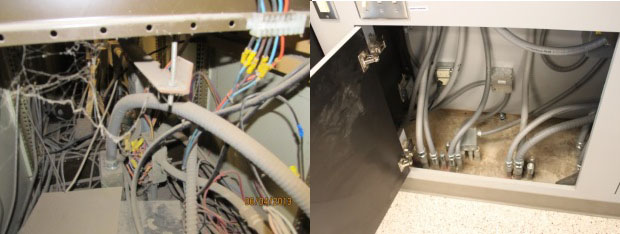
Building 3 presented some bigger challenges. An entire abandoned control bank and a trailer of wire were removed, and a functional millwork cabinet with streamlined console was installed. It received a coat of spray on insulation and was completed in July 2015.
Renovations at all three locations included new HVAC units, doors, window tint, epoxy flooring, dimmable LED lights, sidewalk lights, storage cabinets, traffic monitors, bird deterrents, pest deterrents and fixtures. Where needed, walls and ceilings were patched and painted, acoustical tiles were installed and exterior paint was applied.
“Now that the renovations are complete, many have commented especially on the comfort and functionality. The before and after pictures show the marked difference in the appearance,” added Weeks. “But to me, it went much deeper than that. Our entire team really took this project to heart and embraced the concept of improving the working conditions. It was very rewarding to us to help improve the quality of life,” said Weeks.


Integrating Safeguards, Security, & Emergency Services at CNS
Integrating organizations across two states (and two time zones) can be complex. The divisions within the Safeguards, Security, & Emergency Services organization have been working to integrate, standardize and consolidate their many processes at the Pantex Plant and Y‑12 National Security Complex and are making great progress.
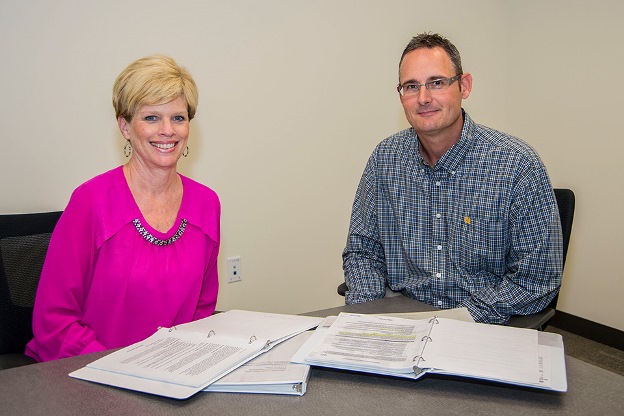
Linda Pyatt, Y-12 S&S Performance Assurance Issues Management, assists Gannon Tucker, the CNS SS&ES change control administrator based at Pantex, with consolidating security's document control.
The initial approach was to simply enable department‑level managers to integrate their processes with their counterparts. They were able to identify many ways to integrate, but it became difficult to fully execute those ideas. An Integration Management Team was created and charged with facilitating the divisions through this complex process. The team took on a systems approach and assisted each department manager with developing an integration plan for his or her group then guided and assisted them in surmounting obstacles as they worked through their plans.
Brian Deorocki of SS&ES Operations Management at Pantex explained, “Individual department managers focus on their areas and are not always able to see the big picture as it relates to all of the internal and external connections. The team, however, is able to see the system as a whole and is better able to integrate the moving pieces, so to speak.”
A steering committee oversees integration efforts and resolves issues that could not be resolved at the department level. The committee is comprised of the four direct reports to the SS&ES vice president. Ultimately, the S&S steering committee approves all integrating actions. The Integration Management Team works closely with various teams from Booz Allen Hamilton and is accountable to the steering committee to ensure no independent effort exists that will conflict with the CNS five absolutes.
These positive working relationships have enabled the development of integration plans and consistent processes. For example, the administration of random drug and alcohol testing can now take place at either site for visiting personnel. Also, the Annual Security Refresher Briefing had been a requirement for all personnel at Y-12 when the DOE order only required it for cleared personnel; that process is now standardized at both CNS sites and complies with the DOE order. Weekly security shares, used as security reminders during meetings, are now used jointly at both sites and can be accessed on the CNS intranet. In many cases, just the formalization and documentation of some long‑established informal processes naturally fit into the integration effort. The SS&ES integration strategy has been to work with each program separately and simultaneously.
Performance Assurance is leading the way toward integrating both security programs. This department provides internal services to divisions and easily transcends across those division lines, with standardized processes for assessments, issues management and performance testing. Performance assurance activities can also effectively identify gaps in other integration efforts warranting attention. To date, Performance Assurance is operating as one team to fully integrate the program across the enterprise.
SS&ES teams continue integrating the Pantex and Y-12 programs. A strong foundation cannot occur over night, but CNS security personnel are striving to see it completed soon.
Ken Freeman, SS&ES vice president, said, “The integration effort has been challenging, but we are very pleased with the work our employees are accomplishing. Through their continued collaborative and cooperative efforts, we anticipate having even greater success in FY 2016.”
Pantex supports March of Dimes
Pantex was a proud presenting sponsor of the recent March of Dimes Golf Tournament that took place Aug. 22. CNS contributed $8,000 to benefit the goal of healthy babies and mothers in the area. The annual golf tournament is a popular event among Pantexans. “Not only were we able to have a good time, we were able to support a great cause,” said Todd Ailes, Pantex deputy site manager.

Kenny Steward, Pantex quality operations director, knows the significance of being able to give and how it drives Pantexans to participate in multiple events throughout the year. “As one of the largest employers in the Amarillo area, it is important for us to give back to our community and support many of our charities both local and national,” Steward said. “It was an honor to be one of the 60+ employees to represent CNS and the Pantex Plant at the March of Dimes Golf Tournament.” Steward added that being a part of the first‑place team for the third flight was a nice way to top off the event. Pantexans who participated signed a commemorative banner and received a complimentary golf towel courtesy of CNS.
| Notable team results with Pantex participants | ||
| 1st Flight | 2nd Flight | 3rd Flight |
|---|---|---|
| 2nd Place Mike Smith Corey Boyd Bob McWaters Rick Allford |
3rd Place Paul Diaz Sr. Paul Diaz Jr. Steven Diaz Cameron Diaz |
1st Place Joe Marshall Todd Ailes Bob Asbury Kenny Steward |
| 3rd Place Doug Cruz Curt Hinz Jerry Tenorio Frank George |
2nd Place Jimmy Ramirez Harry West Tim Alvarado Arnold Galbraith |
|
| 6th Place Danny Sena Pat Sena Roger Williams Gary Haynie |
5th Place Tyson Sherwood Detrik Sherwood Grant Singleton Brad Henston |
|
| Long Drive # 18 A.M. — David Vasquez | ||