



News
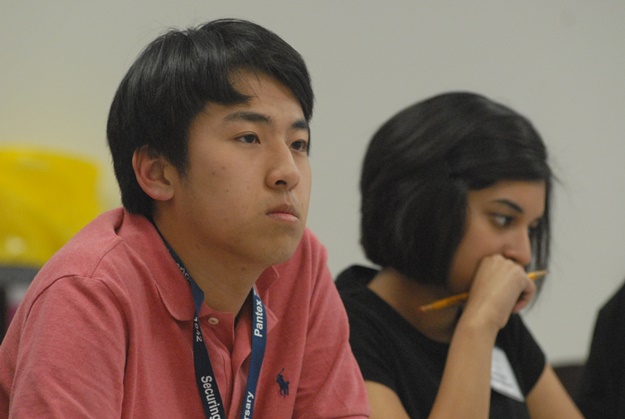
College Pre-Hires Visit Pantex
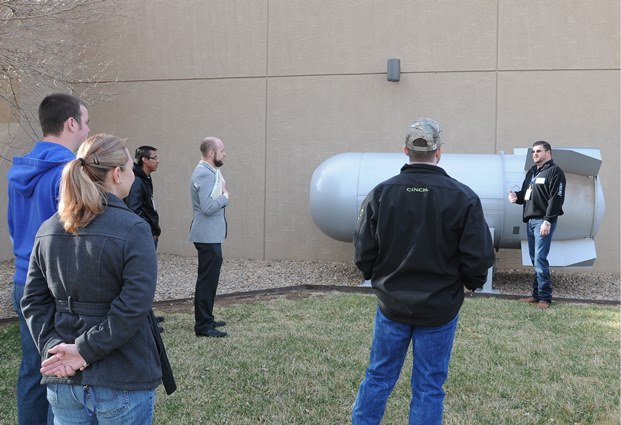
Engineering has always been an in-demand skill at Pantex, and for six years, the Pantex College Pre-hire program has worked well to help meet the need. But the growing demand for employees in other hard-to-fill jobs has meant the program is branching out in a new direction.
Shane Rogers, who has managed the pre-hire program since it started in 2007, just returned from a month-long tour of seven colleges in Texas and New Mexico. In addition to engineers, Rogers was looking for scientists and IT professionals who had important knowledge they could bring to the plant.
“We have had so much success finding and hiring engineers with the pre-hire program that other divisions started to approach us to see if we could help out,” Rogers said. “We’re hopeful that we’ll be just as successful expanding into these new areas.”
This is the first year Rogers looked for computer science (CS) and computer information systems (CIS) majors, in addition to the traditional engineering, math and science majors. The number of high-paying jobs in the IT marketplace makes it extremely difficult to find and recruit people with that skill set.
The pre-hire program reaches out to juniors and seniors who will agree to come to work at Pantex, in exchange for reimbursement of tuition and fees for up to two years. A group of students are interviewed at the schools, then selected candidates are invited to come to Pantex for a second interview and a chance to see some of the work done at the plant. The first semester of the program in 2007, Rogers made offers to six students. This semester, he hopes to make 26 offers.
Recruiters visit a variety of schools proximate to Pantex, including West Texas A&M, Oklahoma State, Texas Tech, University of Texas at El Paso, New Mexico State, New Mexico Institute of Mining and Technology and University of New Mexico. Students from as far away as Tennessee and Maryland have been invited for onsite visits following phone interviews.
“The idea is to essentially create a pipeline for students to come to Pantex from schools in our area,” Rogers said. “It benefits them by helping to defray some of the cost of tuition, and it certainly benefits Pantex by recruiting and retaining talented employees.”
Pantexans Donate Cookware to Charity
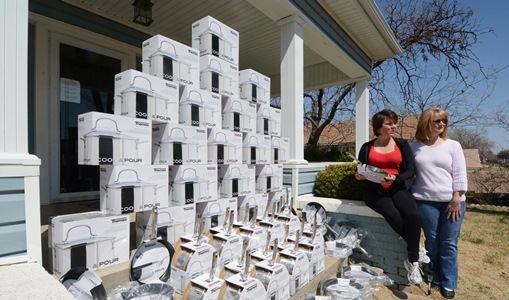
Cooking dinner will be a lot easier for about 20 needy families in Amarillo thanks to the generosity of Pantexans, who used a grocery store promotion to secure more than $6,000 of cookware for a local charity.
More than 70 pots and pans were donated to local charities by Pantexans Scott and Lauri Minton, who had been collecting stickers donated by their coworkers. The stickers represent nearly $100,000 in groceries purchased from United Grocery Stores, an area chain that has been giving stickers redeemable for cookware since October.
“I think this really represents the Pantex spirit. As Pantexans, we are always looking for ways to have a positive impact on our communities,” said Lauri Minton.
Lauri Minton said she and her husband started collecting the stickers when they realized they did not need new pots and pans, but that there were people in Amarillo who did. The Mintons spread the word around the plant, and were quickly overwhelmed with the positive response.
As the promotion entered the final days, word spread through social media, and the pace of giving picked up even more.
The pots and pans – over 21 complete sets – were dropped off at Martha’s Home Friday, an Amarillo shelter that provides a place to live for homeless women with children while guiding them toward a lifestyle of self-sufficiency. Several pots and pans were also donated to the Pantex Christmas Project, which has been providing Christmas gifts to needy families for more than 50 years.

Plant Tradition: Lunchtime card game ongoing for 40 years
Though some of the faces have changed, there’s one thing that hasn’t. If it’s lunchtime at Pantex, there’s a game of Spades taking place. What started as a way to pass the time in the cafeteria during lunch is a ritual for Andy Marshall, Dale Moon, Jimmy Myers and Kevin Brown, whose job it is to bring the cards.
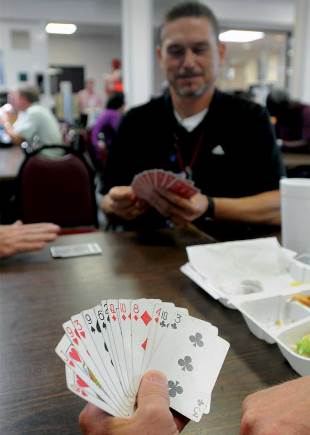 “It’s fun. I see it as a break in the action of the job. Kinda like recess in elementary school,” said Myers, a technical advisor and 33-year Pantex veteran. Eight hands are played each day with scores recorded in a log book. Why Spades? “It’s easy to play and eat at the same time,” said Myers. “Not much strategy involved.”
Two alternate players, Kenny Steward and Mike Brinson, fill in when needed. On call are Barry Hill, Pablo Reyes, Adam Myers and Ron Wilcox.
“People play until they retire, leave or are unable to play,” explained Myers. “We then usually let the first alternate in the game replace the starter.” At times, players leave Pantex to work elsewhere and then return to the Plant, as is the case for Steward and Brinson. “They are waiting for their chance to be the starting pitcher, rather than a bullpen ace,” said Myers.
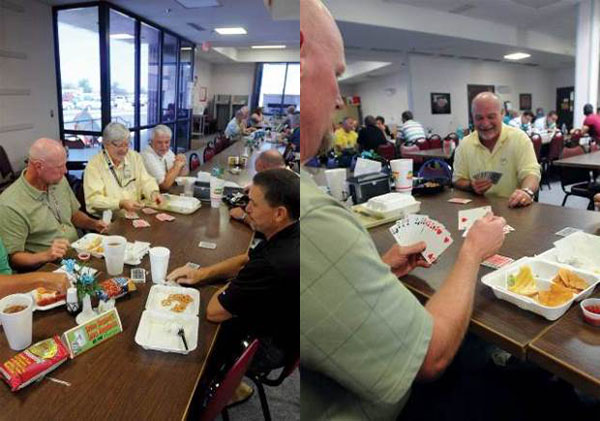
There’s not much Kevin Brown, program manager and 18-year Pantex veteran, doesn’t like about the lunchtime card game. “The camaraderie and competition, with a little trash talking, allows us a break from the hectic day, even though for just a short period of time,” he said. “It can be a stress reliever.”
Special rules keep the 40-year-old game interesting. One is that no matter how far behind you are, you can win in the last hand. But serious business it isn’t. “We usually remember everyone’s most ignorant play and then keep reminding them about it later,” said Myers.
Among Myers’ favorite memories is the time then-General Manager Denny Ruddy approached the group to ask what they were playing. “We all thought, well, I guess this game has come to an end. But, he was truly interested and began making fun of how Steward was playing his hands.”
CoLOSSIS Key to Nondestructive Stockpile Analysis
Pantex Home to World’s Only Computed Tomography Imaging System for Pit Surveillance
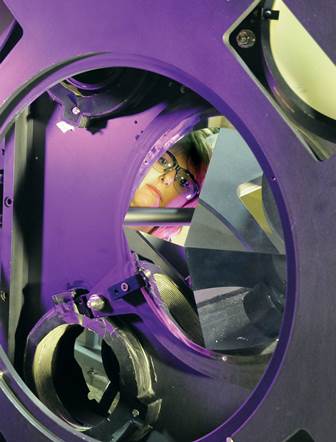
Dana Landrum, Quality Assurance technician, is reflected in the four-sided pyramidal mirror of CoLOSSIS, a computed tomography imaging system unique to Pantex and used to nondestructively determine the integrity of pits.
What does it take to look inside the core of a nuclear weapon? Start with four cryogenically cooled astronomy cameras capable of 8,000 by 8,000-pixel images, one four-sided pyramidal mirror and a burst of photons generated by an X-ray source nearly 100 times more powerful than a medical computed tomography (CAT) scan, and you have the world’s only computed tomography imaging system used to determine integrity of pits – CoLOSSIS.
As many as 1,800 images of each pit are taken over multiple days at Pantex using the Confined Large Optical Scintillator Screen and Imaging System, or CoLOSSIS, to nondestructively determine if they will function as expected. A pit is a component made of plutonium metal and is the heart of a nuclear weapon. The imaging is conducted on surveillance units as designated by the National Laboratories.
Prior to the introduction of CoLOSSIS three years ago, film was used for analysis of pits, which offers only a two-dimensional perspective. But confidence in the nation’s nuclear stockpile required more efficient technology.
The 32,000-pound, lead-shielded CoLOSSIS is operated by highly trained quality assurance technicians whose background stems from the medical or industrial non-destructive evaluation fields.
It takes an average of 15 to 18 hours for CoLOSSIS to work its magic, during which time a component rotates approximately 0.2 degrees for each image until it has rotated 360 degrees to capture an entire data set. During each rotation, the X-ray source known as a linear accelerator, or LINAC, produces photons collected by a scintillator that converts the photons into green light used to create a digital image. Collimators direct the energy, focusing the X-ray beam onto a pyramid-shaped mirror that reflects the light into the cameras, which in turn collect the data.
Data is then transmitted to Lawrence Livermore National Laboratory, designer of the system, and Los Alamos National Laboratory. The labs use computer code to reconstruct the analyses by stitching images taken by the four cameras into one. This offers scientists a three-dimensional view inside the nuclear weapon’s core that they can literally “walk through” to detect manufacturing flaws and the effects of aging.
“This system represents a successful collaboration between Pantex and the Design Laboratories, despite the technical challenges that are to be expected of a one-of-a kind system like CoLOSSIS,” said Gerken.
Designs for a second CoLOSSIS system are in the works and equipment is being procured, Gerken said. “Once operational, this system will give us a second line to aid in workflow throughput and could possibly provide capabilities for analysis of different components,” he said.
Pantex Behind the Scenes: Operations and Emergency Services Dispatch Centers
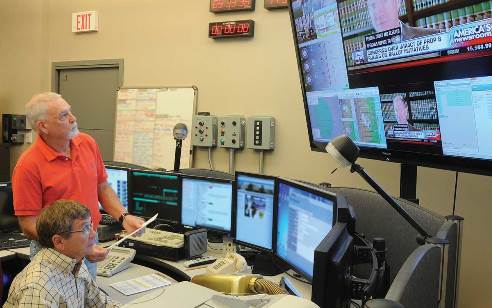
Robert Inglis and Forrest McLaughlin (seated) review incoming information at the Operations Center, the 24-hour base often referred to as the Heart of Pantex.
“May I have your attention please?” The room instantly grows quiet as Pantexan listen to the familiar voices for directions, notifications or warnings. The Operations Center (OC) is what some may call the Heart of Pantex. It is responsible for 24-hour management of operations to ensure the overall safety and efficiency of the Pantex Plant.
Established under the Department of Energy’s (DOE) Occurrence Reporting Program in 1990, the OC strives to provide information to the appropriate publics in a timely manner. The Center began operations in a small conference room with few supplies. The need for more equipment and space quickly became obvious. Soon after, operations moved to the building where they remain today.
With 12 years of experience at the Plant, Matt Eberly recently accepted the position as Emergency Services Group manager, which encompasses both Fire and Emergency Management Departments. “The work is extremely important because both the OC and Emergency Services Dispatch Center (ESDC) programs require prompt, safe and reliable action 24/7 to support Plant operations and our surrounding communities,” said Eberly.
“The ESDC and OC teams are required to operate in an environment where precision and effectiveness are critical. They essentially work in the nerve center of all Plant operations.”
The OC consists of nine employees, each with at least 30 years of experience at the Plant. Eight of them are Plant shift superintendents, while Bill Ornelas is Pantex’s Move Right specialist. The OC is responsible for a number of operations, such as weather notification activities, movement of materials and initiation of protective actions for Plant personnel.
Randy Nuttall, who started in the Maintenance Department, enjoys working in the OC because of the diversity within the job. “Every day is different. You never know what the call is going to bring. And it helps that I work with the best group of people,” said Nuttall.
 At the Plant's Emergency Dispatch Center, Dorcas Gaddis and Melodi Parton (seated) monitor fire alarms from the Center's testing console.
Across the hall from the OC is the ESDC. Similar to the OC, it houses nine employees working side-by-side. The ESDC is responsible for testing fire alarms throughout the Plant, assisting surrounding counties with emergency calls and for medical and fire emergencies on Plant site.
When the ESDC first started operations in 2006, Don Rhoades, a Pantex veteran, transferred with over 29 years of experience in security. He said the transition was easy and normal, and he enjoys where he is working now. “I love the job itself. Our main goal is to protect life and property, and when I go home at night, I feel a sense of accomplishment knowing that I helped people that day,” said Rhoades.
His colleagues, Dorcas Gaddis and Steve McWilliams both agree that communication is what makes them successful. McWilliams explained that the job comes with great pride in knowing potential lives are saved each day.
Pantex Nominated for Presidential Award
Work with migratory birds nets U.S. Fish and Wildlife Service award nomination
For the third year in a row, the Pantex Plant has been nominated by the Department of Energy and the National Nuclear Security Administration for a national award in recognition of its research on migratory birds.
Pantex will represent the DOE/NNSA in the competition for the 2014 Presidential Migratory Bird Federal Stewardship Award, which has been administered by the U.S. Fish and Wildlife Service since 2011. Each federal agency is eligible to nominate one project or action conducted by or in partnership with a federal agency that meets the intent and spirit of Executive Order 13186 by focusing on migratory bird conservation.
The Presidential order directs federal agencies to promote research on migratory birds through partnerships, outreach and information sharing. DOE/NNSA typically chooses the nominee each year from all facilities that have migratory bird programs.
“DOE and NNSA nominated Pantex three years in a row for this award, which indicates just how strong our migratory bird program is at Pantex,” said Teresa Robbins, acting assistant manager for Environment, Safety, Health & Quality with the NNSA Production Office (NPO). “We are proud to represent the DOE and NNSA in this competition and proud that our migratory bird conservation efforts have been recognized through this nomination.”
The site’s work to research and protect migratory birds began to evolve in 2002, and over the years has included efforts involving Western Burrowing Owls, Purple Martins and migratory birds that may be affected by wind energy development. Work is proposed and coordinated by James D. Ray, Pantex Plant wildlife biologist, with support from NPO.
Pantex pursued partnerships with multiple educational, governmental and private organizations, including Texas Tech University, the United States Geological Survey’s Texas Cooperative Fish and Wildlife Research Unit, West Texas A&M University (WTAMU), private landowners, banding site cooperators, York University and the Purple Martin Conservation Association.
This year’s application focused heavily on the research elements of the migratory birds program and the academic and professional output that has resulted from that research. Research on migratory birds at Pantex has contributed to five Master of Science degree theses and has been published in multiple technical journals. Presentations on the research have been made at more than 30 professional meetings, as well as local groups.
Currently, a multifaceted project is evaluating the effects of wind energy development on migratory birds. This program includes a contract with WTAMU and has resulted in the development of a comprehensive literature review on the impacts of wind energy on wildlife, and the initiation of pre- and post-turbine monitoring of migratory birds. This project also involves surveys of plots for wintering and migrating raptors, surveys of plots in different habitat types during the breeding season for birds and nests, along with radio and satellite tracking of Swainson’s hawks.
New research collaborations have provided insights into the migratory patterns of the Swainson’s hawks and the Purple Martins as they migrate from the Texas Panhandle to winter in South America.
Taken together, the different actions involved in the migratory bird program present a picture of a site that is dedicated to exceeding the minimum federal mandates for migratory birds.
“Pantex is really a unique site that provides many excellent opportunities for research into all areas of wildlife and the environment,” Ray said. “We are committed not only to taking care of the environment here at Pantex, but to contributing to wildlife conservation on a larger scale, beyond the borders of the plant.”
CONTACT
Greg Cunningham
Public Affairs
Office (806) 477-5140
Pager (806) 345-1560
Lubbock High Wins High School Science Bowl
Team to represent region at National Science Bowl
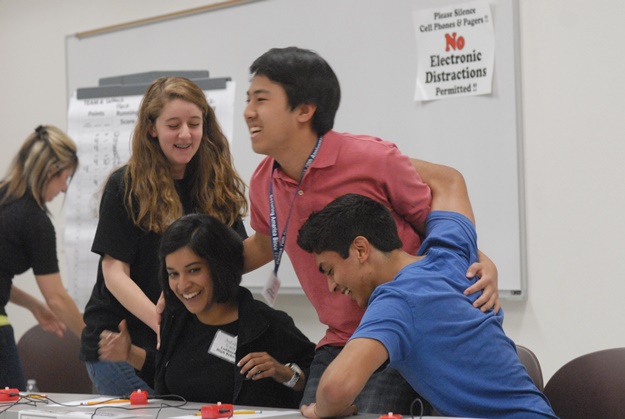
After nearly 12 hours of grueling intellectual competition Saturday, a team from Lubbock (Texas) High School edged out the team from Amarillo High School to take top honors at the Pantex High School Science Bowl competition. The Lubbock High team will represent the region at the National Science Bowl in April.
More than 30 teams gathered at West Texas A&M University to test their knowledge of science and math, and to battle it out for a trip to the national competition in Washington D.C.
The Amarillo High team – made up of three sophomores and one freshman – had an excellent competition, moving into the finals without a single loss. The Lubbock High team had to beat another Lubbock team to move into the finals, then beat Amarillo twice for victory in the double elimination competition.
The Lubbock team will be joined at nationals by a team from Panhandle Junior High, which won the middle school competition two weeks ago. Pantex has sponsored the Science Bowl competition in the Amarillo area for 23 years.
Pantex High School Science Bowl Set for Saturday
Teams from as far away as Lubbock, Higgins to compete for regional title
More than 30 teams of competitors will once again gather at West Texas A&M University (WTAMU) for the annual Pantex Science Bowl competition.
This weekend’s event will feature 35 high school teams from 20 schools across the Texas Panhandle and High Plains in a head-to-head competition that will thoroughly test their knowledge of math and science.
“This is the culmination of months of work for these dedicated students,” said Debra Halliday, B&W Pantex Science Bowl coordinator. “It’s amazing to see how much knowledge they bring to the competition every year.”
Around 200 Pantex employees and community volunteers will be on hand to help run the Science Bowl. The competition features teams of four students answering science and math questions in a game show style round-robin format, followed by a double elimination tournament after lunch. The winner of Saturday’s event will be eligible to travel to Washington in April to compete with scores of other teams from across the U.S. for the national title. Last year, Amarillo High School won the regional competition and tested their knowledge in Washington D.C.
In addition to bragging rights and a shot at the national title, the winning team will earn $1,000 for its school’s science program, with $500 and $250 going to the second and third place schools.
This year, the Education Credit Union has joined the U.S. Department of Energy (DOE), Pantex and WTAMU in sponsoring the event. Science Bowl is the DOE’s longest-running educational outreach program. Science Bowls have been held in this area for 24 years.
The high school round is the second phase of the Science Bowl competition. A team from Panhandle Junior High School won the middle school competition February 8.
Schools participating in this year’s Pantex High School Science Bowl are:
Amarillo High School
Booker High School
Canyon High School
Caprock High School
Dumas High School
Estacado High School
Fort Elliott High School
Friona High School
Hartley High School
Higgins ISD
Highland Park High School
Holy Cross Catholic Academy
Lazbuddie High School
Lubbock High School
New Home ISD
Palo Duro High School
Panhandle High School
Randall High School
Shallowater High School
Spur High School
CONTACT
Greg Cunningham
Public Affairs
Office (806) 477-5140
Pager (806) 345-1560
Dignitaries Make Mark on Pantex Renewable Energy Project
U.S. Congressman Mac Thornberry joined local dignitaries and other visitors gathered at the Pantex Plant Thursday to make their mark on an important wind project at the Plant. The visitors joined NNSA Production Office and B&W Pantex leaders, as well as representatives from project contractor Siemens Government Technologies Inc., in signing one of the massive wind turbine blades that will become part of the Pantex Renewable Energy Project (PREP). When it is complete this spring, PREP will be the largest federally owned wind farm in the U.S. and will provide more than 60 percent of the annual electricity needs for the Plant.
The ceremony provided stakeholders an opportunity to receive an update on the project, as well as get a close-up look at the wind turbines that make up the project. Each blade weights 11 tons and is more than 150 feet long. When completed, the towers will stand over 400 feet tall at the blade tips.
Elected officials visiting the Plant included Thornberry, Texas State Sen. Kel Seliger, Texas State Legislator Four Price, Amarillo Mayor Paul Harpole and Carson County Judge Lewis Powers.
B&W Pantex Makes Donation to United Way

B&W Pantex General Manager John Woolery, center, presents a B&W corporate donation Friday to the United Way of Amarillo and Canyon. United Way Interim Executive Director Jeff Gulde, left, and Campaign Director Stephanie Goins were on hand to receive the gift.
The $57,250 corporate donation supplements more than $650,000 pledged by Pantex employees to United Way for 2013, making Pantex one of the largest supporters of United Way in the Texas Panhandle. Woolery recognized that Pantexans “have big hearts” and are proud to give back to their communities.