
Pantex Blog
HEPF Construction Reaches Halfway Mark
Workers at the Pantex Plant last month finished the largest concrete pour to date on the High Explosives Pressing Facility, completing the last of the elevated soffits, which are part of the roof deck/second story of the building.
The pour marked the completion of approximately 50 percent of the construction on the 45,000 square-foot facility, which will combine high explosives operations from numerous outdated buildings into one state-of-the-art facility which will help to bolster Pantex’s status as the DOE’s High Explosives Center of Excellence for HE manufacturing.
Construction of the $65 million facility is expected to be complete next year. The construction effort is being managed by the U.S Army Corps of Engineers and the design effort/plant support is being led by B&W Pantex/CH2MHill.
Don Cook Visits Pantex
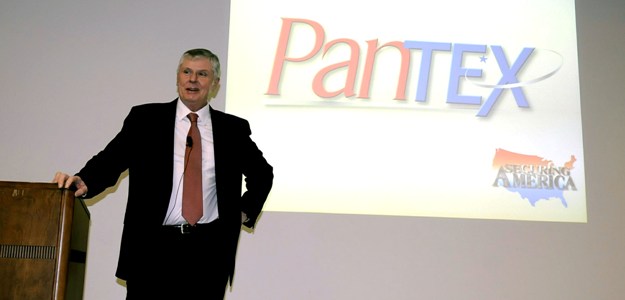
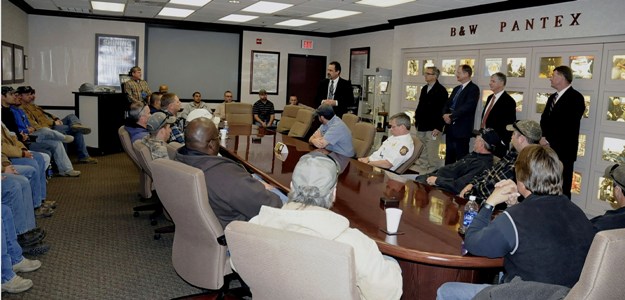
Don Cook, NNSA’s deputy administrator for Defense Programs, last week spoke to Pantexans about the future mission of Pantex and the critical role the plant will play in maintaining the nation’s stockpile for decades to come. During the visit, Cook congratulated some of the 100-plus Pantexans who helped to secure the plant and conduct recovery operations during and after the Feb. 25 blizzard that dropped more than 19 inches on the Amarillo area.
Record Blizzard Hits Pantex
When the biggest blizzard in 70 years is bearing down on your nuclear weapons facility, you’d better have a good plan and a dedicated group of people to execute that plan.
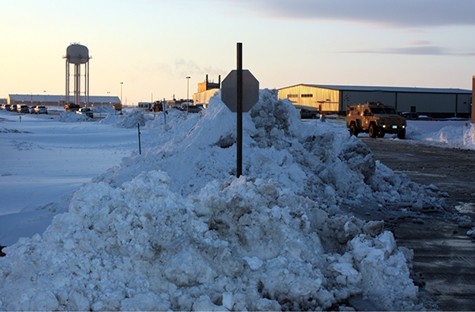 The Pantex Plant was fortunate to have both those elements in place on February 25 when a massive blizzard dumped 19.1 inches of snow – the second highest total ever recorded in Amarillo – on the plant. To make matters worse, 70-mile-per-hour winds whipped up drifts ten feet high.
More than 100 dedicated Pantexans spent the next 48 hours helping to dig out and secure the plant, enabling the nation’s primary nuclear weapons assembly plant to return to operations after only two days of lost work.
Most importantly, the massive recovery effort and return to work were accomplished without a single lost time injury and no substantial damage to facilities or property.
Forecasters were predicting the looming blizzard could be a record breaker, so the Pantex Yard Group broke out the snow plan and started looking for volunteers several days before the snow started falling. Nearly 30 members of the Yard Group stepped up to help ensure the plant could weather the storm. They were joined by more than 100 Security Police Officers, firefighters, plant shift superintendents, equipment mechanics and emergency services dispatchers who were prepared to ride out the storm.
“It just shows how selfless our people are, because every one of them had families that were snowed in while they were out here,” said Plant Maintenance Department Manager Lew Monroe.
“They made a conscious decision to be here to help ensure this facility recovered and returned to operation.”
Operations at the Plant were suspended late Feb. 24 in advance of the storm, and when it finally arrived, snow quickly overwhelmed the efforts of the Yard Group. Heavy snow was compounded by howling winds that created huge drifts and reduced visibility to essentially zero. Snow accumulated so quickly and so deeply that four-wheel-drive security vehicles and even a fire truck became stuck in the snow.
After a couple hours of working in whiteout conditions, the Yard Group was forced to retreat indoors and hunker down. As soon as the snow stopped, workers moved out into the howling wind with heavy equipment to start clearing paths through the drifts.
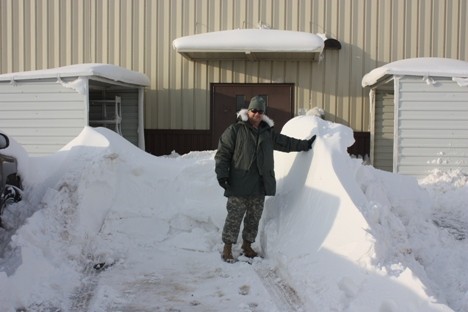 To ensure safety, the workers operated in teams of two or three to start clearing the 57 miles of paved roads and 28,000 linear feet of sidewalks scattered across the 16,000-acre site. David Taylor, yard group supervisor, said many of the equipment operators have decades of experience at Pantex and know the plant like the back of their hand.
“All of our crews who volunteered to come out take great pride in what they do,” Taylor said. “They see it as a service to this country to make sure this Plant is taken care of.”
The crews immediately focused on opening critical areas of the plant to ensure security and emergency services were able to move freely. The battle was nonstop, as the winds continued to whip the snow around, often requiring roads to be plowed three or four times. The snow caused significant issues with the electrical distribution system, requiring several of the plant’s high voltage teams of electricians to brave the weather to help keep the electrical system at the plant operational.
For 48 hours, work crews battled the elements, working long shifts and sleeping where they could before finally being able to declare the plant open for operations Wednesday morning.
“As these guys were leaving the plant, they were glad to go and get some rest. But a lot of them were still worried about whether they’d done enough,” said Yard Group Supervisor Vance Morrison. “That tells you just about all you need to know about their dedication.”
Pantex Remembers 9/11 with Memorial
World Trade Center steel is monument's focal point
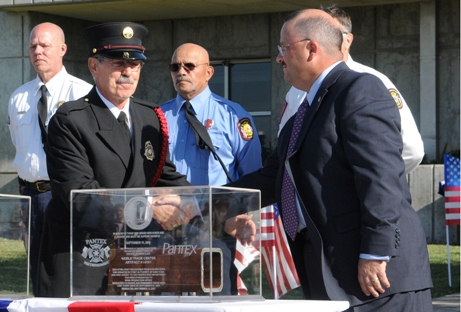
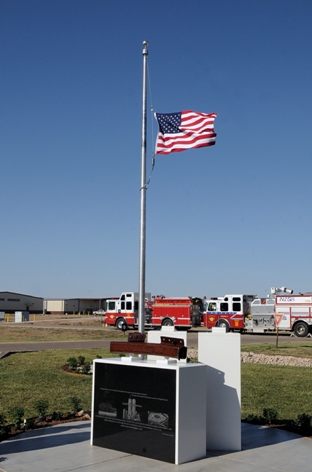 Each year, the anniversary of the September 11, 2001 tragedy brings America together to remember the bravery of both first responders and everyday heroes. This year, Pantexans gathered to unveil a monument years in the making featuring salvaged steel from the World Trade Center.
Pantex 9/11 memorial
In a ceremony outside the Pantex Fire Department, a memorial was dedicated. Etched in marble, flanked by two quartz towers and topped with a piece of steel from the World Trade Center, the memorial to all who lost their lives in the attack has now become a permanent part of the landscape at Pantex.
“It is extremely appropriate that we place this memorial in front of the building that houses our first responders, because it serves as a symbol of our gratitude for the service they provide to this Plant,” Mark Padilla, Assistant Manager for Programs and Projects with the NNSA Production Office (NPO), said. “It also serves as a bridge between our first responders and the first responders who gave their lives on that fateful day.”
Efforts to create the monument at Pantex began in October 2009 with a letter to the Port Authority of New York and New Jersey requesting a piece of the World Trade Center for a memorial monument. Once onsite, the steel was cut in Pantex’s own Machine Shop.
“It is important that we can visually see something tangible and realize that what we do is important to our freedom and the American way of life,” said Donovan Morgan, Pantex Fire Department battalion chief, who spearheaded the memorial initiative.
Craft Supervisor and member of the Navy Reserve John Herrera oversaw work done on the steel in the Machine Shop. “I revere the World Trade Center steel just as I would a piece of steel from the USS Arizona,” he said. “On the USS Arizona, we had military personnel from the Navy and the Marines die on board when it sank. At WTC, we had civilians die from the deliberate attack.”
“During the attack at Pearl Harbor, the sleeping giant awoke,” said Herrera. “During the attack at WTC, it united all fellow Americans, both civilians and serviceman, as brothers and sisters. It changed the way we live and made us more aware of the existence of terrorism around the world. As I walk past the WTC memorial, I will remember the civilians that died on that day and the dark moments this nation has endured.”
In addition to display in the monument, pieces of the salvaged World Trade Center steel are now displayed onsite at the NNSA Production Office building and at the Pantex Visitors Center.
"80s Ladies" Redefine Weapons Work
W80, Mod 0 undergoes dismantlement
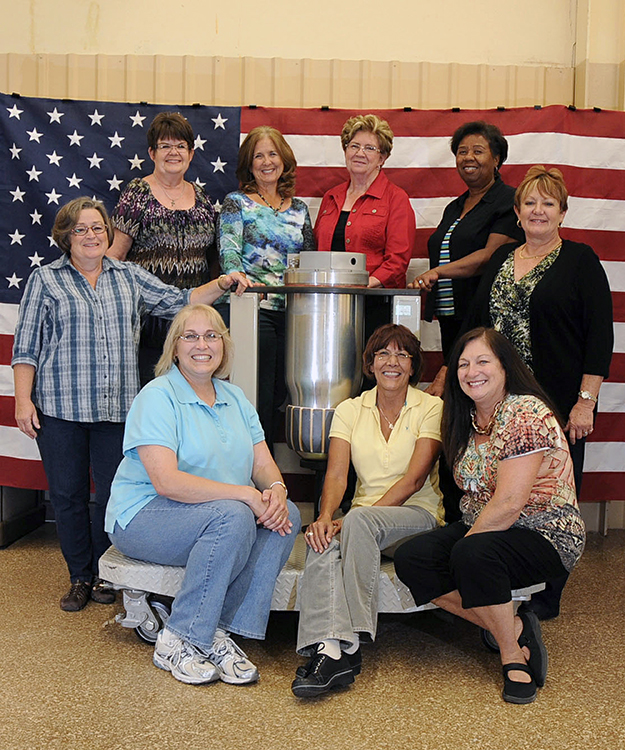
Back in the day, men worked the production line at Pantex. Then came the W80, the first weapons program in which assembly and disassembly were performed by women. Groundbreaking women, dubbed the “80s Ladies,” seized the opportunity to gain the skills
necessary to perform mechanical work.
Called the “common warhead,” the W80 was developed as a multi-service, multi-application weapon and is used in a majority of nuclear-armed U.S. Air Force and Navy missiles.
One of the first women to enter the field in 1979, Peggy Crow, left her clerical job for a position as an assembler/inspector on the W80 program with the goal of earning more money.
“A woman really had to work hard to prove her worth and value,” Crow said. “One thing easier for women was using their hands in small places to complete a process. Also, women were generally more detailed oriented. In the early years in the production area, women had to be resilient
and very open-minded.”
June Cooley recalls a spirit of teamwork and remembers the ladies working together for a common goal. “We had a good work ethic and took pride in doing a good job,” she said. “This took place during the Cold War and there was a common theme among the workers – ‘If we ever have to use one of these, and it gets through, it better work.’”
Bobbye Koenig preferred working with “girls” because guys had a tendency to take the tools and do the job while women watched. “It wasn’t their fault, most guys are raised that way – men did man’s work and women did woman’s work. The bad part of that deal was our work was mopping floors, sweeping and cleaning parts. Give me the tools, I want to do the fun stuff,” said Koenig.
For many, the production line was a jumping-off point for their careers. In 1992, Crow went on to become the first woman in the NNSA enterprise to become a weapons trainer for the W80 program. Another 80s Lady, Betty Whitfield, gained experience with 12 weapons programs
while assigned to the line. “That experience got me where I am today,” said the quality engineer.
“There are so many more women on the line now performing the jobs once delegated only to men,” said Cheryl Phillips, former inspector. “It says something about the character of the women who came before, paving the way, making it possible for us to be able to perform these jobs.”
Today, women at Pantex serve as production technicians as well as engineers, scientists, technicians and managers.
“The years that I worked on ‘the Line’ are among my most cherished memories at Pantex,” said Twanda Taylor, former weapons inspector who carpooled with coworkers on the graveyard shift. “I interacted with coworkers who seemed like close-knit family who looked out for and helped
one another.” Added Wanda Williams, former assembly operator, “We were like a close family and still share the closeness.”