
Pantex Blog
Pantex Proud: Kenton Falerios

Thousands of dedicated Pantex citizens like Kenton Falerios work every day to support the Pantex mission. Take three minutes to learn about who he is, what he does, and why he is proud to be a Pantexan.
More doesn’t always mean better... unless you’re talking about dogs. Kenton Falerios would know — he has nine.
“Dogs are God’s gift to mankind; angels without wings,” Falerios said. “I really love them. I’d have more, but my wife drew the line at nine!”
Falerios works in Emergency Management as the lead emergency exercise planner, and just like how a guard dog is always prepared when needed, he develops response procedures so Pantexans are always poised and ready for potential emergencies.
Molly, Emma, Pinta, Mya, Remi, Rosebud, Elsa, Jasmine, and Max help make up the Falerios pup pack. Each has a role — princess, cuddler, protector, and instigator. At Pantex, each of us has a role in emergency response... albeit with more work-appropriate positions. Falerios conducts site-wide and functional exercises in addition to overseeing the controller/evaluator training and building warden program. He says he couldn’t do it all without the support of others, which is why he leans on his work pack.
“After spending 22 years in the U.S. Army, I learned that one person cannot do it all,” Falerios said. “To be able to achieve our goal and accomplish our mission, teamwork is a must. All the site managers and directors have all been very supportive when I approach them regarding using their facilities for exercises. They understand the importance of exercises, and it sure makes my job easier.”
And just like each pup has their own personality and features, Falerios uses his personal touch to make a distinct difference in emergency planning.
“Every organization has plans, procedures, and checklists, but it’s that personal experience, that finesse, or personal touch that makes a difference,” Falerios said. “If folks have pride in what they do, then they’ll show it through the products they deliver, which makes the organization better overall.”
How do you and your team contribute to mission success?
Emergency Management is one of those departments I like to call the “silent professionals.” We develop the emergency response procedures and training that you hope will never be used, but when they are needed, you’re glad you have them.
What has been your proudest moment at Pantex to date?
When Defense Nuclear Facilities Safety Board’s Vice Chair Thomas Summers, stated that the Lone Wolf-25 Exercise was robust, creative, and one of the best exercises that he had seen and that the Pantex Emergency Management Department is the model of Emergency response in the DOE complex.
Why is it important we hold ourselves accountable in our daily tasks?
Never accept the easy wrong over the hard right. For what we do out here, why would you not want to produce the best product you can? Our country depends on us to produce the best product regardless of our political leanings or personal beliefs.
Who in your life has inspired you the most and why?
My parents. They taught me if you have time today then get it done, because you don’t know what tomorrow will bring. I kept that same philosophy with me in the Army and afterward.
Leading by Mentoring

As a critical element to developing leaders, mentoring benefits both mentor and mentee. To encourage mentoring behavior and take leadership development at Pantex to the next level, Human Resources Talent Management introduced a 12-month formal mentoring program in August 2025. As the Pantex Mentorship Program nears the end of its inaugural year, participants reminisce about the program’s successes.
“The program provided a great opportunity for self-discovery and a deeper understanding of my own professional aspirations,” Rebecca Hatch, information security specialist and mentee said. “This experience reaffirmed a desire to consistently challenge myself and strive for higher levels of performance in everything I do.”
The 2025-2026 mentorship program attracted 48 mentors and 104 mentees. Each applied separately and were assigned partners by Talent Management. The pairings were often from different organizations, based on common interests and availability.
Project Performance Analytics Senior Manager Justin Fox mentored several employees, including Hatch. Fox said the program offered him a chance to share his experiences — both successes and failures — and help his mentees avoid the same pitfalls.
“I wanted to be a mentor because I feel it’s everyone’s responsibility to use their own experiences to help push others further than they’ve gone themselves,” Fox said. “I believe a mentor is someone that is not only a sounding board and confidant, but also an advocate and sponsor of the people they’ve chosen to invest in.”
Through the program, mentors and mentees were encouraged to meet regularly to connect on topics such as goal-setting, feedback, effective communication, conflict management, and ethical decision- making.
Safety Analysis Engineering Analyst Madison Davis said she applied to the program because she wanted to push herself out of her comfort zone as well as learn from someone who is insightful and experienced.
“My mentor and I have gotten to know each other,” Davis said. “He mentored me by having one-on-one open conversations about the monthly topics and examples to help each of us learn. He has also brought me along into the field to learn about construction projects and fire protection engineering.”
Davis’s mentor and Projects Engineering Line Supervisor Luke Powell said he focused on establishing a comfortable environment where his mentees could tackle challenging areas, emphasizing mutual growth and positive intent in his coaching efforts.
“Like exploring a new playground, but with fences that protect you from risks of playing in the street, the program provided a structured framework and clear objectives, which helped formalize the relationship and ensure consistent progress,” Powell said. “A significant highlight has been witnessing rapid trust-building with my mentees, leading to tangible progress.”
With the successes of the pilot mentorship program, Talent Management plans to grow and improve the program next year to continue to build relationships and drive improvement in leadership development at Pantex. The pilot program was only available to non-bargaining employees, but, this year, Talent Management will be opening up the program to bargaining employees as well.
“911, What’s the location of your emergency?”
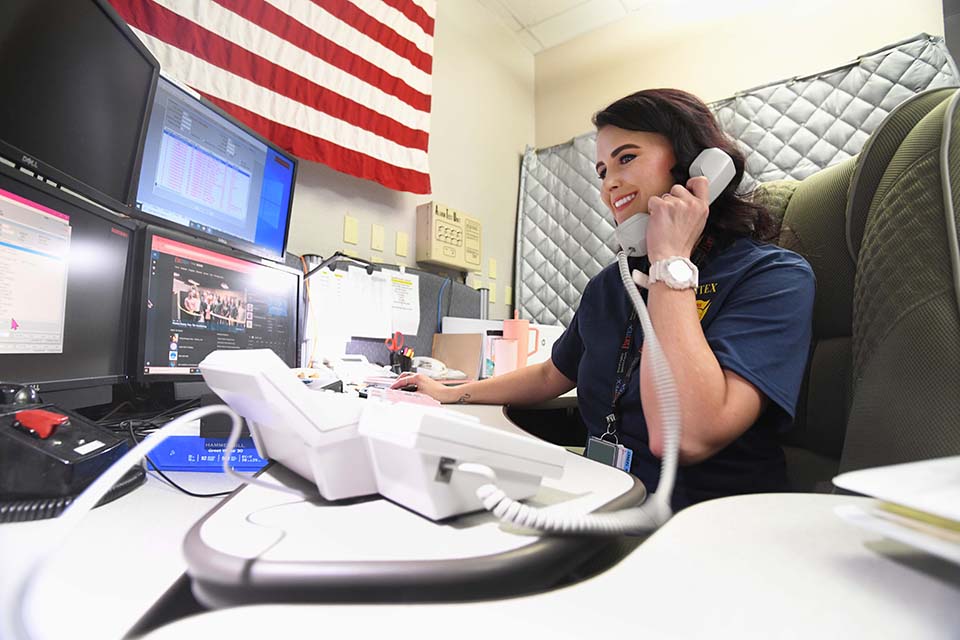
National Public Safety Telecommunicators Week is celebrated the second week in April and honors dispatchers like Britnee Callaway. Photo by Michael Schumacher.
Last year there were over 365 medical, fire, and hazardous material calls that came into the Emergency Services Dispatch Center (ESDC) at Pantex. The dispatchers who take those calls are the lifeline to emergency services, working to get help to people when they need it.
“We are the first point of contact when you have an emergency or need assistance,” Dispatcher Britnee Callaway said. “We understand that time is precious and can make a difference in the outcome of a call. If we receive a call for service, we ask a lot of questions to ensure we get the right resources to your location quickly. As one dispatcher is taking a call, another is dispatching the Fire Department to get them started to the location.”
National Public Safety Telecommunicators Week is April 13-19 and honors the dedication of dispatchers in their critical safety role. Emergency Services dispatchers are important to Pantex, the nearby communities, and the first responders going to the incident.
“My favorite part of being a dispatcher is not always knowing what the day is going to bring outside of the day-to-day tasks,” Callaway said. “At any point, someone could be having an emergency, and we get to help. Not only do we serve the Pantex community, we also assist the surrounding counties. So, each day has the potential to be more exciting than the last in terms of service.”
Callaway joined Pantex Emergency Services in 2024. At the time, there was a total of 10 dispatchers running a 24/7/365 operation. The number of dispatchers has recently increased helping to alleviate fatigue and strengthen resources during multi-incident response.
“With this growth, we have been able to better serve the community that carries out the Pantex mission,” she said. “Along with new dispatchers comes new ideas, processes, and technology from previous departments. It’s exciting to see how the technology has evolved and to have the opportunity to incorporate some of this into our role here.”
Dispatchers regularly assist with testing fire systems, monitoring buildings for new and existing alarms, assisting with hazmat calls, keeping records, and monitoring events happening around the community. The dispatchers working in the ESDC bring a wealth of experience from previous internal positions at Pantex and from outside agencies. They take pride in serving Pantex in this critical role.
“We are a mix of personnel that have served different departments,” Callaway said. “The members with the longest experience have been previous security police officers; the newest members came from surrounding county and city services. We even have a previous operations control specialist for Apollo Med Flight. With these different backgrounds, we have even more experiences available for us to draw from.”
Dispatchers are the front line of communication between people who need help and the emergency service providers administering aid. Without their calm demeanor, quick thinking, and skillful decision making, it would make getting critical help to those who need it much harder. This week and throughout the year we honor the dispatchers who answer the call.
Paws on patrol
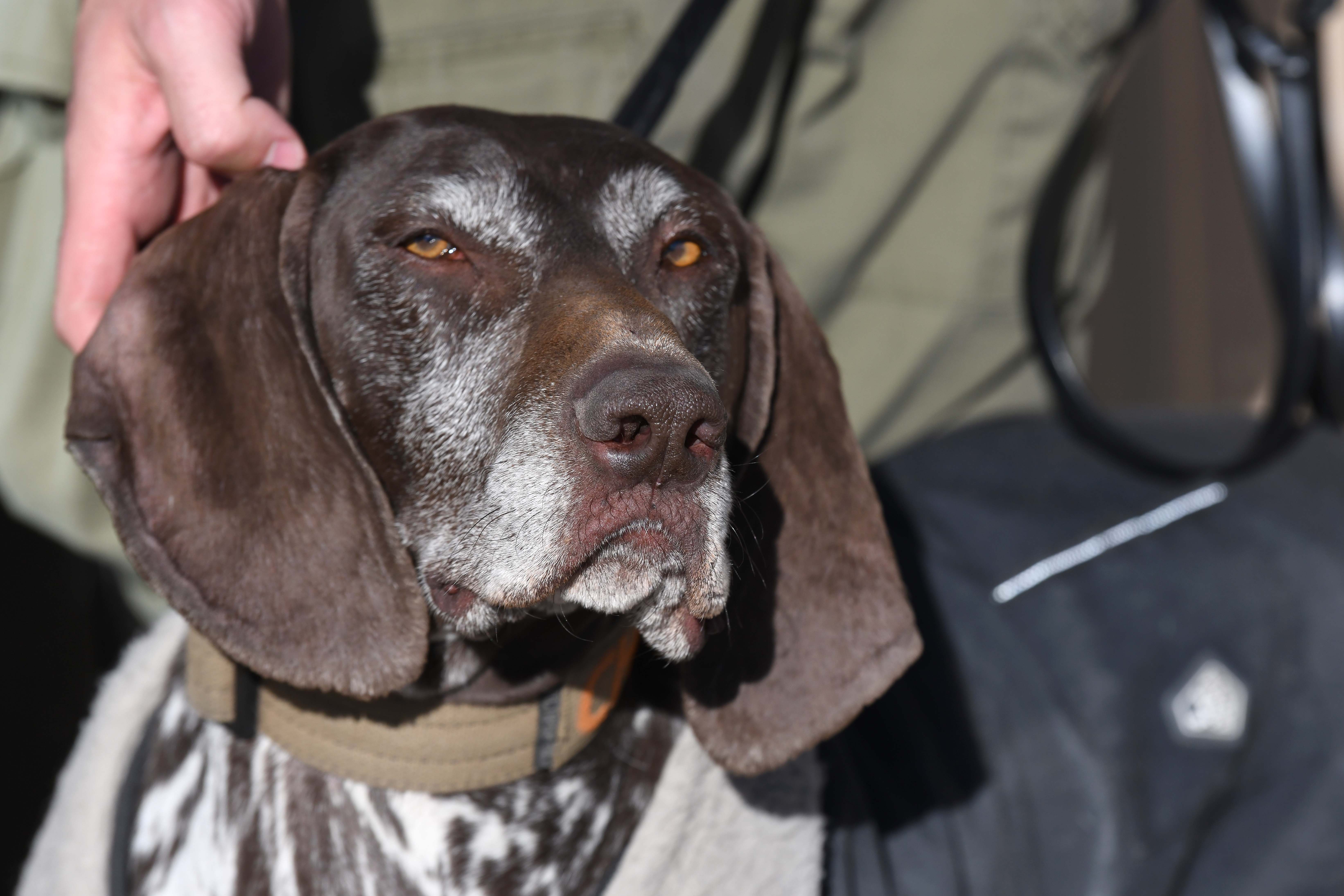
Pantex is home to a large, well-trained team of security police officers, otherwise known as the ProForce. But there are five members of this dedicated team that stick out from the rest. They don’t swipe badges or carry radios, but they do love a good treat. With noses trained sharper than any sensor and loyalty that can’t be taught, these team members are a powerful reminder that sometimes the best security comes with a fur coat and a wagging tail. Enter the good boys and girls of Pantex: Chief, Hazel, Alo, Stryker, and Hunter.
Canine units offer unique capabilities that greatly augment human efforts in various missions. Their senses are significantly more sensitive than those of people, enabling them to detect subtle scents associated with a variety of substances, even in challenging conditions or when items are concealed. Much like people, the dogs all have their strengths and bring different skills to the table.
“Some dogs might struggle with low hides, deep hides, or high hides,” K-9 Handler Wesley Wood said. “It’s very important that we spend time getting to know them so we can encourage their strengths.”
Their specialized sensory input allows for rapid and precise detection that is unattainable through human observation or technological means alone. They possess super agility, endurance, and a natural ability to navigate complex terrains, making them incredibly valuable to rescue operations, tracking, and perimeter security.
“The dogs are an incredible asset to Pantex and our protection strategy,” K-9 Operation Manager Captain Bobby Ovalle said. “They work in tandem with our current protective posture and make for excellent partners to our security police officers.”
These officers exhibit a great sense of pride in their work and every handler is quick to say how much their dogs “love their job.”
“Hunter loves to work. He loves doing a good job and you can always tell that he walks like he owns the place when he finds an odor or does a good job,” K-9 Handler Cali Bernard said.
But just like people, the dogs like to decompress. They love a variety of activities like hiking, swimming, going to Home Depot or Lowe’s, and, in Chief’s case, napping on the couch.
Canine units are a powerful reminder of the benefits of collaboration. Their presence provides a psychological deterrent and their behavioral traits allow for them to contribute to mission success in ways that complement and enhance our physical security requirements. When it comes to protecting the site, they really have a nose for it.
Burgers, bombs, and bravery: The dauntless life of Pete Lopez
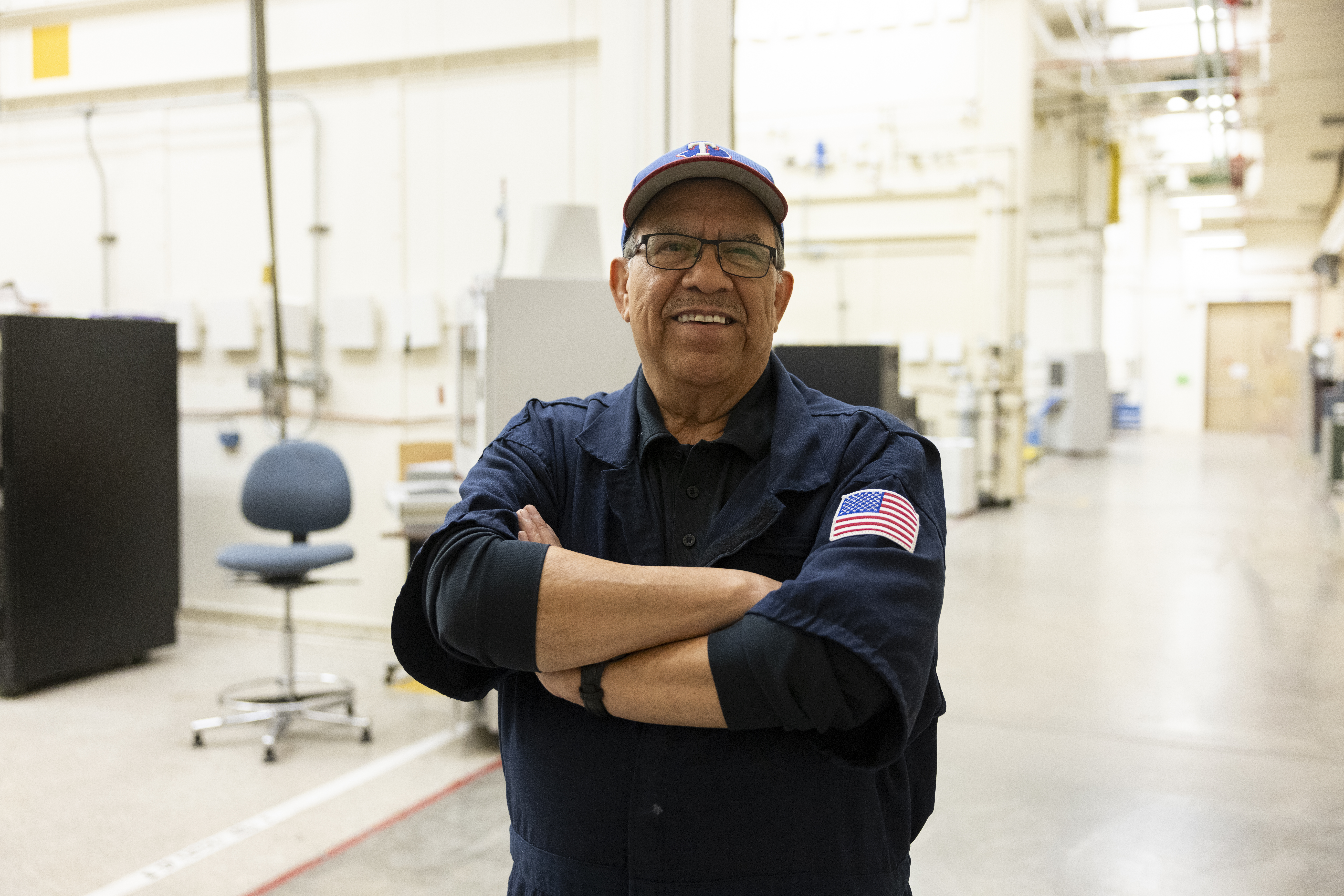
Pete Lopez doesn’t mince words.
“I knew what I was signing up for. It’s a risk-reward job. Of course there are risks involved, but there is so much reward knowing what we contribute to and what that means.”
Lopez has gained and employed a wealth of knowledge and experience in his 54 years serving the Pantex mission. He carries himself well, tells a story like an old friend, and has an infectious smile that reminds you nothing is ever as bad as it seems. Maybe that’s because Lopez himself truly knows that nothing really is ever as bad as it seems.
“I grew up in a little town called Munday, Texas. I was number 9 out of 10 kids. I got a scholarship to North Texas State for drama out of high school, but we were very poor so it just didn’t feel like a real option.”
Perhaps it was this moment where Lopez first learned the delicate balance between risk and reward.
The risk:
“I had a friend who had gotten drafted to fight over in Vietnam. I knew I was going to get drafted too, so instead of college I just went and signed up. It was good for me, though. It made me grow up fast.”
The reward:
“I used to think we had it really bad being so poor when I was growing up, but … when I got to Vietnam and saw people eating scraps wherever they could find them, it started to change my mind. I met a kid down there who was about my size. I wrote my mom and told her to send me all of my clothes to give to him. It was just a different world.”
After Vietnam, Lopez found himself at a crossroads. The year was 1972, and at 22 years old the young man who had to grow up much faster than most found himself on the road that led to Pantex.
“I was in a conversation with somebody and they asked me ‘have you ever thought about going to work out at that bomb plant?’ I said, ‘bomb plant? What’re you talking about?’ I’d never heard of any bomb plant.”
A short time later, Lopez found himself at the old bomb plant, just not where you would expect.
“I started out in the kitchen,” he remembered as he cracks a smile that quickly gives way to a chuckle. “Eventually they put in a new grill and I was the hamburger cooker.”
While he enjoyed this role, the calling to something greater presented itself. There again he met his old friends, Risk and Reward.
The risk:
“I bid out and became what was then called an assembly operator. (We call them PTs now.) This was back in the ‘70s. The Cold War was still going on, and we knew it was an important job. We knew what we were building and how important it was. It was a different world back then. It’s serious now, but it really felt serious then.”
The reward:
“I enjoyed what we were doing. I couldn’t wait to get to work every day. I still enjoy it to this day. The standard was to take every day very seriously. I remember saying ‘we got boys on the other side of that water, and if we have to use these things, the ones with my name on them, those better work. I took pride in my work. That was important to me.”
Over a half-century later, Lopez is now settling into the twilight of his career. His life lessons don’t stop once he leaves the site. At home, having raised two sons, and watching as his three grandchildren will soon face the crossroads he did decades ago, he does his best to teach them the value of each day.
Currently, Lopez serves as a quality assurance technician in Satellite Operations where he relishes the role of passing on his immense knowledge and experience to the ones who will follow.
“I do my best to train all of the new people the way they need to be trained. You can’t overemphasize the importance of the job we do. You gotta make sure you do it right. You gotta take pride in your work.”
When all is said and done, Lopez can look back on his life knowing that each time he weighed the risk, and the reward, the risk was never as significant as the infinite growth that would come his way.
The reward:
“When I started out, I was just so blessed and put with really good people, people who did everything the right way. Everybody supported you; you could reach out to anyone for guidance. That’s what I try to do for those new ones that come to me.”
If Lopez has proven anything, whether it be to himself or those who get to know him. It’s that the only real risk in life is never taking a risk at all.