
Pantex Blog
SBA recognizes Pantex as a leader
The Pantex Plant’s Supply Chain Management organization recently received three awards from the Small Business Administration.
Pantex received the following awards:
- SBA leader in the Lubbock-West Texas District and the SBA Region VI (comprised of Texas, New Mexico, Oklahoma, Arkansas and Louisiana),
- Provider of outstanding stellar access to procurement opportunities for small businesses and
- SBA Procurement All Star.
The awards were presented by SBA Region VI District Director Calvin Davis and Regional Administrator Yolanda Garcia Olivarez.
Pantex has a long history of working with small business. Kelly Delgado-Goudschaal, acting manager of Supply Chain Management said, “These awards are a direct reflection of the dedication and the commitment of the Procurement personnel at Pantex. We have had a long-standing tradition of supporting small businesses within our community. We also work with the West Texas Procurement Center to develop and mentor small businesses within our community.”
Achieving the subcontracting goal is part of the plan. “We have an established goal each year as to the amount of dollars to be awarded to small businesses, and we work with a variety of organizations, such as those with expertise in special tooling, packaging and fuels,” according to Compliance team lead Barbara Smith. Consolidated Nuclear Security, LLC has a small business subcontracting goal of 65 percent for the plant.
Smith added, “It is an honor to be recognized by SBA as a leader for promoting small businesses. For the past seven years, we have consistently exceeded our small business goal. Pantexans continue to support SBA initiatives by identifying small businesses with which we can contract.”
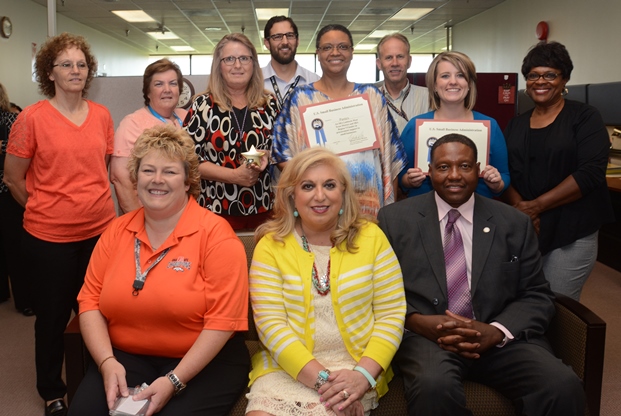
Small Business Administration Region VI SBA District Director Calvin Davis and Regional Administrator Yolanda Garcia Olivarez recently presented awards to Pantex’s Supply Chain Management organization. Featured in photo, front row, from left, Kelly Delgado-Goudschaal, Olivarez and Davis. Back row from left, Frances Tillery, Barbara Smith, Teresa Albus, Jeff Gillmore, Tammi Pedro, Randy Lucas, Ashley Hayton and Diane Johnson.
CNS and Metal Trades Council reach new labor agreement
Consolidated Nuclear Security (CNS) was informed by the Metal Trades Council (MTC) that a new four-year labor agreement has been ratified for work at the Pantex Plant. CNS is appreciative that the negotiations and work stoppage are resolved, and Pantex looks forward to all employees represented by MTC returning to work on October 5, 2015.
Reminders for employees returning to work October 5:
- Pantex managers and supervisors will be contacting employees represented by the MTC with instructions on where to report.
- The Pantex Plant is open for normal operations. All personnel are to report for duty according to their regularly assigned schedules.
- Continue to exercise caution as you approach the Plant and slow down to prevent accidents or injuries.
- Safety and security remain top priority. All security and medical reporting requirements remain in place. Also, please remember not to bring Personal Electronic Devices into prohibited areas.
CNS supports women in STEM luncheon
Since the 1940s when they traded in their aprons for coveralls and gas masks, women have played a key role at the Pantex Plant. To honor their past contributions and celebrate the work they currently perform, Consolidated Nuclear Security, LLC was a corporate sponsor of the recent 2015 Louise Daniel Women’s History Luncheon and Women’s Equality Day Celebration.
The sponsorship was fitting because this year’s event highlighted the work done by women in science, technology, engineering and math (STEM) fields.
Natalie Waters, a Pantex industrial engineer, spoke about the history of local women in STEM and presented a vignette about female STEM professionals at Pantex.
“Young girls and women who live in the Panhandle today should be proud of the women pioneers who worked hard, paved the way and excelled in their STEM fields,” said Waters.
The annual event is named for Louise Daniel, a local science teacher and civic volunteer. Before her death in 2003, Daniel requested that her friends create an event to remind women of all ages about women’s historic struggles to achieve equality.
Six years ago, her friends honored this last wish by creating a women’s history lecture fund at the Amarillo College Foundation. They host a lecture and luncheon in August to coincide with Women’s Equality Day, focusing on a different facet of women’s history each year.
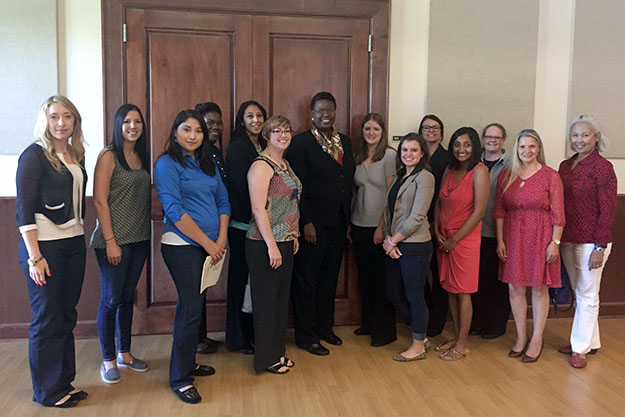
Pantex industrial engineer Natalie Waters, Ph.D., was a keynote speaker at the Louise Daniel Women’s History Luncheon. Pantex scientists and engineers attending the event included (from left) Rachel Ehler, Hannah Pemberton, Isela Galan, Erin Robinson, Raquel Barrera-Chavez, Halianne Crawford, Waters, Brandy Ramirez, Meagan Brown, Courtney Waddell, Karishma Myers, Jessie Phifer, Zelda Martinez and Ava Azores.
The people behind HEPF: Mitch Carry
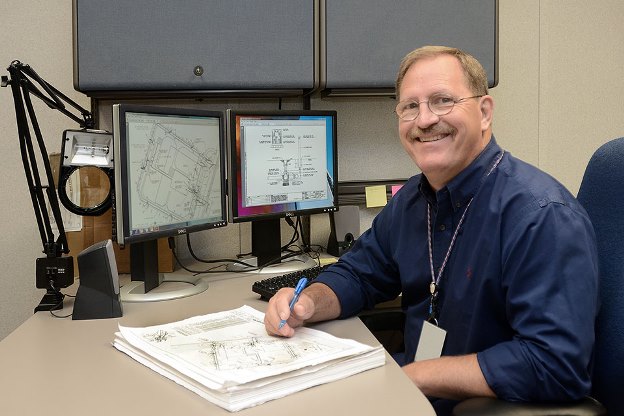
Mitch Carry, startup manager, of the High Explosives Pressing Facility, has been a part of the project since it began.
The plan to improve the current process for manufacturing high explosives at the Pantex Plant has been in the works since 2002. The current facilities date back to the 1960s, and the equipment involved in pressing is aging and nearing the end of its service life. The current high explosive pressing process occurs in multiple facilities across the plant. The completion of the High Explosives Pressing Facility consolidates all of these processes in one building.
Mitch Carry, startup manager, has been a part of the HEPF since the project began. Carry’s role is to make sure all the required work is completed to guarantee compliance with the appropriate contract requirements for startup and safe operations. This role requires that he have a broad understanding of plant requirements and their associated regulations. It also requires that he work closely with many of the plant organizations to get the work accomplished. When there are problems, he is responsible for working with the right people to resolve the issues.
A major component in guaranteeing compliance is compiling the “objective evidence” or documentation showing that all products satisfy the requirements and prove that the facility is constructed according to strict specifications.
“We have to have documentation for all aspects of the construction,” Carry said. “For example, when you’re placing concrete, you have to be able to prove you installed the rebar correctly, properly mixed and placed the concrete, and then successfully tested the strength of the concrete in accordance with the requirements.” Proving the work was done correctly is no small feat, considering the new facility has about 8,000 yards of concrete, delivered at an average of 9 yards per truck and installed in more than 55 separate placements. “Assembling the records for each placement creates a pedigree for the final product,” he said.
The newly constructed High Explosives Pressing Facility at Pantex will consolidate and improve operations.
Whether it’s the concrete, fire extinguishers, blast doors or even the HE presses, the documents and reports that go with each item are important, and Pantex must be able to produce documentation showing that all aspects of the facility operate safely.
“The basic function of the documentation is to ensure that the facility operates safely and as designed,” said David Crump, director of Pantex Projects Management.
Being able to show that the facility is up to current NNSA regulations is a pivotal step when it comes to getting the facility ready to be occupied, and Carry’s role ensures that part of the process goes as smoothly as possible.
“He has to make sure that all of the facility and the construction and installation documentation that goes with it are available for review by the startup team,” Crump said. “Mitch is a very important to the success of the HEPF and making sure we are ready to go through the readiness process.”
Hope Wallace, project manager, collaborates with Carry by supporting the work involved in the startup process. “Mitch takes a very active role as the startup manager.” Wallace said. “He has to assemble the entire team, and he knows that it takes the whole team to get the project finished.” Even with a project of this scale, great leaders know the importance of keeping up the morale. Carry makes a point to do his best to minimize the stress levels.
“With such a long and important project, there is a lot of pressure placed on everyone, but Mitch knows that you still have to be able to have fun, and your work has to be enjoyable. He does a great job of taking off some of that pressure and it helps the team to keep moving forward,” Wallace said.
While the startup effort on a project this size is daunting, the end result will be a state-of-the-art facility unlike any other. Not only will the new HEPF replace the current, outdated facilities, it will also allow employees to work in an environment designed specifically for this type of work.
“This facility was designed and built for high explosives processing. The whole facility is compliant with all current high explosive processing regulations required by NNSA,” said Carry.
Carry emphasized that one of the most important aspects of the HEPF is how streamlined it will make the process of pressing high explosives, which, in turn, allows for higher production.
“We are looking at our key performance parameters effectively tripling production.” Not only does the new facility allow for greater production, having everything housed in one area will decrease the amount of time Transportation has to spend moving the high explosives. This will help cut down their workload and allow Transportation to focus on other activities, Carry said.
With all of the state-of-the-art equipment and consideration that went into the design of the HEPF, Carry said that the real reason this facility will be so successful is the people who have been involved in the entire process. “There are a lot of good people working on this project, and they know the importance of making it successful. They are the reason for this facility’s success.”
CNS, University of Tennessee Partner on New Fire Protection Program
Fire is a significant threat to industrial facilities. To enhance our fire protection expertise, CNS has partnered with the University of Tennessee, Knoxville, on a new graduate-level engineering program.
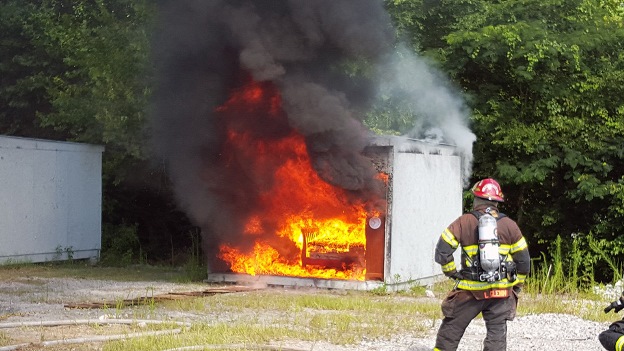
The Graduate Certificate Program in Fire Protection Engineering gives our employees new educational and career opportunities while improving the CNS enterprise’s fire protection capabilities. Twenty five CNS employees from a cross-section of organizations are acquiring critical skills in fire protection engineering while earning graduate-level credit.
Y 12 Fire Protection Engineering Manager David Greer and UT Electrical Engineering and Computer Science professor David Icove got the program rolling. Greer contacted Icove in January 2014 about teaching a course on Fire Dynamics Simulator software to his staff. The two discussed the idea and determined a university program, comprising several core courses open to all engineering students, would better serve CNS and UT.
Fire protection engineering uses the fundamental principles of advanced science and engineering to protect people, property, and the environment from fire. The field is facing a shortage of qualified engineers, so the graduate certificate program makes specialized training available to CNS engineers from different disciplines, as well as UT students studying engineering and related fields.
“As a profession, fire protection engineering is in high demand, and there is a very short supply of qualified engineers. Currently, only two schools in the U.S. offer accredited engineering degrees — Oklahoma State University and the University of Maryland. UT is now the only university in the southeast offering accredited coursework in this field,” Greer said.
The UT Fire Protection Engineering program, which launched in fall 2014, offers four graduate-level courses. The courses combine industry perspective with university expertise, and class assignments are designed around real Pantex and Y 12 problems. Icove, an internationally recognized forensic engineering expert with more than 40 years of experience in the field, teaches the courses.
The initial 16 week program met with success, so this summer UT offered each of the four courses in condensed three week sessions. “This special compressed program is intense,” Greer said. “In a one week period, the students get a semester’s worth of time in class, plus two weeks for homework and a term paper. In three weeks, they’ll complete a graduate-level engineering course but will only be away from the plant for four days. The format is very demanding, but it is the only way many of the participants would ever have time available to take these courses.”
CNS Chief Fire Protection Engineer Randy Lanham said engineers at the Pantex Plant who have taken courses have been impressed. “One engineer said he can use the information in his job right now — which is a big positive. Another said taking the courses has encouraged her to continue with a master’s degree in fire protection engineering,” Lanham said.
Matthew Alt, a UT civil engineering graduate who now supports Uranium Processing Facility Quality Assurance, said the program is a great opportunity to obtain training in a different field.
“We perform a lot of oversight reviews, and these courses provide the tools and training for reviewing process and program documents like the Preliminary Fire Hazards Analysis.”
The curriculum offers CNS the opportunity to provide new educational and career opportunities to employees and to target qualified fire protection engineering candidates likely to establish careers locally. “We hope to see this develop into a full master’s program in the near future,” Greer said.
Greer is appreciative of the commitment and support he has received while working through the details of starting the program. “I had to work through the process, but every person, without exception, has been positive about the program. Not once did anyone say ‘no,’ ‘stop,’ or ‘slow down’ — it was always ‘Great idea! What can we do to help?‘” He credits Linda Bauer, Mike Beck, Tom Christman, and Debbie Reed for helping get the program launched.