Friendly skies: Pantex advancing drone program
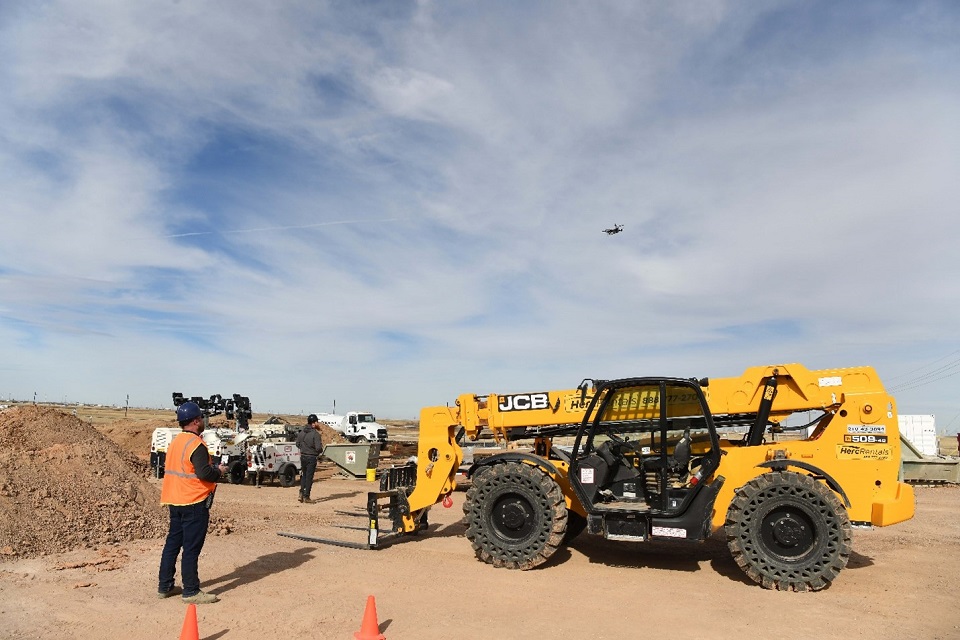
Members of Reliability Engineering completed drone flights over the construction site for the Environmental Sampling Facility. Photo by Michael Schumacher.
When you think of an aviation program, you might envision planes, jets, or other large aircraft. But as technology grows larger, useful gadgets get smaller. That's why Pantex's aviation program consists solely of Unmanned Aircraft Systems (UAS), commonly known as drones.
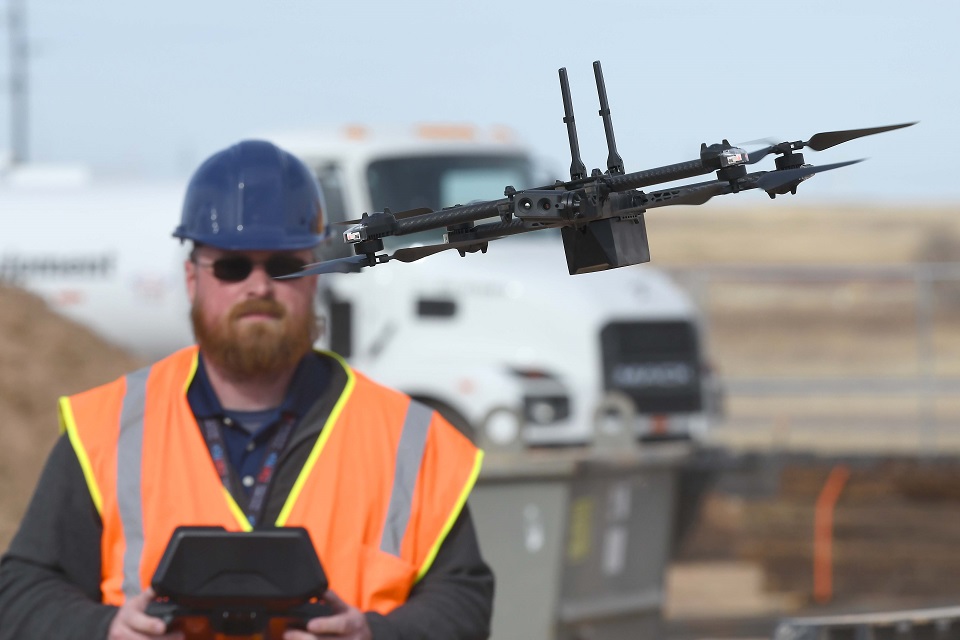
“We've been flying drones at Pantex since 2021,” Aviation Safety Officer Joshua Herm said. “Our goal right now is bringing the program out of its infancy to make it more robust. Currently, we have been able to use drones for photos and videos, inspections, 3D mapping, counter–UAS activity, and live streaming video to increase situational awareness.”
The aviation program was developed and refined to meet mission needs by experts in Safeguards, Security, and Emergency Services (SS&ES) and is run though the Operations Center in Emergency Management. Herm ensures the requirements and responsibilities of the program are met and manages the day–to–day demands of the job. His background positions Pantex to transform the aviation program to a project of the future.
“I spent over 23 years in the Marine Corps, and over half of that time I was a CH–53E Super Stallion helicopter pilot,” Herm said. “My background allows Pantex to have a professional aviator in the role of Aviation Safety Officer, with knowledge and experience of actual aviation operations as well as familiarity with Federal Aviation Administration rules and regulations.”
When Pantexans want to conduct a drone or manned aircraft flight, or even just have an aviation–related question, Herm is the person to contact. He works with the team in SS&ES on the Digital Transformation Initiative, which helps to identify new and emerging technologies and advance Pantex's capabilities in part through the acquisition of new drone and other unmanned systems. Herm's knowledge is valuable as Pantex sets a solid foundation for how future flight operations are conducted.
“The use of drone aircraft and contracted manned flights can be a great asset to other divisions and departments by acting as a force multiplier and tool that allows those organizations to effectively complete an assigned task in a more efficient manner,” Herm said. “This can range from inspections that need to be completed in difficult–to–access areas by Infrastructure, assessing work done for Safety, emergency response by Emergency Management, and even getting much–needed imagery or video for business communications.”
Herm is in charge of more than just overseeing drone flights. He receives flight requests, reviews documents for conflicts with other departments, and evaluates requests for safety to determine if they will cause a flight issue or disruption to any Pantex operations. He also works with NNSA and the FAA to determine if there are issues with the airspace and flight operations, and coordinates with other departments around Pantex as well as external agencies.
Emergency Services offers a training course for any Pantex employee interested in becoming a new drone pilot at the Plant. The training is held a few times each year to build a sufficient cadre of operators. New UAS operators are necessary to facilitate the growing number of flights requested and the equally necessary culture change needed across the Plant, in what Herm sees as a future sky filled with drones.
“I would like to see drone operations at Pantex become a daily event — Emergency Management drones being used when the ERO is activated to increase situational awareness or to locate and identify emergent issues within a short timeframe, as well as every department that thinks they could use a drone to their benefit to increase their capabilities,” Herm said. “I truly think that drones have the ability to assist us in many ways, and I would like to see those ideas become a reality.”