



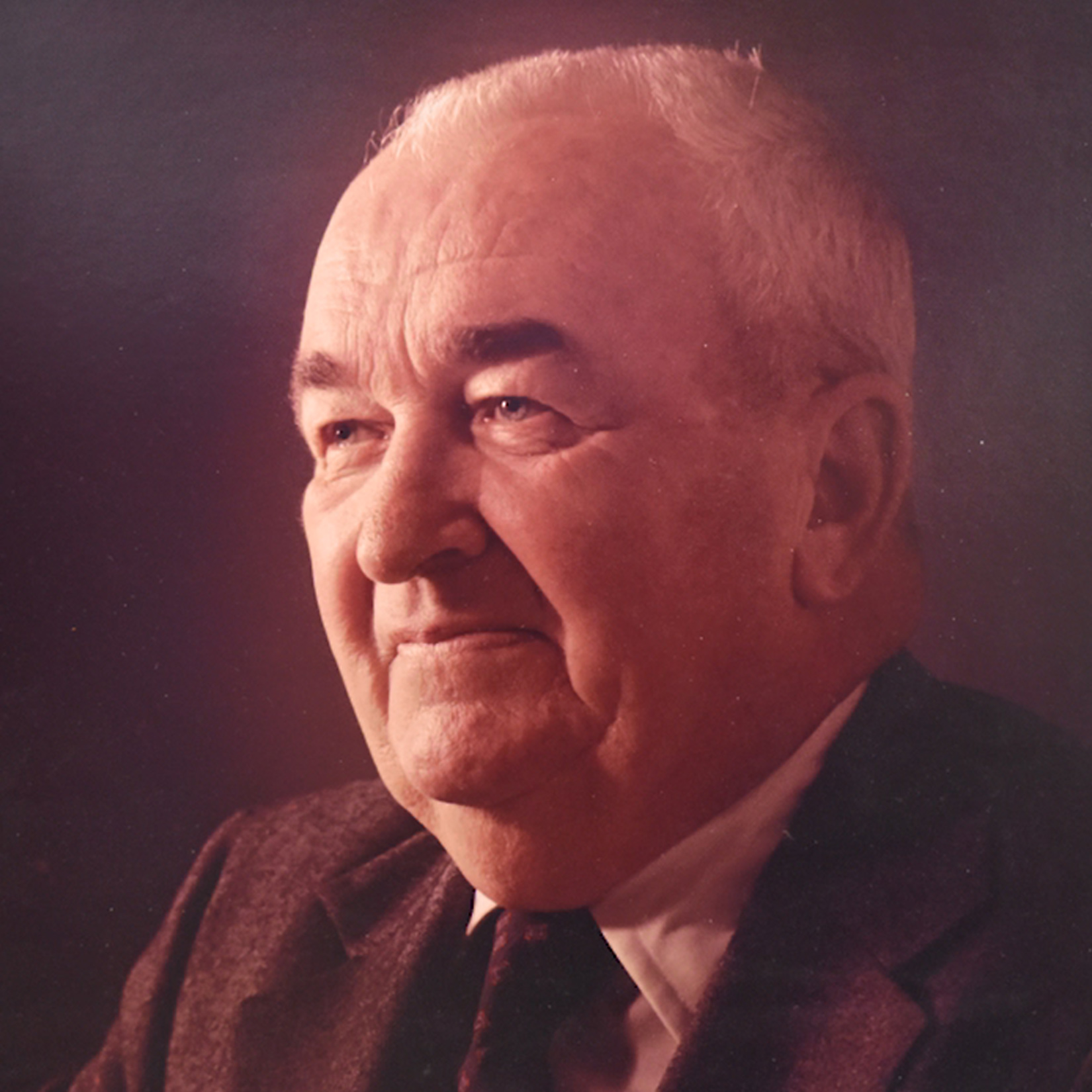
John C. Drummond
The building’s initials are mentioned hundreds of times a day around Pantex. The largest and most-populated building at Pantex is commonly referred to as the JCDC, but have you ever wondered how the JCDC got its name?
During construction, site leadership held a Pantex-wide contest while the then-unofficially designated administrative support complex (ASC) was being constructed. Submissions such as “The Triad” or “Pantex Headquarters (PHQ)” were bandied about, along with a handful of other titles or names. But when the final votes were tallied, the runaway winner was John C. Drummond Center (JCDC) to honor the legacy of a beloved Pantexan.
John was born in Boston, Massachusetts, on December 2, 1905. His early career started with a city field engineer position in Boston before he moved to the Boston & Maine Railroad in the late 1920s.
By the early 1930s, John worked for various companies before becoming the superintendent of construction at Mason & Hanger Silas Mason Company during construction of the Merriman Dam at Lackawack, N.Y.
As the United States entered World War II, John was transferred to Minden, Louisiana, as an engineering assistant at a construction site. That site, the Louisiana Ordnance Plant, would be one of the nation’s largest artillery ammunition- and bomb-loading assembly plants. He continued with them as loading line superintendent and then division superintendent.
When World War II ended, John was made a design engineer on projects converting five munitions’ facilities into ammonium nitrate fertilizer plants. He was then assigned to the Wabash River Ordnance Works at Newport, Indiana as project manager of an ammonia oxidation and neutralizing plant. By July 1947, John was on the move again, assigned as assistant chief engineer on a project at the Iowa Ordnance Plant in Burlington, Iowa.
“We moved to Burlington, which was also in the nuclear business, but also in the conventional business,” recalled son Skip Drummond. “And I think dad was on the conventional side up there, wasn’t he?” he asked sister Joan Hood.
“Well, to start with,” Joan confirmed. “We went to New Mexico and California. And then back to Kansas City to learn about the places that were involved in nuclear weapons, and because the company had visions of coming back and winning this contract, and later to the Fort Randall Dam outlet works and tunnels job at Pickstown, South Dakota, where he developed a saw carried by rail car to cut into granite for blasting – his last move before coming to Pantex.”
With most of the family’s relocations coming to an end, the Drummonds’ sights were set on the Texas Panhandle.
“Procter and Gamble had the operating contract for the first 5 years that the plant was in business,” Skip said. “Mason and Hanger and dad were here the first time in ‘50, ‘51 and a little bit of ’52 and the rebuilding of the plant was completed.”
John was an instrumental leader in the establishment and growth of the Pantex Plant, creating a legacy that continues today. He arrived at Pantex in 1951 to supervise construction as the Army and Atomic Energy Commission transformed the World War II-era Pantex Ordnance Plant into a nuclear production facility.
“So, in ‘56 Proctor and Gamble, for whatever reason, they wanted out. I think the Atomic Energy Commission just picked Mason & Hanger, whose leaders said to dad, ‘You're familiar with the plant. You helped rebuild it, so we want you to run it.’ Dad spent a lot of time on the line, working closely with everyone, he was always so encouraging. I bet dad knew almost 100% of the people out here and probably knew the names of their wives and some of their kids.”
He served as the Pantex Plant manager from 1956 to 1974, overseeing the expansion of Pantex production during the height of the Cold War with the Soviet Union.
Skip also recalled an endearing nickname from a popular radio and film character that was attached to his dad during his time as manager. That character was known as one of the first true heroic leaders in the entertainment industry.
“You know, there was a fictional detective called Bulldog Drummond. And whoever made that connection, though, and then called him Bulldog. I'm not really sure who called him that first,” Skip said.
“I don't think they called him that to his face.” Joan interjected.
Regardless, the nickname stuck — with good reason.
“But he got the nickname because he took care of the employees,” Joan continued. “And it didn't matter whether it was his son-in-law or whether it was Joe Blow; he took good care of the folks.”
John was very involved with community efforts while leading Pantex. He was vice chairman of the Board of City Development, chairman of the Amarillo’s Civil Service Commission, along with being a board member and trustee for the Amarillo Foundation for Health and Science Education, the Amarillo Zoological Society, and St. Anthony’s Hospital.
Following his retirement from Pantex, John was elected mayor of Amarillo and served from 1975 to 1977. He passed away 5 years later in April 1982.
The JCDC held its open house in 2018, and during that ceremony the 343,000-square-foot, state-of-the-art facility was dedicated as the John C. Drummond Center.
Skip and Joan thought it was the best tribute their father could receive.
“We're a little bit prejudiced, but we think it was a great choice,” Skip said.