



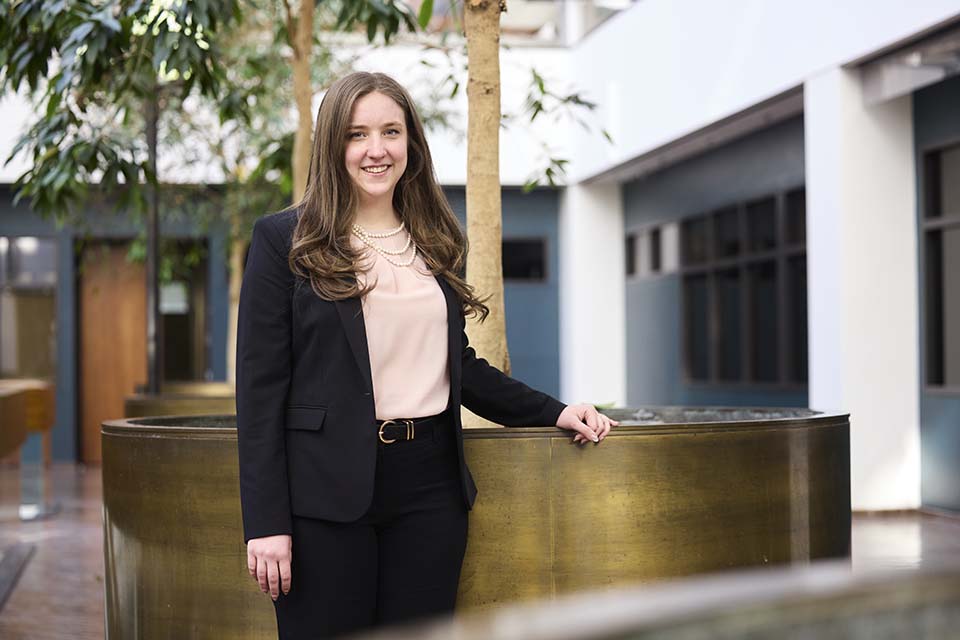
Thousands of dedicated Pantex citizens like Allie Bridenbaugh work every day to support the Pantex mission. Take three minutes to learn about who she is, what she does, and why she is proud to be a Pantexan.
What is the number of current Pantex employees? What is my organization’s attrition rate? How many Pantexans have master’s degrees? These are not questions on an episode of Pantex-themed Jeopardy. These are the questions that make up Allie Bridenbaugh’s day-to-day. As a Human Resources data analyst, she’s a professional metric-maker and spreadsheet wizard providing HR analytics and tools for organizations across the plant.
Providing answers to these seemingly simple questions is actually quite complicated, but Bridenbaugh enjoys the challenge.
“The everyday work here allows for a lot of knowledge to be gained,” she said. “It can be challenging at times, but overall, it is one of my favorite things about working at Pantex. When it comes to the work I do, I want people to trust that the information I give is accurate and complete.“
Bridenbaugh started out in Project Controls, where she gained her passion for data. That led her to pursue further education in information systems and business analytics, ultimately landing her the job in HR where she has worked for the past two years.
“I found that I really enjoyed visualizing data and understanding the underlying structure of the data to find innovative new solutions,” Bridenbaugh said. “My proudest moments happen when I realized I have gained mastery over something that had at one point felt hopeless. At Pantex, this has happened more times than I can count.”
While Bridenbaugh says “pride” isn’t something she strives for, she is proud to be a Pantexan because of the caliber of people at the site, citing both their goodness and resilience.
“When I say I am a Pantexan I am also saying I care, I work hard, and I am capable,” she said.
Why is it important we hold ourselves accountable in our daily tasks?
Accountability is really important to me. It helps establish trust with those around me, and it keeps me vigilant about the quality of my work. Knowing that my work is a reflection of me is a huge motivator.
Why is being open to learn from others critical for mission success?
You don’t know what you don’t know, and that is especially true at Pantex. Everyone I have met here has had something to teach me, so I try to be a sponge when others talk.
What’s your favorite outside-of-work activity?
I used to take classes at a local gym called Flying Fitness where I participate in the aerial arts, but when I do it there is not much aerial or art involved. It is still very fun, though!