



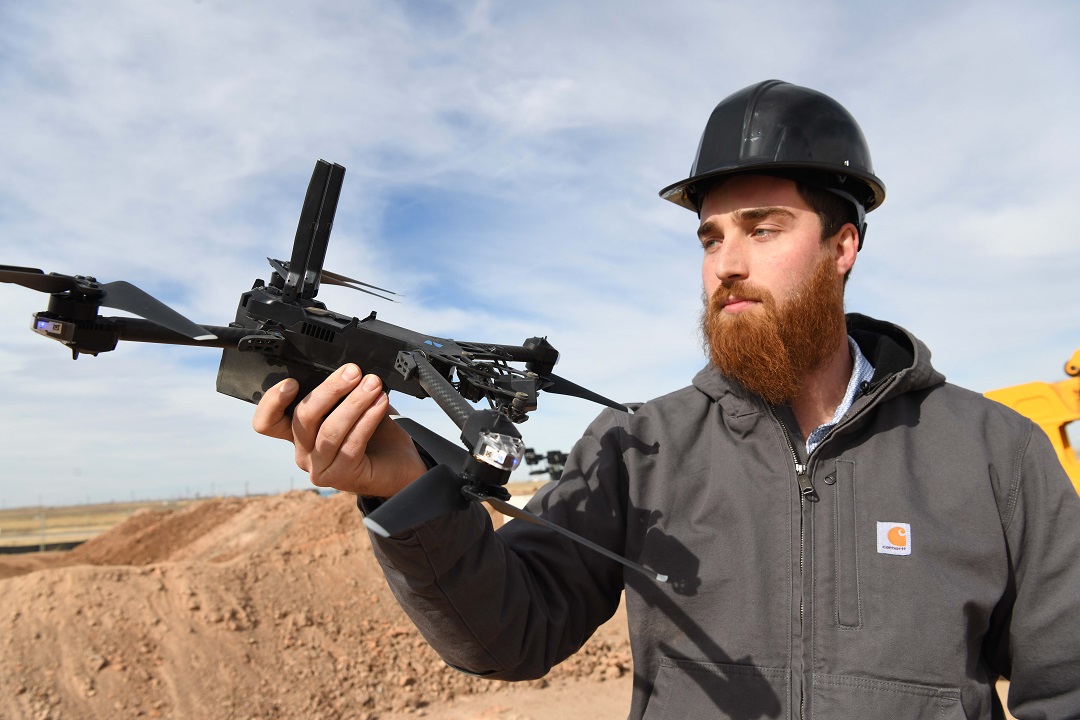
As Pantex continues to develop its drone aviation program, the site’s fleet is being employed in new, exciting ways.
“With our current drones, we are doing 3D modeling,” explained Infrastructure and Projects Director Ryan George. “The first is of the water tower, with a goal of providing Projects Engineering a complete 3D model. There’s a project to improve the ladder and access. Using the drones to complete that model means people don’t have to climb up there — it’s a safety issue.”
George makes a crucial point about the drones’ safety benefit, yet that alone isn’t the driving force behind them.
“Drone inspections started out as a Plant-Directed Research and Development project I proposed,” said Reliability Programs Performance Analyst Tony Burks. “We have a lot of aging infrastructure and they’re starting to get damaged — cracks and so forth. It’s getting hard to track all that damage.”
So, how do the drones compile data on aging infrastructure?
“We use the drones’ 3D rendering software,” Burks said. “Using AI, it will go take all the images, and we put that into a software … that lets us calculate distances to within centimeters. Over time, we can look and see if there’s any damage, discolorations, or rust that’s formed and is starting to grow.”
The longer-term idea, as Burks described it, is to create three-dimensional models of Pantex buildings. The use of these models varies from helping Infrastructure to Safeguards and Security and beyond.
“If you do a 3D model of facilities once a year, basically, you can provide indications of settling or structural issues,” George said.
The more use cases that crop up for drones, the more varied, too, is the hardware employed. After all, not all drones operate in the skies above.
“Our domestic water tanks — any of your freshwater tanks — have a five-year inspection environment,” George said. “So, we either have to put a human being in dive gear or we have to drain the tank completely; do the inspection, the cleanup, and refill the tank; or, if we have an inspection drone, we can just put it in the tank.”
It seems when it comes to drones, the sky isn’t the limit — the imagination is.